Cristiano Ronaldo’s Al-Nassr Omission: A Power Play or The Beginning of the End in Saudi Arabia?
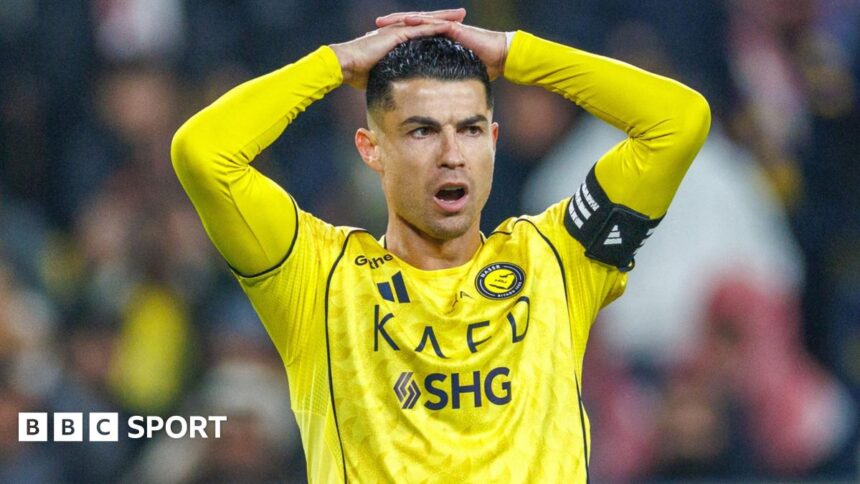
The Saudi Pro League’s brightest star was conspicuously absent. As Al-Nassr took to the pitch against Al-Riyadh on Monday, the familiar silhouette of Cristiano Ronaldo was nowhere to be seen. Officially “left out of the squad,” this administrative phrasing belies a seismic tremor shaking the very foundations of Saudi football’s ambitious project. The league’s top scorer, a global icon, and the man whose arrival signaled the start of a new era, now finds himself in a startling standoff with the kingdom’s most powerful financial entity. This isn’t just a missed match; it’s a potential watershed moment.
The Spark: From On-Field Dominance to Off-Field Discontent
On the surface, Cristiano Ronaldo’s second full season in Saudi Arabia was a resounding individual success. At 40, he defied time, finishing as the 2024-25 Saudi Pro League top scorer with an impressive 25 goals. His leadership and relentless drive were never in question. Yet, beneath the goal celebrations, a narrative of frustration was brewing. The stark reality for Ronaldo is that, despite his personal accolades, team silverware has remained elusive since his blockbuster £177 million per year move in 2022. The Arab Club Champions Cup stands as his only major trophy with Al-Nassr, while domestic and Asian glory has been captured by their arch-rivals, Al-Hilal.
According to reports from Portuguese outlet A Bola, the core of Ronaldo’s dissatisfaction stems not from his teammates or manager, but from the very top: the Public Investment Fund (PIF). Ronaldo is said to be “refusing to play,” disillusioned with the club’s direction and management under the PIF’s control. This accusation strikes at the heart of the Saudi league’s centralized model, where competition is ostensibly fostered between clubs ultimately overseen by the same sovereign wealth fund.
The Structural Conundrum: PIF’s Control and The Illusion of Rivalry?
To understand the depth of this conflict, one must examine the unique and controversial structure of the Saudi football landscape. The Public Investment Fund (PIF) holds a controlling 75% stake in four major clubs: Al-Nassr, Al-Hilal, Al-Ahli, and Al-Ittihad. This means the kingdom’s fiercest football rivalries are, financially and strategically, siblings under the same corporate parent.
- Centralized Talent Allocation: Critics, and seemingly Ronaldo, question whether decisions on player signings and resource distribution are made to optimize league competitiveness or to serve a broader, state-directed agenda.
- Al-Hilal’s Dominance: Al-Hilal’s recent supremacy—winning a historic treble and boasting a star-studded squad—fuels perceptions of favoritism. The feeling at Al-Nassr may be that they are the “second favorite” son in the PIF portfolio.
- Newcastle United Connection: The PIF’s multi-club model extends to the English Premier League with Newcastle United, raising further questions about strategic priorities and resource flow across the network.
For a competitor of Ronaldo’s legendary intensity, the idea that the playing field might not be level is anathema. His refusal to play is a monumental act of defiance against this system, a direct challenge from the world’s most famous footballer to the most powerful fund in Saudi Arabia.
Expert Analysis: Decoding Ronaldo’s Gambit and PIF’s Dilemma
This standoff is a high-stakes game of chess with unprecedented variables. From a sporting perspective, Ronaldo holds significant leverage. He is the SPL’s primary global ambassador. His presence guarantees eyeballs, commercial deals, and legitimacy. Losing him prematurely, especially under a cloud of discontent, would be a massive PR blow to the “Project.” His goals are irreplaceable, and his absence diminishes the league’s prestige instantly.
However, the Public Investment Fund (PIF) holds a different kind of power. They represent the long-term, state-backed vision of Saudi Arabia’s Vision 2030. No single player, not even Ronaldo, is bigger than the project. The fund must balance appeasing its iconic star with maintaining absolute authority over its sporting strategy. Allowing Ronaldo to dictate terms could set a dangerous precedent for other mega-stars in the league.
Key questions now emerge: Is this a negotiated play for more control over sporting decisions at Al-Nassr? A push for guaranteed, marquee signings to finally overtake Al-Hilal? Or is it, as some speculate, the first overt step toward an early exit, a manufactured rift to facilitate a move away from Saudi Arabia altogether?
Predictions: Reconciliation, Exit, or Stalemate?
The path forward is shrouded in uncertainty, but several scenarios are plausible:
- Swift Reconciliation & Concessions (Most Likely Short-Term): Both sides have too much to lose. We may see a private meeting, assurances of increased investment in Al-Nassr’s squad, and a public statement attributing the absence to a “minor misunderstanding” or a “tactical decision.” Ronaldo returns, the league saves face, and the project continues.
- Contractual Standoff & Early Termination (High Risk): If trust is irrevocably broken, a negotiated contract termination could loom. This would be messy and costly for PIF, but might appeal to Ronaldo if he desires a final challenge elsewhere (e.g., MLS, a romantic return to Sporting CP).
- Protracted Stalemate (Damaging for All): The worst outcome. Ronaldo trains separately, missing crucial games, while Al-Nassr’s season unravels. This would damage the club’s ambitions, the league’s image, and Ronaldo’s legacy in the region simultaneously.
- Structural Revelation (Long-Term Impact): This incident may force PIF to re-examine its hands-on management of club rivalries. Creating more apparent autonomy for individual clubs could be necessary to maintain credibility and satisfy ultra-competitive icons.
Conclusion: A Pivotal Clash of Egos and Empires
Cristiano Ronaldo’s surprise omission from the Al-Nassr squad is far more than a team sheet anomaly. It is a flashpoint, revealing the inherent tensions within Saudi Arabia’s rapid football revolution. This is a clash between the world’s most iconic individual sporting ego and the collective, state-powered machinery of the Public Investment Fund (PIF). Ronaldo, the ultimate winner, is challenging the very architecture of the competition he was hired to elevate.
The outcome will resonate far beyond Riyadh. It will signal to other stars in the league—and those considering a move—how much agency they truly have. It will test whether the Saudi project is a sporting endeavor with competitive integrity or a purely economic and soft-power exercise. For now, the ball is in the PIF’s court. How they respond to Ronaldo’s astonishing power play will define the next chapter, not just for Al-Nassr, but for the entire global perception of the Saudi Pro League. The era of quiet acquiescence is over; the era of confrontation has begun.
Source: Based on news from BBC Sport.