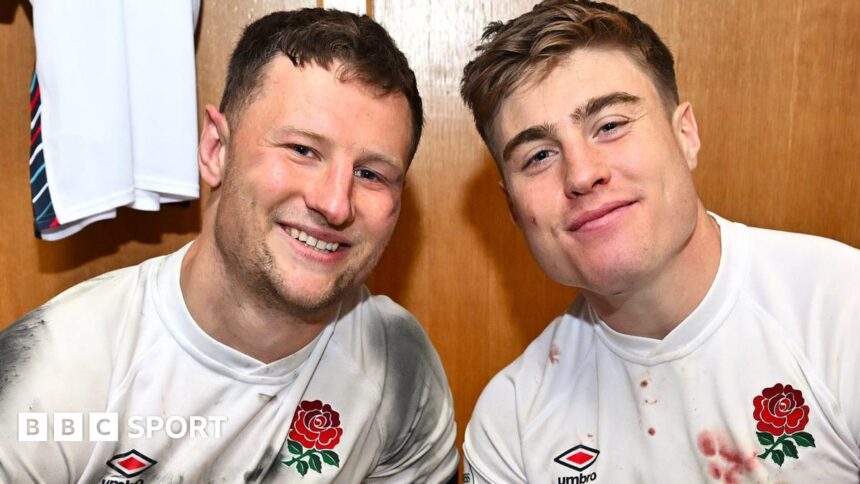
‘He gets nailed – he’s good at that’: Inside England’s Unlikely and Unselfish New Centre Duo
In the high-octane, collision-based world of modern Test rugby, centre partnerships are often defined by their power, their footwork, or their sleight of hand. Rarely are they defined by one man’s willingness to be a human shield. Yet, as England builds towards a new era, an unheralded and gloriously pragmatic duo has emerged, forged not in the spotlight of superstardom but in the unselfish dark arts of the gainline. Fraser Dingwall and Tommy Freeman, the starting centres in England’s summer tour wins over Wales and Australia, are rewriting the job description for midfield success—one sacrificial hit at a time.
The Unlisted Skill: Sacrifice as Strategy
Ask any aspiring centre about their key attributes, and you’ll hear about passing range, defensive reads, or explosive line breaks. You will almost never hear about the art of attracting two defenders to create space for someone else. For Fraser Dingwall, however, this is a core competency. As his wing-turned-centre partner Tommy Freeman revealed to the BBC’s Rugby Union Weekly podcast with a telling smile, “He kind of gets nailed to put me in a hole – he’s very good at that. Sacrificing himself for the greater good!”
This quote is more than just a humorous aside; it is a window into a deliberate and intelligent tactical understanding. Dingwall, the Northampton Saints captain, is not a bulldozing 110kg behemoth. His game is built on exceptional rugby intelligence, timing, and a complete lack of ego. He runs lines that fix defenders, knowing the tackle is coming, to manipulate defensive shapes. Freeman, blessed with blistering pace and a taller, more powerful frame, is the prime beneficiary, hitting the subsequent gap with momentum. It’s a partnership where one man’s pain is the other’s—and the team’s—direct gain.
Club Chemistry Forged into Test Steel
The critical advantage this pairing holds is a deep-seated familiarity. Both are products of the Northampton Saints production line and have spent years understanding each other’s rhythms at Franklin’s Gardens. This isn’t a hastily assembled Test combo; it’s a club connection accelerated to the international stage.
- Fraser Dingwall (Inside Centre): The brain. The organiser. A player whose defensive communication and decision-making have been praised by coaches for years. He is the glue that allows more flamboyant talents to shine.
- Tommy Freeman (Outside Centre): The weapon. Traditionally a winger, his move to 13 exploits his pace and surprising strength in contact. Dingwall’s selfless play creates the one-on-one opportunities Freeman craves.
This dynamic was crystal clear in the first Test against Australia. Dingwall’s subtle, holding runs consistently drew in Australian jerseys, creating the disjointed defensive line that Freeman and the back three exploited. It’s a low-risk, high-reward strategy that plays to England’s current strengths: a formidable set-piece and a tactical kicking game led by Marcus Smith. The centres don’t need to force miracle plays; they need to be efficient, smart, and tough. This duo embodies that.
Expert Analysis: Why This Pragmatic Pair Works
From an analytical standpoint, the Dingwall-Freeman partnership is a masterclass in complementary skills. In an era where coaches often seek like-for-like power across the gainline, England head coach Steve Borthwick has opted for a more nuanced, puzzle-piece approach.
“What Borthwick identifies is reliability and role clarity,” says a former international analyst. “Dingwall is your ultimate ‘first-receiver’ option—defenders know they must commit to stopping him, which creates second-phase opportunity. Freeman, with his back-three skillset, is then playing against a fractured defensive line. It’s not glamorous, but it’s incredibly effective and reduces handling errors.”
Furthermore, their defensive synergy is paramount. Dingwall’s communication organises the frontline, allowing Freeman to use his pace and wide-angle vision to drift onto dangerous attackers or shoot up for intercepts. Their club-honed understanding means they shift as one unit, a non-negotiable requirement against the world’s best.
Predictions: A Long-Term Fixture or a Short-Term Solution?
The inevitable question now is about longevity. Can a partnership built on such a specific, unselfish dynamic endure against the varied threats of South Africa, New Zealand, and Ireland?
The evidence suggests it has a real chance. Their skill sets dovetail perfectly with the evolving England game plan under Felix Jones and Borthwick—a plan that values territory, pressure, and capitalising on opposition mistakes rather than endless phase-play. Dingwall’s work rate and Freeman’s finishing are ideal for this model.
Challenges will come. Physical specimens like South Africa’s Damian de Allende will test Dingwall’s channel, while clever playmakers like Ireland’s Bundee Aki will probe Freeman’s defensive positioning at 13. Their success will hinge on continuous evolution—perhaps Freeman adding more playmaking to his game, or Dingwall developing an even more threatening short-passing game to keep defenders honest.
What is certain is that they have seized their opportunity. With established names like Manu Tuilagi and Henry Slade now out of the picture, this summer was an audition. Their two-Test audition has been a resounding success, not through individual highlight reels, but through a collective, winning contribution.
Conclusion: A New Blueprint for England’s Midfield
Rugby folklore is filled with iconic centre pairings: Greenwood and Tindall, Giteau and Mortlock, Nonu and Smith. They are remembered for artistry or brutality. Fraser Dingwall and Tommy Freeman are writing a different kind of story—one of intelligence, sacrifice, and profound teamwork.
In acknowledging that “he gets nailed,” Tommy Freeman didn’t just praise his teammate; he defined a philosophy. In the relentless economy of Test rugby, where inches and seconds decide matches, having a player who willingly absorbs punishment to create an advantage is priceless. This unassuming duo from Northampton has shown that chemistry can trump sheer star power, and that the “greater good” is a powerful motivator. They may not be the most celebrated names on the team sheet, but as England’s new midfield foundation, they are proving to be among the most effective. Their rise is a testament to the fact that in rugby union, the whole can indeed be far greater than the sum of its parts—especially when one part is so willing to be the anvil for the other’s hammer.
Source: Based on news from BBC Sport.