Liverpool’s Long-Term Vision: A Calculated Gamble That Could Define the Slot Era
The Premier League table in late February makes for uncomfortable reading at Anfield. Liverpool, the reigning champions, sit in sixth position, looking up at the Champions League qualification places they have treated as a birthright for the better part of a decade. In a normal season defined by such a dip, the January transfer window would be a frantic period of corrective surgery. Yet, Liverpool’s only significant move was a statement of profound, almost stubborn, long-term planning: a £60 million agreement for French defender Jérémy Jacquet from Rennes, a player who won’t bolster the squad until this summer. This decision lays bare the club’s strategic faith in new manager Arne Slot and his project. But as the current campaign reaches its critical climax, the pressing question becomes: could this forward-thinking approach inadvertently undermine Slot’s first season before it has truly begun?
The Anfield Anomaly: Investing in Tomorrow Amid Today’s Struggle
Liverpool’s inactivity in the January window, save for the future-dated Jacquet deal, is a stark anomaly in the modern Premier League. Clubs in their perceived position—outside the top four with tangible flaws in the squad—typically react. They seek a short-term spark, a proven veteran, or a solution to an immediate tactical weakness. Liverpool, under the restored stewardship of Sporting Director Richard Hughes and the data-driven gaze of Fenway Sports Group, did the opposite. They doubled down on a multi-window strategy initiated with the summer signings of players like midfielder Jesper Lindstrøm and forward Crysencio Summerville.
This approach signals two core beliefs from the Anfield hierarchy. Firstly, a total conviction in Arne Slot’s coaching ability to navigate the remainder of the season with the tools at his disposal. Secondly, a disciplined commitment to a specific recruitment profile: young, high-potential assets who fit a defined playing model, even if their impact is deferred. The Jacquet deal is the epitome of this policy—a major investment not for February, but for the next five seasons.
The calculated gamble is that short-term pain will yield long-term gain. The club is effectively asking Slot to bridge the gap to summer with a squad that has shown both thrilling potential and alarming inconsistency. The risk is quantified, but it is a risk nonetheless.
Dissecting the Squad: Where Liverpool’s Immediate Needs Lie
To understand the potential cost of this long-term view, one must examine the squad’s current fault lines—areas the January window could have addressed. The Jacquet signing, a left-footed centre-back, solves a future problem, but several present concerns persist:
- Defensive Depth & Reliability: While Jacquet will eventually partner or compete with Ibrahima Konaté, the current defensive unit has been prone to costly lapses. Virgil van Dijk’s enduring class is undeniable, but the drop-off in certain games has been stark. A ready-now defender could have provided immediate stability for a top-four push.
- Midfield Dynamism: The post-Fabinho era has seen Liverpool’s midfield reconfigured. While Alexis Mac Allister has excelled in a deeper role, the engine room can still be overrun against physical opposition. The lack of a specialist, top-tier defensive midfielder was a summer talking point that remained unaddressed in January.
- Attacking Consistency Beyond Salah: Mohamed Salah’s departure for the Africa Cup of Nations highlighted a reliance on his genius. While Diogo Jota is a lethal finisher and Darwin Núñez a chaotic force, the lack of a consistent, Salah-level threat from the right flank in his absence was palpable. A direct, pacy winger could have been a January catalyst.
By not reinforcing these areas, the board has placed its faith in Slot’s tactical acumen to find internal solutions. Can he unlock greater consistency from Ryan Gravenberch? Can he devise a system that mitigates defensive fragility? The answers will define their season.
The Slot Factor: Trust, Tactics, and Transition
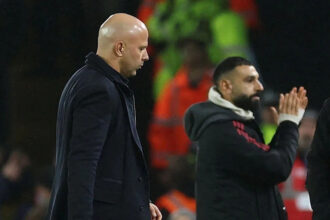
At the heart of this strategy is the relationship between the club and Arne Slot. The Dutchman was appointed not as a firefighter, but as a cultural and tactical architect. His high-intensity, possession-based philosophy requires specific player types. The Jacquet signing is a clear Slot player—comfortable on the ball, aggressive in the duel, and young enough to be moulded.
This window demonstrates that the board is willing to prioritise the manager’s long-term blueprint over short-term appeasement. It is a significant show of faith, but it also increases the pressure on Slot’s man-management skills. He must now keep a squad, aware of its limitations, fully motivated for a Champions League chase, while simultaneously integrating new ideas. The potential pitfall is a “transition season” narrative taking root if results waver, which could affect player morale and fan patience.
Slot’s reputation as a developer of talent is key here. The club is betting that his coaching can elevate the current group enough to secure a top-four finish, making the summer transition into a position of strength rather than one of necessity. Failure to do so, however, would mean missing out on Champions League revenue and allure, complicating future recruitment and casting an early shadow over his tenure.
Predictions: The High-Stakes Final Stretch
The ramifications of Liverpool’s quiet January will be decided on the pitch in the coming months. Several scenarios are now in play:
- The Successful Gamble (Most Likely): Slot’s coaching sparks a consistent run. Existing players find new levels, and Liverpool’s superior firepower sees them clinch a top-four finish. The Jacquet announcement is seen as a powerful signal of intent for a big summer, and Slot’s project begins with momentum and Champions League football secured.
- The Costly Miss (Clear Danger): Injuries bite or form dips. The perceived gaps in the squad prove decisive in tight games. Liverpool finish fifth or sixth, missing out on the Champions League. The £60m for Jacquet is questioned when a £30m January fix might have secured top four. Slot faces immediate pressure and a harder sell to top transfer targets.
- The Middle Ground: A Europa League finish, followed by a transformative summer where Jacquet is the first of several major signings. While not a disaster, it would frame Slot’s first season as one of clear transition, delaying the true title challenge by a year.
The fixture list offers no favours, and the competition—Aston Villa, Tottenham, Manchester United—all strengthened in January. Liverpool’s path is arguably the hardest, by design.
Conclusion: A Defining Philosophy at a Defining Moment
Liverpool’s decision to secure Jérémy Jacquet for the future, while standing pat in the present, is more than a transfer policy; it is a declaration of a long-term philosophy. It is a bold, confident move that breaks from the reactive norms of the Premier League. It states that the project under Arne Slot is a multi-season build, and that the club will not be swayed from its strategic path by the inevitable bumps in the road.
However, the Premier League is a brutal arena where the present is all-consuming. The stark reality is that long-term planning can have immediate consequences. By not providing Slot with a mid-season tool to fix evident issues, the board has inextricably linked his early success to their calculated risk. If he guides this squad into the top four, he will be hailed as a visionary and the Jacquet deal will look like masterful planning. If they fall short, the narrative will focus on a missed opportunity and a window of neglect.
In the end, Liverpool are playing a deeper game. They are betting on the manager, the model, and the future. But in the fierce urgency of now, that future could come at a significant cost to the present. The final months of this season are no longer just about results; they are the first real audit of a brave, uncompromising, and potentially era-defining strategy at Anfield.
Source: Based on news from Sky Sports.
Image: CC licensed via www.flickr.com