Goodell’s Cautious Stance: NFL Commissioner Defers Judgment on Steve Tisch’s Epstein Emails
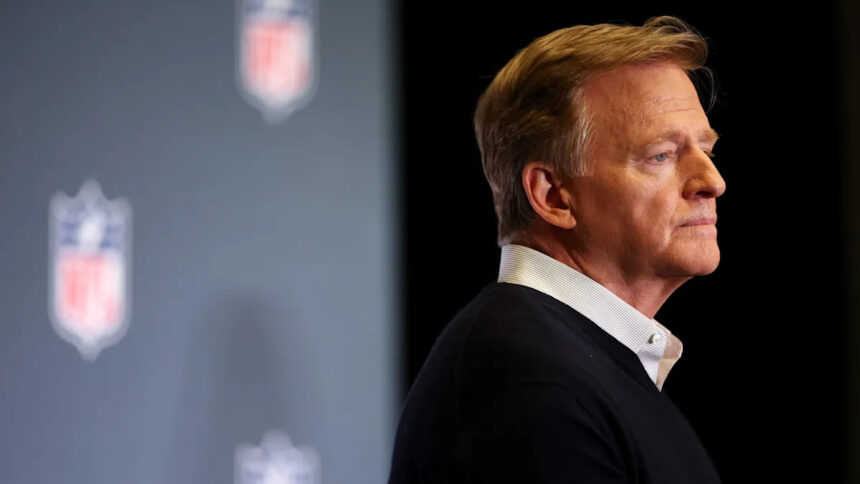
The spectacle of the Super Bowl week press conference is a familiar ritual: a blend of football prognostication, league business, and the occasional pointed question. But this year, Commissioner Roger Goodell faced a query that cut through the usual pre-game hype, landing squarely in a shadowy nexus of power, scandal, and the NFL’s own moral code. In a moment that underscored the league’s vulnerability to external controversies, Goodell was forced to address the revelation that New York Giants co-owner Steve Tisch exchanged multiple emails with the convicted sex offender and financier, Jeffrey Epstein. His response was a masterclass in corporate caution: “Let’s get the facts first.”
The Commissioner’s Tightrope Walk: Policy, Perception, and Power
Roger Goodell, the steward of America’s most powerful sports league, found himself navigating a uniquely treacherous path. On one side lies the NFL’s Personal Conduct Policy, a document famously wielded against players, coaches, and executives with the force of law. On the other stands the sanctity of the NFL ownership circle, a group of 32 individuals whose influence and capital are the bedrock of the league. The question posed to Goodell was not about a player’s transgression, but about the potential misconduct of one of his own bosses.
Goodell’s verbatim response is a study in procedural neutrality. “We’re going to look at the context of those, we’re going to try to understand that,” he stated, deliberately avoiding any presumption of guilt or innocence. His immediate deferral of any discussion on potential discipline for Tisch was telling. It highlighted a critical, often unspoken, tension: applying the Personal Conduct Policy to an owner is a political minefield of the highest order. The policy states it applies to “everyone in the NFL,” but its enforcement across different strata of the league’s hierarchy has never been equal.
- Fact-Finding First: Goodell explicitly prioritized gathering information over swift judgment, a stance that balances legal prudence with public relations.
- Context is King: The league’s investigation will likely focus not just on the existence of emails, but their content, frequency, and purpose.
- Ownership Precedent: The NFL has disciplined owners before (e.g., Dan Snyder, Jerry Richardson), but always for established, adjudicated facts or internal investigations revealing clear misconduct.
Beyond Tisch: The Looming Shadow of the “Epstein Files”
Perhaps the more significant moment came with the follow-up question: was Goodell concerned other owners could be implicated? His answer acknowledged the vast, unknown scope of the scandal. “I know that three million documents came out late this week,” Goodell said, referring to the latest tranche of court releases. This admission frames the Tisch inquiry not as an isolated incident, but as a potential harbinger.
The specter of the “Epstein client list” or further document dumps creates a persistent vulnerability for the league. The NFL’s brand is intricately tied to public trust and family-friendly entertainment. Association with Epstein’s network, which exploited young women and girls, represents a direct threat to that carefully curated image. Goodell’s statement—”we’ll continue to follow any of the facts that come up”—is a clear signal that the league office is on high alert, aware that the ground beneath the most powerful men in sports may not be as solid as it seems.
This scenario presents an unprecedented crisis management challenge. The league cannot control the release of court documents, nor can it easily investigate the private dealings of its owners from decades past. Its power is reactive, not proactive, leaving it in a defensive posture against a scandal whose full dimensions remain unknown.
Analysis: The Unwritten Rules of Ownership Accountability
As a sports journalist observing league dynamics for decades, Goodell’s phrasing reveals the unwritten playbook for handling ownership issues. The “get the facts” mantra serves multiple purposes:
1. It Buys Time and Controls Narrative: In the immediate news cycle, it projects sober responsibility. It pushes the story from the explosive headline phase into a procedural phase, which is easier for the league to manage.
2. It Establishes a High Bar for Action: By emphasizing context and a full fact pattern, the league implicitly sets a standard for evidence that may be difficult to meet with emails alone, unless they contain clear evidence of wrongdoing or conspiracy.
3. It Navigates Internal Politics: Owners are a fractious group, but they unite fiercely against perceived threats to their autonomy. A rushed investigation of Tisch could trigger a defensive reaction from the entire ownership committee, making Goodell’s job untenable. A deliberate, fact-based approach provides political cover.
The central question is whether the Personal Conduct Policy has the teeth to address associations, however troubling, that may not have resulted in a criminal charge. The policy’s language on “conduct detrimental to the integrity of the NFL” is broad, but its application to an owner’s historical correspondence would break new ground.
Predictions: What Comes Next for the NFL and Tisch
Based on Goodell’s comments and historical precedent, we can forecast the likely path forward:
- A Quiet, Internal Review: The league will not announce a flashy “investigation.” Instead, its legal and security teams will quietly scrutinize the available email documents, likely requesting further context and explanation from Tisch and his representatives.
- Outcome Hinges on Email Content: If the emails are revealed to be merely logistical (e.g., regarding a charity event, a flight) or innocuous, the league will likely issue a statement that the matter has been reviewed and closed. If they contain evidence of knowledge of crimes, inappropriate discussions, or a deeper relationship, the pressure for meaningful discipline will become immense.
- The Waiting Game on Future Disclosures: The NFL’s biggest concern is not the current Tisch revelation, but the next one. League officials will be monitoring document releases closely, knowing another owner’s name could surface at any moment. This uncertainty is the true crisis.
- Potential for “Voluntary” Stepping Back: In a worst-case scenario for an owner, the league may seek a behind-the-scenes resolution, such as a “voluntary” temporary step back from committee roles to let the story fade, avoiding a formal disciplinary ruling that tests the policy’s limits.
Conclusion: A Defining Test for the League’s Moral Authority
Roger Goodell’s “facts first” approach is a legally safe and politically astute initial move. However, it merely postpones a more profound reckoning. The NFL has spent years promoting itself as an institution that holds everyone accountable. The Steve Tisch email revelation and the potential for more Epstein files connections presents the ultimate test of that principle.
This is no longer just about a potential violation of policy; it is about the integrity of the shield itself. How the league handles the possibility of malfeasance at its very apex will define its moral authority for years to come. The world is watching to see if the Personal Conduct Policy is a tool for justice or a instrument of convenience. Goodell has called for patience to gather facts. Once those facts are in, his league must have the courage to act upon them—without fear or favor—or risk revealing that its famed standard of conduct applies only to those who wear helmets, not those who sign the checks.
Source: Based on news from Yahoo Sports.