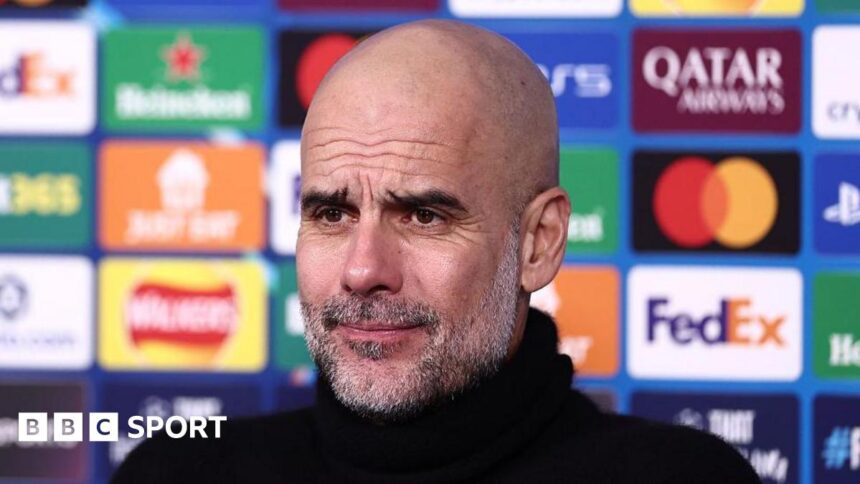
Guardiola’s ‘Grumpy’ Transfer Jibe: The Masterful Economics of Manchester City
In the rarefied air of a Premier League press conference, where every syllable is parsed for meaning and controversy, Pep Guardiola delivered a line with the perfect cocktail of mischief, sarcasm, and a pointed message for the footballing world. Following a routine victory, the Manchester City manager, with a faux-glower, declared he was “a little bit sad and upset” that his club only ranks seventh in the Premier League for net spend over the last five years. The comment, met with knowing chuckles, was far more than a throwaway joke. It was a calculated grenade lobbed at the persistent narrative of City’s financial dominance, revealing the sophisticated, self-sustaining machine the club has become under his stewardship.
Decoding Pep’s “Grumpy” Gambit: More Than a Joke
To understand Guardiola’s quip, one must first look past the smile and see the strategic framing. For years, the dominant external narrative surrounding Manchester City’s success has been one of pure financial brute force—an endless well of petrodollars funding an assembly line of stars. Guardiola, ever the perfectionist and a fierce defender of his project, used humor to weaponize the latest data, flipping the script entirely.
His “sadness” ironically highlights a monumental achievement: sustainable success. While the gross spending is undeniably high—evidenced by another heavy January outlay—the net spend figure tells the story of a club operating with elite-level business acumen. The ability to sell, and sell well, has become a cornerstone of the City model. Guardiola wasn’t lamenting a lack of spending power; he was slyly boasting about the club’s financial health and transactional genius, all while poking fun at his own caricature as a coach who simply demands more signings.
The Numbers Behind the Narrative: A Blueprint for Modern Football
The statistics, as Guardiola knows, are compelling. According to data from Transfermarkt, while Manchester City have invested heavily in the transfer market since 2019, they have also recouped a staggering £550 million in player sales over the same five-year period. This is not the model of a club simply accumulating talent; it is one of constant evolution and asset management.
- High-Value Exits: The sales of academy graduates like Cole Palmer and Romeo Lavia, alongside established stars like Gabriel Jesus and Oleksandr Zinchenko, demonstrate a ruthless efficiency. They are developed, integrated, and sold at peak value, funding the next cycle of recruitment.
- Net Spend Reality: A seventh-place ranking in net spend puts City behind clubs like Arsenal, Manchester United, Chelsea, and Tottenham. This contextualizes their spending within the Premier League’s hyper-inflated ecosystem, challenging the notion of their unique financial advantage.
- Directorial Praise: Guardiola was quick to credit the architects. “Really good. Txiki [Begiristain] before and Hugo [Viana] now,” he stated, highlighting the seamless succession planning and strategic vision in the recruitment department.
This model creates a virtuous cycle: success on the pitch increases player values and the club’s allure, which funds further strategic investment, sustaining success. It’s a far cry from the scattergun spending often associated with newly-rich clubs.
The January Splurge: Strategic Need, Not Reckless Spending
Guardiola’s joke gains another layer when considering City’s recent activity. For a second consecutive year, they were the Premier League’s biggest January spenders, bringing in Antoine Semenyo and Marc Guehi for a combined £84 million. This follows a £180 million outlay the previous January. On the surface, this seems to contradict the net spend argument. However, a closer look reveals a strategy of targeted, decisive action.
These are not panic buys or luxury additions. They are calculated moves to address specific squad needs—often prompted by injuries or departures—with players who fit the Guardiola prototype. The club pays a premium for the right player at the right time, confident in their system’s ability to elevate the individual and, ultimately, protect or even increase their future resale value. It is spending with a clear, long-term vision, backed by a proven track record of player development and sales.
The Future: A Self-Sustaining Empire and the Legacy of Pep
Looking ahead, Guardiola’s “grumpy” commentary signals a new phase for Manchester City. The club is transitioning from a project fueled by significant investment into a self-sustaining superpower. The focus is now on organic growth, elite talent identification, and maintaining a squad that can challenge on all fronts without relying on net transfer deficits that could threaten long-term stability under increased regulatory scrutiny.
This has profound implications for Guardiola’s legacy. He will not only be remembered for the trebles and the mesmerizing football, but for helping to architect a sustainable footballing operation. He is proving that sustained dominance in the modern era requires not just a visionary coach, but a holistic club model where the sporting and business departments are in perfect sync.
Predictions for the coming years suggest City will continue to be major players in the transfer market, but increasingly as sellers as much as buyers. The academy will play an even more crucial role, not just in producing first-team players, but in generating pure profit to reinvest. The club’s aim is to exist in a state of perpetual motion, where one era seamlessly blends into the next without the need for a costly “rebuild.”
Conclusion: The Joke That Told the Truth
Pep Guardiola’s feigned displeasure over Manchester City’s seventh-place net spend ranking was a masterclass in messaging. Wrapped in a joke was a powerful statement of intent and a rebuttal to critics. It announced that Manchester City are no longer just the big spenders; they are the smartest operators in the room. They have built a winning machine that also functions as a profitable, self-financing enterprise.
The days of the simplistic “buying the league” accusation are over. Guardiola, Txiki Begiristain, and Hugo Viana have constructed something more durable and, for their rivals, more daunting: a club that wins with its head, its heart, and its spreadsheet. So, the next time Pep gets “grumpy” about finances, listen closely. He’s not complaining—he’s telling you exactly why Manchester City are here to stay.
Source: Based on news from BBC Sport.