Ole Miss QB Trinidad Chambliss’ NCAA Appeal Denied, Setting Stage for Unprecedented Legal Fight
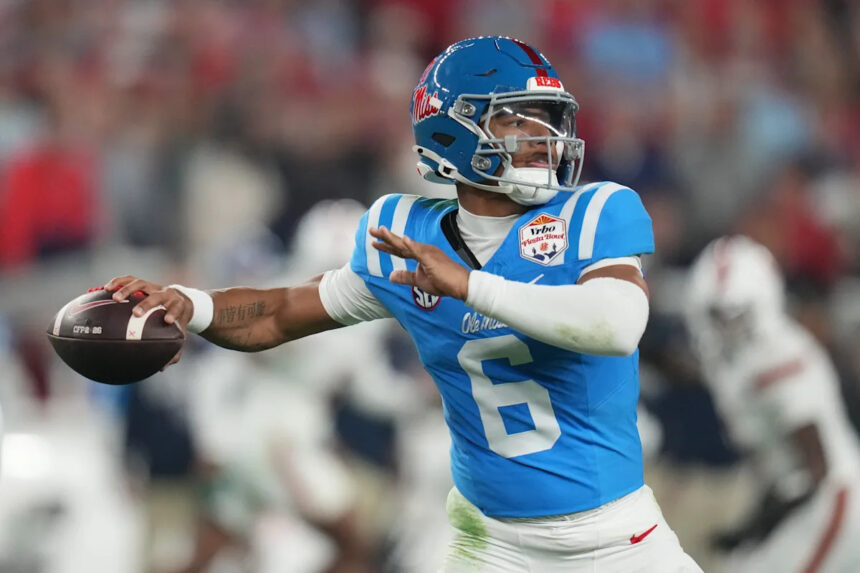
The cold, bureaucratic machinery of the NCAA has rendered another verdict, but this time, the recipient is refusing to accept it as the final word. The University of Mississippi announced Wednesday that quarterback Trinidad Chambliss’ appeal for an additional year of eligibility has been denied, closing the NCAA’s internal review process. Yet, far from signaling the end, this denial has ignited a fierce and potentially landmark battle that is now shifting from the playing field to the courtroom. Ole Miss isn’t just protesting; they are declaring war on the NCAA’s decision-making process, framing it as an “indefensible” act that contradicts the organization’s own rules. The saga of Trinidad Chambliss is no longer just about a sixth season of college football; it has become a high-stakes test case for athlete advocacy, institutional power, and the very consistency of the NCAA’s governance.
The Bureaucratic Gauntlet: A Timeline of Denial
Trinidad Chambliss’s journey to this pivotal moment is a story of resilience met with rigid protocol. His quest for a sixth year stems from the lost time and medical hardships that have defined his collegiate career. The NCAA’s initial rejection on January 9 was a blow, but not an unexpected one in the often-opaque world of eligibility waivers. Ole Miss immediately exercised its right to an appeal, taking the case to the NCAA’s Athletics Eligibility Subcommittee—a body designed as a final internal arbiter. This week’s denial from that subcommittee represents the exhaustion of all administrative remedies within the NCAA’s own system.
This procedural end point, however, has only served to galvanize the university. In a scathing public statement, Ole Miss officials did not mince words: “The NCAA’s decision was indefensible in light of the undisputed facts.” This language is notably confrontational, signaling a strategic shift from persuasion within the system to confrontation from outside it. The university has effectively stated that the NCAA is not only wrong but is acting in contradiction to its documented precedents and the clear medical evidence presented in Chambliss’s case.
Beyond the Bylaws: The Human Element and Legal Precedent
To understand why Ole Miss is willing to wage this public and legal war, one must look at the core of Chambliss’s argument. While specific medical details are private, the appeal for a sixth year of college football eligibility typically requires demonstrating circumstances beyond an athlete’s control that severely limited participation in two separate seasons. For Chambliss, this likely involves significant injury timelines that robbed him of developmental and competitive years.
Expert analysis suggests Ole Miss’s aggressive stance is calculated. “The university’s statement is a direct challenge to the NCAA’s credibility and consistency,” says a veteran collegiate compliance consultant. “By publicly calling the decision ‘indefensible’ and highlighting ‘documented medical records,’ they are building a narrative of arbitrary governance for the court of public opinion and, now, an actual court of law.” This move is reminiscent of other recent challenges to NCAA authority, but unique in its direct, institution-backed support for an individual player’s eligibility.
The key elements of the ongoing legal fight will likely hinge on:
- Procedural Fairness: Did the NCAA follow its own rules and prior precedent in evaluating Chambliss’s medical evidence?
- Arbitrary and Capricious Standard: Can Chambliss’s legal team prove the denial was so unreasonable as to be unlawful?
- State Law Injunction: The immediate goal in state court will likely be a temporary restraining order or injunction that would allow Chambliss to participate in spring practice or even the 2024 season while the case is decided.
The Stakes for Ole Miss, the SEC, and the NCAA
The implications of this battle stretch far beyond one quarterback’s final season. For Head Coach Lane Kiffin and the Rebels, Chambliss represents valuable depth and experience in the sport’s most important position. In the hyper-competitive SEC landscape, every scholarship and every seasoned player is a critical asset. Fighting for Chambliss is a powerful signal to the team and recruits about the program’s loyalty to its players.
For the NCAA, this is another front in its escalating war to maintain unilateral control. Each legal challenge chips away at its aura of invincibility. A loss in state court, or even a protracted legal battle that forces a settlement, could open the floodgates for other athletes and schools to challenge eligibility rulings in court, bypassing the NCAA’s internal committees entirely. The NCAA’s statement—or notable lack thereof—in response to Ole Miss’s accusations will be telling. They often prefer to operate in silence, but the university’s very public “holding the NCAA accountable” dare may force a response.
Predictions: A Lengthy Battle with No Clear Winner
Predicting the outcome of this clash involves navigating uncharted legal territory. The immediate prediction is for a messy, protracted conflict.
- The Legal Path: Chambliss’s team will push for an expedited hearing seeking injunctive relief. The NCAA will argue that courts should not interfere with the internal decisions of a voluntary membership association. A judge’s willingness to grant an injunction before the season is the first major hurdle.
- Potential Outcomes: The case could end in a settlement where the NCAA grants the eligibility without admitting fault, a clean legal victory for either side, or a ruling so narrow it doesn’t set a broad precedent. The most likely scenario is a settlement that allows Chambliss to play but keeps the NCAA’s broader authority technically intact.
- Season Impact: Even if Chambliss wins a temporary injunction, the cloud of ongoing litigation could be a distraction. However, the “us against the world” mentality could also galvanize the Ole Miss locker room, creating a powerful motivator for the entire team.
Conclusion: A Defining Moment in College Athletics
The denial of Trinidad Chambliss’s appeal is not an epilogue, but a provocative prologue to a much larger story. Ole Miss has drawn a line in the sand, transforming a routine eligibility dispute into a principled stand against what it sees as institutional injustice. This case underscores the growing impatience of member institutions with the NCAA’s often inscrutable and inconsistent decision-making. Whether in the state courtroom or the court of public opinion, the NCAA accountability demanded by Ole Miss will resonate across the country.
Trinidad Chambliss’s fight is now about more than snaps and statistics. It is about due process, the weight of medical evidence, and the right to a fair hearing. As the legal filings replace playbooks, the outcome will send a powerful message: will the NCAA’s internal bureaucracy remain the final, unassailable word, or will the threat of legal consequence finally force a new era of transparency and consistency? One quarterback’s pursuit of a sixth season may well help write the rulebook for challenges to come.
Source: Based on news from Yahoo Sports.