Minions on Ice: How a Spanish Skater’s Olympic Dream Was Saved by Pharrell Williams
In the high-stakes, often rigidly traditional world of Olympic figure skating, the story of a lone Spaniard in a Minions costume fighting for his right to skate to “Despicable Me” music is the kind of plot twist even Hollywood would reject as too far-fetched. Yet, here we are. Tomas-Llorenc Guarino Sabate, an athlete whose best global finish is 20th at the World Championships, has become the breakout star of the 2026 Milan-Cortina Winter Games build-up, not for a quadruple axel, but for a copyright crusade that reached the ears of music superstar Pharrell Williams. In a stunning reversal, Sabate has been granted permission to perform his beloved Minions routine on the Olympic stage, turning a potential legal nightmare into a celebration of personality in sport.
A Flamboyant Figure in a Conventional Sport
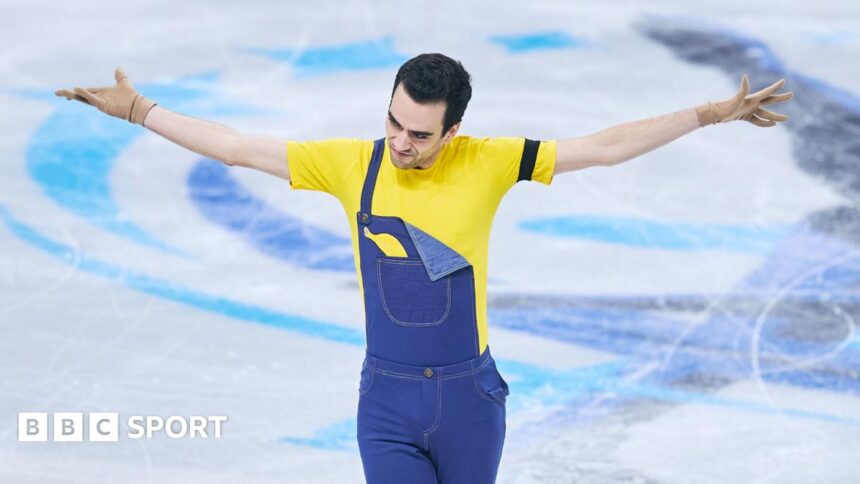
To understand the significance of this moment, one must understand the figure at its center. Tomas-Llorenc Guarino Sabate is not your typical men’s singles contender. In a discipline often dominated by soaring classical scores and dramatic warhorses, Sabate has carved a niche as sport’s great entertainer. Throughout the 2025-26 season, he has consistently turned competitions into a carnival of yellow and blue.
His routine is a meticulously crafted homage: a high-energy mix of tracks from the Minions and Despicable Me films, paired with a costume that is essentially the iconic Minion uniform—a yellow shirt and blue overalls. While purists may have initially scoffed, Sabate’s commitment to the character, combined with genuine technical skill, won over audiences globally. His programs became viral sensations, injecting a dose of unadulterated joy and accessibility into the figure skating circuit. He proved that athletic performance and pure entertainment are not mutually exclusive.
The Olympic Copyright Hurdle: Bureaucracy Meets Bananas
The road to the Olympics, however, is paved with more than just ice. As Sabate qualified for Milan, a formidable obstacle emerged: broadcast and licensing rights. The International Olympic Committee (IOC) and host broadcasters operate under extremely strict, globally-enforced copyright agreements for all music used during the Games. These rules are designed to prevent massive legal liabilities when footage is aired, clipped, and shared across every platform on Earth.
Despite having used the music all season, the blanket Olympic licensing framework did not cover Sabate’s specific Minions mix. Universal Pictures and the music’s rights holders had not granted the special, exorbitantly expensive clearance required for Olympic broadcast. The notification came down: Sabate would need to find new music for the biggest skate of his life. The online outcry was immediate and deafening. Fans, fellow athletes, and sports commentators rallied behind the skater, framing the issue as a corporate rigidity stifling athlete expression.
- The Core Issue: Seasonal event licenses differ from the all-encompassing, perpetual Olympic broadcast license.
- The Athlete’s Plight: Sabate faced losing a key component of his performance identity on the world’s biggest stage.
- Public Backlash: The story became a symbol of cold bureaucracy versus an athlete’s passionate individuality.
Pharrell’s Game-Changing Intervention: From “Happy” to Helpful
As the legal wrangling stretched over days, the story took an unexpected turn. Pharrell Williams, the prolific singer, producer, and composer of the Despicable Me franchise’s smash hit “Happy,” was made aware of the situation. Williams, known for his artistic innovation and supportive nature, personally intervened. While the exact details of the negotiation remain private, it is reported that Williams used his significant influence and relationships within Universal to fast-track a special permission grant for Sabate’s Olympic performance.
This is where the story transcends sports. Pharrell’s action wasn’t just a legal fix; it was an artistic endorsement. He recognized that Sabate’s program was more than just a skater using a pop song—it was a transformative, joyful piece of performance art that celebrated his work. This artist-to-athlete solidarity cut through the red tape and reframed the conversation. It was no longer about what was forbidden, but about what could be possible with a little creative goodwill. The message was clear: art, in all its forms, deserves a platform, even at the pristine Olympics.
Analysis & Predictions: The Ripple Effect on Olympic Culture
The implications of this saga extend far beyond one skater’s routine. Expert analysis suggests this could be a watershed moment for individual expression in judged sports.
First, it sets a powerful precedent. While the Olympic licensing machine will not change overnight, this incident proves that with enough public support and the right advocacy, exceptions can be made for compelling human stories. It may encourage other athletes to push the boundaries of their performance packages, knowing there is a potential pathway for unique artistic choices.
Second, it brilliantly highlights the modern athlete’s brand. Tomas-Llorenc Guarino Sabate is now globally recognizable. His Olympic performance will likely be one of the most-watched clips of the Games, regardless of his final placement. He has demonstrated that in the digital age, forging a genuine connection with a global audience can be as valuable as a podium finish. Sponsors and federations will be taking notes.
Third, it pressures rights holders and the IOC to modernize. The system that nearly blocked Sabate is archaic, built for an era of limited broadcast. In today’s fragmented, social-media-driven landscape, such rigid controls seem increasingly out of touch. We may see a move toward more flexible “athlete performance rights” pools or streamlined processes for pre-cleared popular music.
Prediction for Milan: When Sabate takes the ice in his overalls, the atmosphere will be electric. The performance will be a victory lap before he even begins his jumps. He will be skating not just for a score, but for every athlete who wants to bring their full, authentic self to competition. The judges will face a fascinating test: how to score a program that is technically solid but exists in a completely different aesthetic universe than its competitors.
Conclusion: More Than a Gimmick—A Legacy of Joy
The tale of the Spanish skater, the Minions, and the music superstar is a perfect Olympic fable for our times. It underscores that the Games, at their best, are about more than medals and records; they are about human stories. Tomas-Llorenc Guarino Sabate’s journey to Milan was almost derailed by a conflict between corporate protocol and creative passion. That it was resolved not by a faceless committee, but by the empathetic action of the artist whose work inspired the passion, is profoundly meaningful.
Sabate will skate in Milan. He will do so in blue overalls to the sound of chaotic, joyful Minions music. And in that moment, he will represent something vital: the spirit of play, the courage of individuality, and the idea that the Olympic stage is big enough for Tchaikovsky and Pharrell Williams, for quad jumps and a dose of silly, unapologetic happiness. His legacy won’t be a ranking, but a reminder that sometimes, the most Olympic act of all is to fight for the right to bring your own brand of joy to the world.
Source: Based on news from BBC Sport.