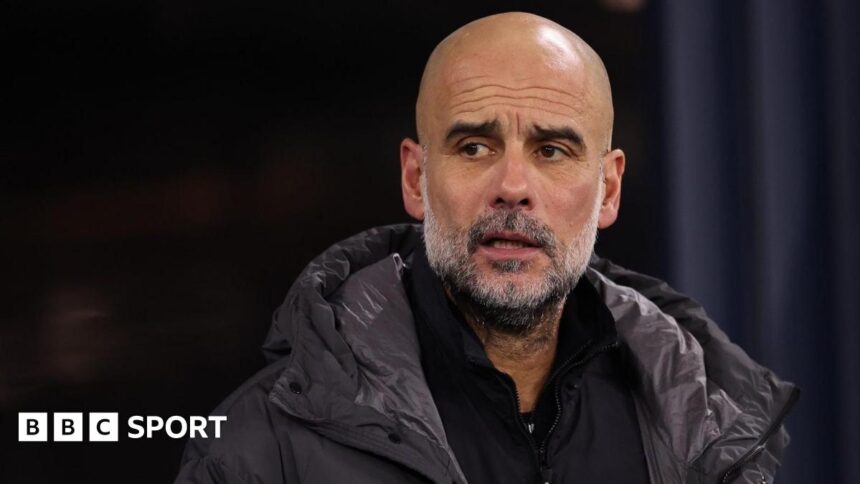
Pep Guardiola’s Defiant Stand: Why a Manager’s Voice Matters Beyond the Touchline
As the football world braces for the seismic Premier League clash between Manchester City and Liverpool this Sunday, the tactical pre-match discourse has been unexpectedly, yet powerfully, upstaged. In a poignant press conference this week, Pep Guardiola, the architect of City’s modern dynasty, transformed the familiar setting from a forum of formations into a platform for profound humanity. Defending his decision to speak on global conflicts, Guardiola posed a question that cuts to the heart of modern sports leadership: “Why should I not express what I feel, just because I am a manager?” This defiant stance, met with both applause and admonishment, reveals a fundamental tension in our consumption of sport and the individuals who shape it. As the Etihad Stadium prepares for a footballing spectacle, Guardiola has already kicked off a more significant debate about conscience, platform, and the price of speaking out.
The Press Conference as a Pulpit: Guardiola’s Unfiltered Humanity
On Tuesday, the narrative was supposed to be about title races and tactical plans. Instead, Guardiola, visibly emotional, redirected the focus. He spoke of using his privileged position to “speak up to be a better society,” articulating the deep “hurt” he feels for victims of war and conflict worldwide. This was not a calculated political statement aligned with a specific faction, but a raw, human reaction to suffering. For Guardiola, the morality of the touchline and the morality of global citizenship are not separate realms. His commentary transcended the typical manager’s script of injury updates and opponent praise, venturing into the vulnerable territory of shared grief and ethical responsibility. In doing so, he challenged the neatly packaged role society often assigns to its sporting figures.
The reaction was instant and polarized. Many praised his courage and empathy, seeing a rare example of a global sports figure leveraging his immense platform for a call to basic human compassion. Others, including some Jewish community leaders, urged him to “focus on football” and exercise greater caution with his language. This criticism underscores a pervasive, often unspoken rule in professional sports: the pitch is your stage; the world beyond it is not your concern. Guardiola’s press conference defiantly bulldozed that boundary.
The “Why Should I Not?” Philosophy: Deconstructing the Criticism
When pressed by BBC Sport to respond to the criticism, Guardiola’s retort was characteristically steadfast and simple: “To be honest, I didn’t say anything special. I don’t feel that.” This response is a master key to understanding his position. From his perspective, he wasn’t delivering a geopolitical lecture; he was expressing a fundamental human emotion—sorrow for the suffering of others. The controversy, therefore, stems not from what he said, but from the fact he said it at all while occupying the role of Manchester City manager.
Let’s deconstruct the core arguments against his outspokenness:
- The “Stick to Sports” Doctrine: This argues that a football manager’s expertise is tactical, not geopolitical, and that fans consume sport as an escape from world affairs. Guardiola’s stance rejects this, implying that silence in the face of injustice is a moral choice he is unwilling to make.
- The Risk of Divisiveness: Sports teams have diverse, global fanbases. Speaking on conflicts can alienate segments of supporters. Guardiola seems to accept this risk, prioritizing a universal message about human suffering over uniform approval.
- The “Lack of Expertise” Critique: The suggestion that only policy experts should comment on complex issues. Guardiola’s rebuttal is inherent in his question—he is not claiming expertise on solutions, but asserting his right, as a human being, to express empathy and a desire for peace.
Ultimately, Guardiola frames his speech not as a political act, but as a human one. His “why should I not?” philosophy posits that a job title should not be a muzzle on one’s conscience.
The Historical Context: When Sports Figures Speak Out
Guardiola is not operating in a vacuum. He stands on the shoulders of athletic giants who used their platforms to confront societal issues, often at great personal cost. Muhammad Ali, Billie Jean King, and Colin Kaepernick each redefined what it meant to be a sports figure, transforming their athletic prowess into a megaphone for justice. In football, figures like Eric Cantona and Marcus Rashford have famously extended their influence beyond the pitch.
However, the manager’s role is distinct. Often seen as a corporate representative and a tactical strategist first, their forays into social commentary are rarer and riskier. A manager’s words can be perceived as reflecting an entire club’s stance, adding layers of institutional pressure. Guardiola, with his unparalleled credibility and trophy-laden legacy, is perhaps one of the few figures in world football with the capital to take this risk. He is testing the boundaries of his role, expanding it from a director of players to a thought leader with a global audience.
Sunday’s Showdown: Will the Discourse Distract or Drive?
All of this frames Sunday’s colossal match against Liverpool in a fascinating new light. The classic narrative pits Guardiola against Jurgen Klopp in a battle of footballing intellects. Now, an added layer exists: how will Guardiola’s emotional and philosophical week impact his team?
Expert analysis suggests two potential outcomes:
- A Unifying Rallying Cry: Guardiola’s raw humanity could further galvanize a dressing room that already sees him as a leader of men, not just a coach. It could solidify a sense of shared purpose that translates into intense, focused performance on the pitch.
- Unwanted Pressure: Conversely, the surrounding media storm could become a distraction, placing an additional, non-footballing weight on the squad. Liverpool, under the relentlessly focused Klopp, might seek to exploit any fractional lack of concentration.
The prediction here leans toward the former. Guardiola is a master of compartmentalization. His ability to channel deep emotion into his work is part of his genius. Expect a Manchester City side that plays with a palpable intensity, perhaps viewing the 90 minutes as both a football match and a statement of resilience for their manager. The conflict on the pitch will be fierce, but it will be played against the backdrop of Guardiola’s insistence that the conflicts off it matter, too.
Conclusion: Redefining the Mandate of a Modern Manager
Pep Guardiola’s press conference was more than a news cycle story; it was a cultural marker. By asking “why should I not?”, he challenged the restrictive contract society often imposes on its celebrities. He argued, powerfully, that influence garnered in one arena carries a responsibility that extends far beyond its borders. The criticism he received highlights the discomfort this causes for those who prefer their sports heroes to remain one-dimensional.
As the final whistle blows on Sunday, regardless of the result, Guardiola’s legacy will have subtly shifted. He will no longer be seen solely as a purveyor of beautiful football, but as a manager willing to embrace the messy, complicated, and morally necessary conversations that beautiful football exists alongside. In an era where silence can be construed as complicity, Guardiola has chosen to use his voice. His message is clear: the title of “manager” does not strip one of the title of “human being,” and the weight of the latter will always inform his approach to the former. The beautiful game, in Guardiola’s vision, is not an escape from the world, but a part of it—with all the obligation that entails.
Source: Based on news from BBC Sport.