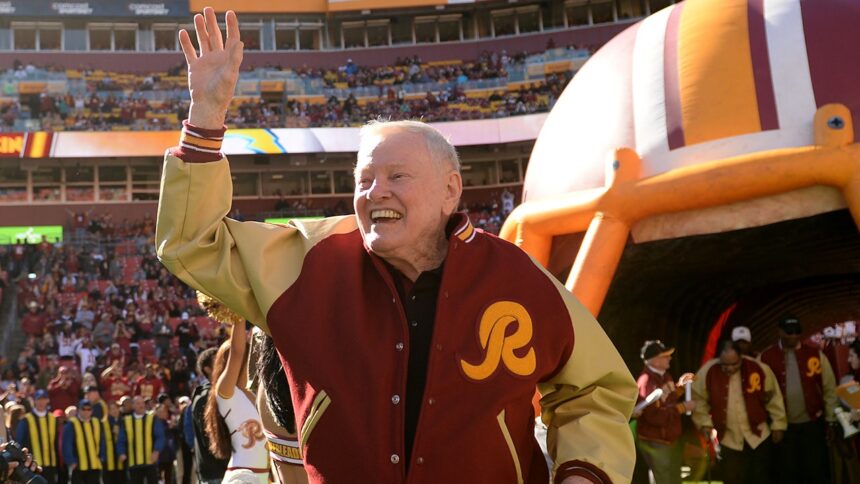
Sonny Jurgensen, Hall of Fame Quarterback and Passing Pioneer, Dies at 91
The football world has lost one of its most vibrant and talented legends. Sonny Jurgensen, the Pro Football Hall of Fame quarterback whose golden arm and fearless style defined an era of the sport, died on Friday at the age of 91. His family announced his passing in a statement released by the Washington Commanders, the franchise where he became an icon. Jurgensen’s death marks the end of a life that wove through the fabric of the NFL for over six decades, first as a record-setting player and later as a beloved broadcaster. While his cause of death is not known, his legacy as one of the game’s purest passers is eternally secure.
The Golden Arm: A Career Forged in Fire and Fun
In an era often defined by ground-and-pound football and punishing defenses, Sonny Jurgensen was a flamethrower. He played with a joyful, almost reckless abandon that endeared him to fans and frustrated coaches in equal measure. His career, spanning 18 seasons from 1957 to 1974, was split between the Philadelphia Eagles and the Washington Commanders (then the Redskins). Jurgensen didn’t just throw the ball; he launched it with a combination of velocity, touch, and uncanny accuracy that was decades ahead of its time.
His statistical achievements, considering the era’s rules that favored defenders, remain staggering:
- Led the NFL in passing yards five times, a feat matched only by legends like Sammy Baugh and Steve Young.
- Became the first quarterback in history to pass for over 400 yards in two consecutive games (1966).
- Retired with 32,224 career passing yards and 255 touchdown passes, records that placed him near the top of the all-time lists when he stepped away.
- Earned five Pro Bowl selections and was a first-team All-Pro in 1961.
Yet, numbers alone can’t capture the Jurgensen experience. He was a portly, balding figure who chain-smoked cigarettes on the sideline, a stark contrast to today’s sculpted athletes. But when he stepped into the huddle or dropped back to pass, he possessed an artist’s command. He famously played through immense pain, requiring a special harness for a chronic shoulder injury, yet still delivering spirals that sliced through the air. His 1974 season, at age 40, where he led the NFL in completion percentage (65.1%) and passer rating (94.5), stands as a testament to his otherworldly talent and durability.
From Philadelphia to Washington: The Making of a Legend
Jurgensen’s journey began with the Philadelphia Eagles, where he served as a backup to Norm Van Brocklin on the 1960 NFL Championship team. Taking over as starter in 1961, he immediately announced his arrival by leading the league in passing yards and touchdowns, earning his only All-Pro nod. Despite his individual brilliance, team success in Philadelphia was elusive, leading to his trade to Washington in 1964.
It was in the nation’s capital that Sonny Jurgensen truly became a folk hero. Washington, starving for football relevance, embraced his gunslinging mentality. He formed an electrifying partnership with Hall of Fame receiver Charley Taylor, and later with the acrobatic Bobby Mitchell. The duo became one of the most prolific pitch-and-catch combinations of the 1960s. Jurgensen’s battles with fellow Hall of Famers like Dallas’s Roger Staubach became the stuff of NFC East legend, epic shootouts that often ended with Jurgensen putting up huge numbers in a losing effort due to a lack of defensive support.
Expert analysis of Jurgensen’s game consistently points to his preternatural field vision and quick release. In a time before sophisticated pass protection schemes, he mastered the art of the quick drop and the lightning-fast decision. Former teammates and opponents often remarked that Sonny saw the field in slow motion, anticipating openings before they happened. His legacy is that of a winner trapped on mediocre teams for much of his career, a quarterback who elevated every offense he commanded through sheer force of will and unparalleled skill.
The Voice of a Franchise: A Second Act in the Broadcast Booth
Following his retirement in 1974, Sonny Jurgensen seamlessly transitioned into a second career that cemented his status as a Washington institution. He joined the team’s radio broadcast team, first as a color commentator and later as a beloved analyst alongside fellow Hall of Famer Sam Huff and play-by-play voice Frank Herzog. For over three decades, his distinctive, gravelly voice and sharp, often humorous insights were the soundtrack to Sundays for generations of Commanders fans.
In the booth, Jurgensen was unfiltered and honest, critiquing poor play with the same directness he used to dissect defenses as a player. His chemistry with Huff, a former linebacker who had once tried to knock his head off, provided endless entertainment and genuine football wisdom. This lengthy second act made him a rare figure: a Hall of Fame player who became the enduring audio narrator for his franchise’s triumphs and heartbreaks, connecting the team’s past to its present for over 50 years.
Legacy and Lasting Impact on the Modern NFL
In the aftermath of his passing, the football community is reflecting on the profound impact Sonny Jurgensen had on the quarterback position. He was a prototype, a proof-of-concept that a team could build its entire offensive identity around the forward pass. While he never won a championship as a starter, his influence is visible in every modern offensive system that prioritizes quarterback play and downfield aggression.
Predictions for how he will be remembered are clear: as a foundational pillar in the evolution of pro football. Historians will place him in the direct lineage of passers from Slingin’ Sammy Baugh to Johnny Unitas to the modern era. His statistical benchmarks, achieved with less protection and against more physical coverage, will continue to astute analysts. For Washington fans, his legacy is even more personal. He is the bridge between the franchise’s early glory and its modern iterations, a constant, comforting presence through decades of change.
The current Washington Commanders organization, now under new ownership, would be wise to formally honor Jurgensen’s memory in a significant and permanent way. Expect his number 9 jersey to be officially retired—a long-overdue honor—and for his name to be invoked as the standard of excellence for all future quarterbacks who wear the burgundy and gold.
A Final Salute to a Football Original
The statement from Jurgensen’s family began, “It is with profound sadness that we share the passing of our husband, father, and grandfather.” That profound sadness is shared by millions of fans who admired No. 9. Sonny Jurgensen was more than a Hall of Fame quarterback; he was a character, a competitor, and a commentator who loved the game with a palpable joy. He played the sport with a flair and fearlessness that made every snap must-see television. He called games with a wit and wisdom that felt like listening to a favorite uncle.
In an age of calculated sports personalities, Jurgensen was authentically and unapologetically himself—both on the field with his daring passes and on the radio with his candid critiques. The NFL has lost a direct link to its mid-century soul, a time when the game was grittier but no less glorious. Sonny Jurgensen’s golden arm is now silent, but the echoes of his spirals and the warmth of his voice will resonate in the halls of football history forever. He wasn’t just a great player; he was football, personified.
Source: Based on news from Fox Sports.