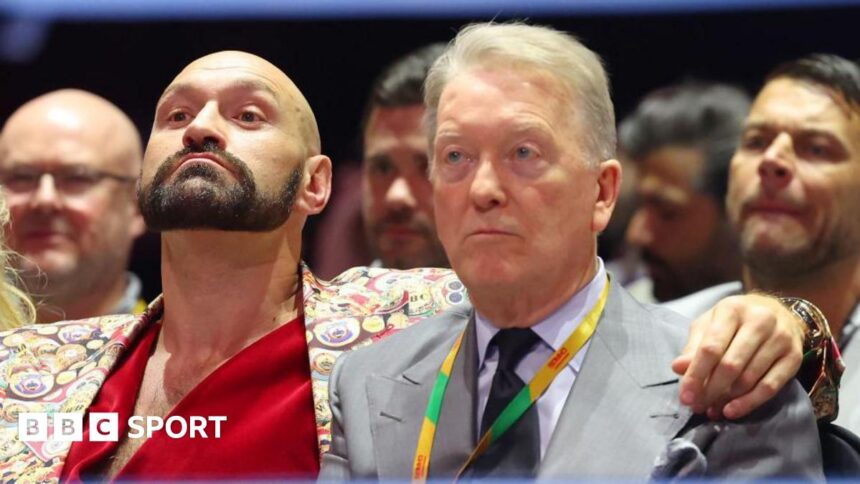
Can’t Live in the Past: Frank Warren’s Vision for Boxing’s Future After 45 Years at the Top
The roar of a 90,000-strong crowd at Wembley Stadium is a long way from the sawdust and canvas of a circus tent. For Frank Warren, the iconic British boxing promoter who celebrates 45 years as a licensed fight-maker this year, both are chapters in the same epic story. From nurturing the explosive talents of Prince Naseem Hamed and Ricky Hatton to guiding the Gypsy King, Tyson Fury, through the heavyweight wilderness and back to the summit, Warren has not just witnessed boxing history—he has repeatedly drafted its blueprint. Now, at 73, with his latest charge, featherweight titlist Nick Ball, defending his crown this Saturday, the hall-of-famer isn’t waxing nostalgic. His gaze is fixed firmly on the horizon. “You can’t live in the past,” Warren states, a philosophy that fuels his relentless drive to shape the sport’s next era.
From Ballrooms to Billions: The Warren Blueprint
Frank Warren’s career is a masterclass in adaptation. He began in an era where boxing promotion was a gritty, local affair, staging shows in modest ballrooms and, infamously, under big tops. His survival and ascent through decades of fierce rivalry, shifting television landscapes, and personal challenges speak to a unique blend of resilience and foresight. He identified and marketed superstars, turning charismatic fighters into household names and breaking British gate records in the process. Warren’s legacy is built on a keen eye for talent and an even keener understanding of the boxing business. He promoted the first live boxing on satellite TV in the UK, foreshadowing the pay-per-view boom. Today, his Queensberry Promotions stands as a powerhouse, a testament to outlasting countless competitors by evolving without ever abandoning the core principle: putting on compelling fights.
The New Frontier: Saudi Investment and the Zuffa Question
Ask Warren about the present and future, and his analysis is razor-sharp, pinpointing two seismic shifts reshaping the sport’s economy. The first is the monumental investment from Saudi Arabia. “It’s changed the dynamic completely,” Warren acknowledges. The Kingdom’s entry, with its unprecedented financial power, has made the once-impossible fights a reality, creating a new global hub for blockbuster events. This influx of capital has elevated the sport’s premium tier to stratospheric new levels.
Simultaneously, he watches the emergence of new players like Zuffa Boxing, the venture from UFC boss Dana White, with seasoned interest. “It’s another outlet, another opportunity for fighters,” Warren says, viewing it not as a threat but as potential expansion. He draws a parallel to the UFC’s own rise, suggesting that fresh, well-funded entities can stimulate the market. However, he cautions that boxing’s complexity—with its multiple sanctioning bodies, networks, and promoters—presents a unique challenge for any newcomer. The key, in his view, will be whether these new forces can create a sustainable ecosystem, not just a series of spectacular one-offs.
- Saudi Investment: A game-changer for making mega-fights, creating a new epicenter for the sport’s elite.
- Zuffa Boxing: A wildcard with significant promotional muscle; its success hinges on navigating boxing’s fragmented landscape.
- The Warren Take: More investment and competition is healthy, but must benefit the sport’s structure long-term.
The Grassroots Crisis: The Foundation Cracks
For all the talk of nine-figure site fees in the Middle East, Warren reserves his most pressing concern for the opposite end of the spectrum: the grassroots of British boxing. This is where the disconnect lies. While the top of the sport enjoys unprecedented wealth, the traditional pathway is eroding. Small-hall shows, the lifeblood where future champions are forged, are struggling. Rising costs, reduced amateur club infrastructure, and limited funding are creating a dangerous bottleneck.
“We have to nurture the talent from the bottom up,” Warren insists. He warns that without a healthy circuit of local shows, the development pipeline for young fighters dries up. The risk is a sport that becomes top-heavy, where a gulf exists between a handful of global stars and a diminished domestic scene. For a promoter who built his empire discovering talent in modest venues, this is not just business—it’s an existential threat to the sport’s soul and its future health.
Warren’s Future: No Finish Line in Sight
So, what’s next for the man who has seen it all? Retirement is not in the lexicon. “I still get the same buzz,” Warren says, his focus on the next show, the next prospect, the next negotiation. His immediate energy is behind fighters like the relentless Nick Ball, embodying the hungry, crowd-pleasing style Warren has always championed. Looking ahead, he predicts a period of consolidation and collaboration among promoters and networks to better serve the sport. He also envisions technology playing a greater role in fan engagement and fighter safety.
Ultimately, Frank Warren’s vision for boxing’s future is a hybrid model: embracing the high-finance global spectacle while fiercely protecting and reinvesting in the sport’s foundational levels. It is a balancing act between the dazzling future offered by new markets and the gritty, essential past that built the sport. His 45-year journey—from circus tents to Saudi Arabia—proves he is perhaps uniquely qualified to navigate it. The past is a lesson, not a residence. For Frank Warren, the final bell is yet to be rung, and the most important fights, those for the very soul and sustainability of boxing, are still to be won.
Source: Based on news from BBC Sport.