Bad Bunny’s Super Bowl Spectacle: A Proud Puerto Rican Love Letter That United America
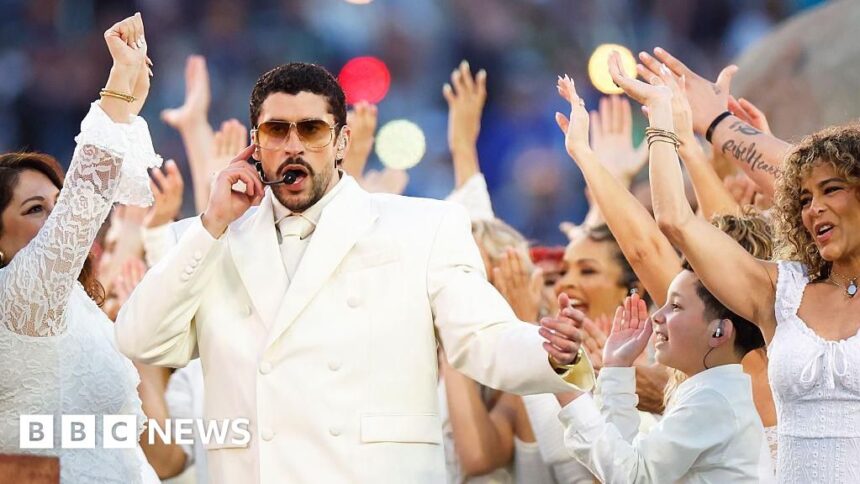
In the high-stakes, hyper-commercialized arena of the Super Bowl halftime show, artists are often faced with a choice: deliver a spectacle of pure, apolitical entertainment or seize the global stage for a pointed message. When Bad Bunny, the genre-shattering titan of Latin music, was announced as the headliner, many anticipated a fiery political statement. Instead, the 31-year-old phenom delivered something more nuanced, more powerful, and ultimately more unifying: a 14-minute, Spanish-only celebration of Puerto Rican identity that doubled as a masterclass in American cultural unity. From the iconic casita to the star-studded porch, Bad Bunny’s performance wasn’t just a concert; it was a vibrant, unapologetic declaration of pride that redefined what mainstream American patriotism can look like.
La Casita on the 50-Yard Line: Building a Puerto Rican World
The moment the stage transformed into a familiar, pastel-colored Puerto Rican casita, the statement was made. This wasn’t just a set piece; it was a cultural transplant. The casita, a staple of Bad Bunny’s tours, represents more than just architecture. It symbolizes community, resilience, and the heart of Puerto Rican life. By placing it squarely on the most American of stages, Bad Bunny performed a profound act of cultural assertion. He didn’t just bring Puerto Rico to Arizona; he made it the center of the American conversation for 14 historic minutes.
This meticulously crafted Latin landscape extended beyond the home. The seamless transition through a nail salon and a neighborhood bar created a living, breathing snapshot of diaspora life. These are the spaces where culture is preserved, stories are shared, and identity is fortified. By elevating these everyday scenes to Super Bowl grandeur, Bad Bunny validated the experiences of millions of Latinos in the U.S., offering a mirror to their lives while inviting the wider world to look in and understand. The choice to perform entirely in Spanish, a Super Bowl first, was the sonic equivalent of this visual statement—a refusal to dilute his artistry for the mainstream, thereby expanding the mainstream itself.
Unity Over Division: The Strategic Heart of the Performance
Given Bad Bunny’s history of outspoken activism, particularly regarding Puerto Rican sovereignty and political corruption, many analysts predicted a direct confrontation with the current U.S. administration. The stage was set, both literally and figuratively, for a protest. Yet, the artist, born Benito Antonio Martínez Ocasio, chose a different, perhaps more sophisticated path. His statement was one of inclusive patriotism and cultural pride as a unifying force.
This was evident not just in the absence of overt protest, but in the deliberate construction of his performance. The guest list was a tapestry of Latin excellence and cross-cultural appeal:
- Ricky Martin: A global Latin pop pioneer, representing the bridge between generations and the enduring power of Latin pop.
- Karol G: The reigning queen of reggaeton, showcasing the current explosive wave of female-led Latin music.
- Pedro Pascal & Jessica Alba: Hollywood stars of Latino heritage, symbolizing cultural penetration into every facet of American entertainment.
- Cardi B: A superstar bridge between the Latin and hip-hop worlds, emphasizing cultural fusion.
- Lady Gaga: The ultimate pop icon, whose appearance signaled a welcoming of the Latin explosion into the very core of the American pop establishment.
This curated community on the porch of the casita sent a clear message: our culture is vibrant, influential, and here to be celebrated by all. The political act was the celebration itself. In a time of frequent division, Bad Bunny presented Puerto Rican joy as a catalyst for collective celebration, proving that pride in one’s specific heritage can be the very thing that brings a diverse nation together.
Decoding the Setlist: A Medley of Record-Breaking Hits
While the visuals told a story of cultural pride, the music solidified Bad Bunny’s undisputed commercial and artistic dominance. As Spotify’s most-played artist in the world for 2025, his medley was a victory lap of global anthems. He opened not with a gentle intro, but with the explosive energy of “Tití Me Preguntó,” a song that has become a global phenomenon. This immediate immersion into his signature sound was a confident assertion of his musical language.
The journey through “MONACO” and “BAILE INoLVIDABLE” showcased his artistic range—from braggadocious swagger to irresistible dance-floor magnetism. Each track, performed in Spanish for an audience of hundreds of millions, demonstrated that language is no barrier to rhythm, emotion, and connection. The performance was a powerful argument for the erasure of the “Latin music” as a niche category; this *is* the dominant pop music of today. By forgoing any English-language crossover hits, Bad Bunny made his strongest point: the world is already listening on his terms.
The Aftermath and the New Blueprint for Megastardom
Bad Bunny’s halftime show will be analyzed for years as a watershed moment. It successfully navigated the immense pressure of the gig by staying authentically true to the artist’s core while executing a show of breathtaking scale and warmth. The immediate impact is multifaceted:
- Cultural Validation: It provided an immeasurable sense of pride and visibility for Puerto Ricans and the broader Latino community in the U.S.
- Industry Shift: It irrevocably proves that a primarily Spanish-language act can carry the biggest live television event on Earth, paving the way for future artists.
- Political Re-framing: It demonstrated that cultural expression can be a more potent, unifying form of “statement” than explicit protest in certain contexts.
Looking forward, this performance sets a new blueprint. Future halftime performers, especially those from historically marginalized communities, will see that they don’t have to compromise their identity to appeal to the center. They can bring the center to them. We can expect global superstars to feel empowered to present their culture, their language, and their specific stories with the same unapologetic confidence. Bad Bunny didn’t just perform; he expanded the aperture of American culture, proving that the nation’s strength lies not in a single narrative, but in the proud, vibrant chorus of all its people.
Conclusion: A Legacy Defined by Pride and Porches
In the end, Bad Bunny’s Super Bowl LVII halftime show will be remembered not for a shocking reveal or a controversial stunt, but for its profound sense of home. He turned the gladiatorial coliseum of a football stadium into a porch party in Santurce. He traded political confrontation for an invitation to dance, to understand, and to celebrate. In doing so, he delivered a masterclass in 21st-century stardom and a redefinition of American patriotism. True patriotism isn’t about uniformity; it’s about the courage to share your unique story with the whole family, trusting that it will make the collective narrative richer. By piling on the Puerto Rican patriotism, Bad Bunny didn’t exclude anyone—he invited the entire world into his casita, and in that act, crafted a halftime show that felt, for the first time in a long time, genuinely and joyfully unifying.
Source: Based on news from BBC Sport.