Drake Maye’s Super Bowl Nightmare: Where His Performance Ranks Among the Worst in History
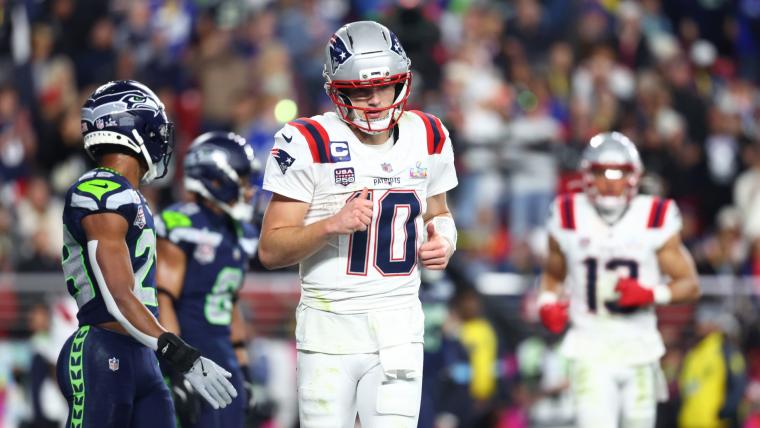
The image was one of pure, unadulterated dejection. With the confetti of a rival celebration beginning to swirl, New England Patriots quarterback Drake Maye stood alone on the sideline, ripping the chin-strap from his helmet with a vacant, thousand-yard stare. The moment of desolation was the perfect coda to a Super Bowl performance that unraveled in spectacular fashion. Seattle Seahawks linebacker Uchenna Nwosu had just sealed Super Bowl 60 with a 45-yard pick-six, the final, crushing blow in a 29-13 defeat. In the aftermath, a shell-shocked Maye could only offer a lament that echoed through decades of Super Bowl infamy: “I’d like to have it back. I’d like to go back to the beginning and re-do it.” For the young quarterback, there will be no re-dos, only a permanent place in the annals of Super Bowl disappointment. But just where do Drake Maye’s struggles against Seattle’s relentless defense rank among the worst quarterback performances in the game’s history?
A Recipe for Disaster: Maye’s Statistical Descent
To understand the magnitude of Maye’s struggle, one must first examine the cold, hard numbers that defined his night. Completing just 18 of 41 passes for 179 yards, zero touchdowns, and three interceptions paints a bleak picture. His passer rating of 36.2 isn’t just bad; it’s a figure that resonates with a specific, haunting familiarity for historians of the game. The Seahawks’ defensive masterplan, orchestrated by a wily defensive coordinator, rendered the Patriots’ offense inert. Maye was under duress on over 40% of his dropbacks, was sacked five times, and consistently misfired on throws he made routine during the Patriots’ playoff run. The critical fourth-quarter interception returned for a touchdown by Uchenna Nwosu wasn’t an anomaly; it was the inevitable result of a quarterback drowning in the moment. The statistics place him in a territory reserved for the most overmatched signal-callers on sports’ biggest stage.
The Pantheon of Super Bowl QB Struggles: Historical Context
Super Bowl history is littered with legendary performances, but its shadowy counterpart is the catalogue of quarterback calamities. To gauge Maye’s standing, we must compare it to the foundational benchmarks of poor play.
- Craig Morton, Super Bowl XII (1977): The gold standard for inefficiency. Morton’s line for the Denver Broncos—4 of 15 for 39 yards, 4 INTs, 0.0 passer rating—remains the statistical nadir. He was benched, and his performance is the bar against which all others are measured.
- Rich Gannon, Super Bowl XXXVII (2003): A league MVP eviscerated by a predatory defense. Gannon threw a Super Bowl-record five interceptions, three returned for touchdowns by the Tampa Bay Buccaneers. His mistakes were direct points for the opponent, a fate Maye narrowly shared.
- Peyton Manning, Super Bowl XLVIII (2014): A shocking display from a legend. Manning’s Broncos were blown out 43-8 by Seattle, and his first snap famously sailed over his head for a safety. While his stats (34 of 49, 280 yards, 1 TD, 2 INTs) aren’t the worst, the context of total systemic failure and his pedigree place it high on this list.
- Jim Kelly, Super Bowl XXVI (1992): The Buffalo Bills quarterback threw four interceptions in a 37-24 loss to Washington, completing just 28 of 58 attempts. It was a day defined by forced throws and miscommunication.
Against this grim backdrop, Drake Maye’s performance carves out its own unique niche. It lacks the sheer volume of turnovers of Gannon or the complete ineptitude of Morton. However, it combines elements of both: crippling inaccuracy, catastrophic turnovers at the worst moments, and a palpable sense of a player overwhelmed by the stage. His rating sits comfortably in the bottom-ten all-time, but the modern context—where rules favor quarterbacks—makes his struggle even more stark.
The Anatomy of a Collapse: Pressure, Scheme, and Youth
Assigning blame for a Super Bowl loss is never simple, but the breakdown of Maye’s game points to a perfect storm of factors. First, the Seattle Seahawks’ defensive scheme was a masterpiece of disguise and pressure. They consistently showed two-high safety looks before rotating into single coverage, confusing Maye’s pre-snap reads. Their pass rush, led by a dominant interior, collapsed the pocket up the middle, preventing Maye from stepping into his throws—a key component of his downfield success.
Second, Maye’s own inexperience and internal clock betrayed him. On the Nwosu interception, he stared down his primary receiver from the snap, allowing the linebacker to jump the route. Earlier picks came from forcing the ball into coverage while ignoring check-downs. “It comes down to who makes plays and who doesn’t. They made the plays tonight,” Maye conceded. The statement underscores a key truth: Seattle’ veterans capitalized on rookie mistakes.
Finally, the Patriots’ game plan seemed to abandon the run too early, placing the entire burden on the young quarterback’s shoulders against a defense feasting on one-dimensionality. The result was a quarterback playing not to lose, but inevitably doing just that.
Legacy and Looking Ahead: Can Maye Recover?
History shows that a catastrophic Super Bowl performance does not have to define a career. Peyton Manning rebounded from his Seattle debacle to win a Super Bowl two years later. John Elway was blown out in three Super Bowls before winning back-to-back titles to end his career. The path to redemption, however, is arduous.
For Drake Maye, the offseason will be a marathon of film study, starting with the brutal tape from Super Bowl 60. The questions he must answer are profound: Can he improve his field vision and progressions under duress? Can he develop a quicker trigger against elite pressure? The Patriots’ organization must also look inward, evaluating how they support their franchise cornerstone with scheme and personnel.
The legacy of Super Bowl 60 for Drake Maye is currently one of infamy. His name is now linked with Craig Morton, Rich Gannon, and Jim Kelly in the most unwanted of fraternities. Yet, his career narrative is still in its early chapters. Where his performance ultimately ranks will be determined not by one night in Santa Clara, but by how he responds to it. Does it become the foundational trauma of a career that never reached its potential, or does it become the painful, necessary lesson that forged a champion? Only time, and Maye’s resilience, will tell.
For now, the memory is fresh: the blank stare, the torn chin-strap, the interception sealing his doom. Drake Maye’s Super Bowl performance was a masterclass in struggle, a entry into the history books he never wanted to author. It stands as a stark reminder that on sports’ grandest stage, glory and despair are separated by the thinnest of margins, and for one night, a promising quarterback learned that lesson in the harshest way imaginable.
Source: Based on news from Yahoo Sports.