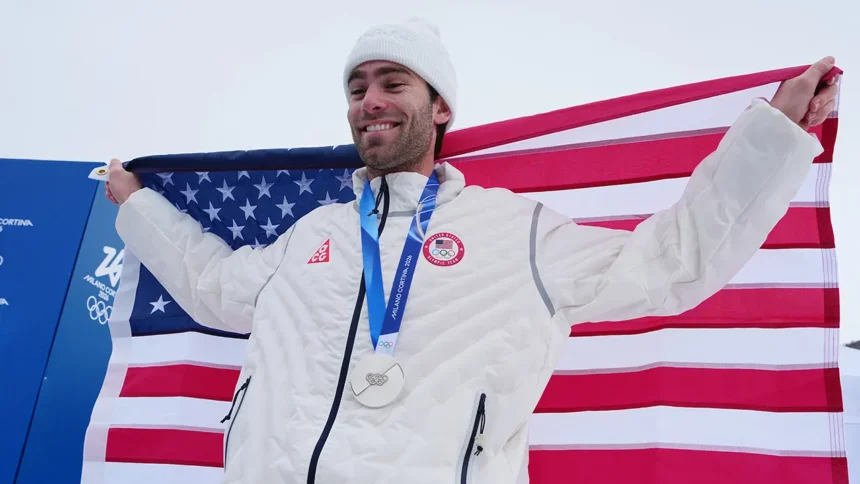
Alex Hall Soars to Silver, Defends U.S. Slopestyle Legacy at Winter Olympics
The pressure was immense, the course a beast of ice and steel, and the field the most talented in history. Yet, when the final trick landed and the spray of snow settled in Livigno, American freeskier Alex Hall stood atop the podium once more, the Stars and Stripes draped over his shoulders and a silver medal around his neck. In a heart-stopping men’s slopestyle final at the 2026 Winter Olympics, Hall did not just defend his title; he defended an entire American dynasty, proving that style and creativity remain the soul of the sport even in the face of ever-increasing technical difficulty.
A Dynasty on the Line: The Weight of American Expectation
Since slopestyle skiing made its Olympic debut in 2014, the United States has owned the men’s podium. From the pioneering gold of Joss Christensen in Sochi to Nick Goepper’s consistent medal haul, and culminating in Hall’s transcendent victory in Beijing, American freeskiing dominance was not just a trend—it was an expectation. Coming into the 2026 Games, the unspoken question was whether that reign could continue against a global field that had spent four years dissecting and innovating upon the American blueprint.
For Alex Hall, the challenge was twofold. He carried the mantle of the defending Olympic champion, a target squarely on his back. More than that, he carries a reputation as the sport’s premier creative visionary. While others chase higher rotations, Hall is renowned for his unique approach, incorporating butter tricks, unnatural rotations, and a seamless, fluid style that makes the improbable look effortless. The Livigno course, with its massive rails and daunting jumps, was a test: would pure amplitude and spin count defeat artistic ingenuity?
Dissecting the Livigno Battle: Where the Medal Was Won
The finals were a masterclass in progression. Early leaders threw down gargantuan triple cork variations, pushing the technical envelope. Hall’s first run was solid but sat him outside the medals. It was in his second run, under the intense pressure of “now or never,” that the champion responded.
Hall’s silver-medal run was a signature performance:
- Technical Mastery on Rails: He initiated with a switch-up to forward 450 off the first rail, a complex setup move that demonstrated control from the very start.
- The Signature “Butter” Flair: On the second rail feature, Hall executed a flawless butter to switch-up to pretzel 630 out, a sequence that left judges and fans alike in awe. This move, more akin to skateboarding than traditional skiing, is Hall’s trademark and a key differentiator.
- Amplitude and Precision on Jumps: He answered the triple-cork debate with a massive left double cork 1620 tail grab, followed by a right double cork 1800 mute grab. While not triples, the execution, height, and clean landings were flawless.
- The Icing on the Cake: He capped the run with a left double cork 1080 safety grab, a slightly less rotated but stylistically perfect finish that showcased his commitment to the complete package over a mere tally of rotations.
This run was a statement. It declared that in a sport hurtling toward a singular definition of difficulty, there is still immense value in style, flow, and execution. The judges rewarded it with a score that catapulted him into second, a position he would not relinquish.
Expert Analysis: What Hall’s Silver Means for the Sport
Hall’s silver is far from a step down. In the context of this specific competition and the sport’s trajectory, it is a resounding victory for a particular philosophy. The gold medalist, who landed a groundbreaking triple cork 1980, represented the zenith of pure rotational physics. Hall’s silver represented the zenith of slopestyle as an art form.
“This was arguably the deepest slopestyle final we’ve ever seen,” commented a veteran freeski analyst. “For Alex to come in with his unique toolkit and not just compete, but secure a medal, validates his entire approach. He didn’t conform to the ‘triples at all costs’ trend; he forced the judges to remember that this is a judged sport based on overall impression. He made skiing look fun, and that’s incredibly hard to do at this level.”
Furthermore, Hall’s performance ensures the U.S. slopestyle medal streak remains unbroken. In securing silver, he upheld a legacy that now spans four consecutive Olympics, a testament to the pipeline and culture of American freeskiing. This silver carries the weight of a team accomplishment, keeping the flag flying high in a discipline the U.S. pioneered on the Olympic stage.
The Future of Freeskiing: Predictions Post-Livigno
The 2026 slopestyle final has set the stage for a fascinating new era. The duel between technical maximalism and creative expression is now the central narrative of the sport.
- The Triple Cork Arms Race: The bar for medal contention has been irrevocably raised. Future competitors will now need a triple cork variation in their run, likely requiring at least 1800 degrees of rotation. The quest for the first quad cork in competition will intensify.
- Hall’s Enduring Influence: Young skiers worldwide study Alex Hall’s runs. His success guarantees that the next generation will continue to innovate on rails and prioritize style, ensuring the sport does not become a mere aerial jumping contest. The “butter” revolution is here to stay.
- Team USA’s Next Wave: With Hall and other veterans potentially moving on, the focus turns to the American newcomers. Does the U.S. system have the next creative genius or the next triple-cork machine in the pipeline? Maintaining the dynasty will require athletes who can blend both.
The prediction is clear: the ultimate champion of the coming years will be the skier who can successfully merge Hall’s unparalleled rail creativity and style with the absolute technical amplitude required on the jumps. The perfect hybrid athlete is the sport’s next frontier.
Conclusion: More Than a Medal, A Legacy of Style
As Alex Hall held the American flag on the Livigno podium, the silver medal gleamed not as a consolation, but as a badge of honor. In an Olympic cycle defined by progression, he progressed on his own terms. He defended not just a title, but an entire ethos. He reminded the world that freeskiing slopestyle is a canvas, and while others paint with broader, more powerful strokes, he remains the sport’s most nuanced and creative artist.
This silver medal solidifies Alex Hall’s legacy as one of the most influential freeskiers of his generation. He is a two-time Olympic medalist, a champion who expanded the sport’s vocabulary, and now, the stalwart who preserved a proud American tradition when the pressure was at its peak. His performance in Livigno wasn’t about defending gold; it was about defending the very soul of creative skiing. And in that mission, Alex Hall was, unequivocally, golden.
Source: Based on news from Fox Sports.