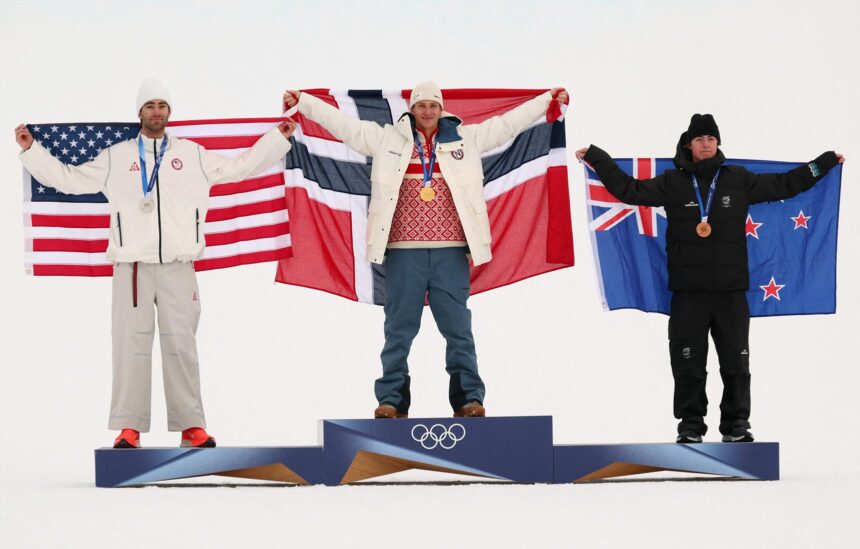
Birk Ruud Soars to Slopestyle Gold, Alex Hall’s Silver Caps Stellar U.S. Legacy
The clouds hung low over Livigno, but nothing could dim the brilliance of Birk Ruud. Under the Italian Alps’ brooding sky, the Norwegian freestyle skier authored a masterpiece on snow, his first-run excellence securing the men’s slopestyle Olympic gold medal at the Milan Cortina Games. In a dramatic defense of his title, America’s Alex Hall captured silver with his signature creativity, while New Zealand’s young gun, Luca Harrington, soared to a surprise bronze, etching a new chapter in the sport’s high-flying history.
A First-Run Masterpiece Seals the Deal
In an event where athletes typically build toward their best score across three runs, Birk Ruud flipped the script with immediate and overwhelming authority. Dropping in as one of the favorites, the 23-year-old from Oslo executed a run that was less a collection of tricks and more a statement of intent. Flawlessly navigating the technical rail section with unique slides and switches, he launched into the jump line with explosive power. His combination of massive amplitude, pristine grabs, and a dizzying array of rotations—including both double and triple cork variations—left the judges with little doubt.
His score of 94.25 instantly became the benchmark. “I knew I had to put down a solid run from the start,” Ruud said after. “The course was challenging, but it allowed for creativity. I just focused on my skiing and let it flow.” This early dominance applied immense pressure on the rest of the field, transforming the competition into a pursuit of the Norwegian phenom from its very beginning.
Hall’s Artistic Silver and America’s Slopestyle Dynasty
The primary challenger was the reigning champion, Alex Hall. Known as skiing’s great innovator, Hall’s approach is rooted in a unique, almost playful style that prioritizes technical difficulty and originality. His silver-medal run was a testament to this philosophy. Where others sought pure power, Hall threaded together sequences of switch take-offs, unnatural rotations, and rail tricks that seemed to defy physics. His ability to spin in multiple directions within a single trick left even fellow competitors in awe.
Hall’s quest for a second consecutive gold came down to his final run. Needing a score in the mid-90s, he pushed the envelope but lost balance on the landing of a rail trick, sliding out backward. The fall sealed Ruud’s gold but did nothing to diminish Hall’s achievement. “I’m stoked for Birk, he absolutely killed it,” Hall stated. “I came here to ski my best and push what’s possible in slopestyle. To get a medal doing that is amazing.”
This silver extends a remarkable legacy for Team USA in men’s slopestyle. Since the event’s Olympic debut in 2014, American men have now medaled in every Games:
- 2014 Sochi: Joss Christensen (Gold), Gus Kenworthy (Silver), Nick Goepper (Bronze)
- 2018 PyeongChang: Nick Goepper (Silver), Alex Hall (6th)
- 2022 Beijing: Alex Hall (Gold), Nick Goepper (Bronze)
- 2026 Milan Cortina: Alex Hall (Silver)
This consistent podium presence underscores the U.S. system’s strength in fostering progressive, stylish skiers.
The Rise of New Faces and the Sport’s Evolution
While the spotlight was on the established stars, the bronze medal performance by Luca Harrington signaled a compelling shift. At just 21 years old, the Kiwi skier delivered under pressure, landing a clean and highly difficult run that blended technical rail work with huge, floated jumps. His podium finish is a breakthrough for New Zealand skiing and highlights the global growth of freestyle skiing.
The Livigno slopestyle course itself played a starring role. Designed to reward both technical rail mastery and aerial prowess, it perfectly captured the sport’s current evolution. Judges are increasingly valuing a holistic approach—no longer just the biggest triple cork wins. The emphasis is now on:
- Rail Originality: Unique approaches, switch entries, and complex slide combinations.
- Amplitude and Style: Not just getting to the landing, but doing so with height, clean grabs, and a smooth, controlled aesthetic.
- Run Fluidity: Connecting features seamlessly, making the entire run look effortless.
Ruud and Hall, in their distinct ways, both excelled in these criteria, proving they are the sport’s foremost complete skiers.
Expert Analysis: What This Means for Freestyle’s Future
Ruud’s victory cements his status as one of the most versatile talents in freeskiing history. An Olympic gold now sits alongside his multiple X Games medals and a Big Air crystal globe. His ability to perform in big air, slopestyle, and even halfpipe makes him a rare triple threat. For Alex Hall, the silver reinforces his role as the sport’s chief artistic visionary. His influence is evident in how younger skiers are now approaching rail sections and incorporating off-axis rotations.
The performance of Harrington, along with other young finalists, points to a deepening international talent pool. Nations like New Zealand, Switzerland, and Canada are producing skiers who can challenge the traditional Nordic and American powerhouses from a very young age. The technical ceiling continues to rise, but the Livigno podium showed that execution and style on the day are still paramount.
Predictions for the Next Olympic Cycle
Looking ahead to the 2030 Games, the landscape appears dynamic and fiercely competitive. Birk Ruud, still in his prime, will aim to defend his title. Alex Hall’s innovative spirit shows no signs of slowing, and he will remain a podium threat. However, the surge of youth cannot be ignored. Luca Harrington, with Olympic experience now under his belt, will be a leading contender. We can also expect to see:
- Increased Technical Difficulty: The integration of quad cork rotations in slopestyle is no longer a question of “if” but “when” for the men.
- Style as the Differentiator: As technical tricks become more common, unique style and run composition will become the ultimate tie-breaker.
- Global Podiums: The era of two or three nations dominating the podium is likely over. The 2030 field could feature medalists from four or five different countries.
Conclusion: Gold Standard Set in Livigno
The men’s slopestyle final in Livigno was a showcase of freestyle skiing at its absolute pinnacle. Birk Ruud demonstrated the explosive, dominant run that defines an Olympic champion, seizing gold with a confidence that never wavered. Alex Hall’s silver medal was a triumph of creativity, ensuring the United States’ remarkable slopestyle legacy continues to shine. And in Luca Harrington’s breakthrough bronze, we witnessed the exciting, unpredictable future of the sport taking flight.
This competition had it all: a masterful first act, relentless pursuit, and the emergence of a new star. It proved that while the tricks get bigger and the spins get faster, the Olympic spirit—of pushing boundaries, embracing originality, and respecting the journey—remains the truest gold standard of all.
Source: Based on news from Deadspin.