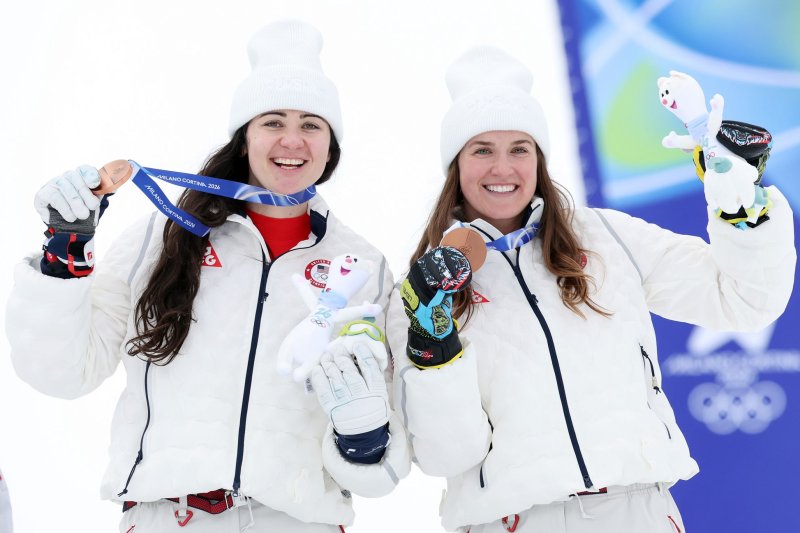
Bronze Brilliance: Moltzan & Wiles Steal the Show as Shiffrin Stumbles in Olympic Alpine Combined
The sun-drenched slopes of Cortina d’Ampezzo promised a coronation. Instead, they delivered a captivating drama of redemption, surprise, and the raw, unforgiving mathematics of the alpine combined. In a stunning twist at the 2026 Winter Olympics, the American duo of Paula Moltzan and Jackie Wiles clinched a bronze medal in the women’s alpine combined team event, while their legendary teammate, Mikaela Shiffrin, found herself off the podium in a race where she was the overwhelming favorite. The result was a powerful reminder that in team skiing, collective resilience often trumps individual pedigree.
A Tale of Two Teams: Strategy and Grit on the Tofane
The innovative team alpine combined event, making its second Olympic appearance, pairs one downhill specialist with one slalom expert. Each skier runs both disciplines, with their combined times deciding the medals. For Team USA, the lineup seemed to present a clear hierarchy. The pairing of Breezy Johnson and Mikaela Shiffrin was the marquee attraction, a powerhouse blend of Johnson’s downhill prowess and Shiffrin’s slalom dominance. The second team of Wiles and Moltzan, while highly capable, flew under the radar.
Johnson executed her role to perfection, laying down a blistering downhill run of 1:36.59, the fastest of the entire field. She handed Shiffrin a precious lead. Meanwhile, Jackie Wiles, racing just behind Johnson, put in a solid fourth-fastest downhill effort, setting up Paula Moltzan for the slalom. The stage was set for Shiffrin to do what she has done for a decade: ice a victory with a surgical slalom run.
But the slalom course at the Tofane Alpine Skiing Centre had other ideas. Shiffrin, who had been virtually unbeatable in World Cup slalom this season, looked uncharacteristically tentative. A slight hesitation, a brush of a gate—in slalom, milliseconds are mountains. She crossed the line with the 15th fastest slalom time, a shocking result that evaporated the team’s lead. In the adjacent start gate, Paula Moltzan, known for her aggressive, no-holds-barred style, attacked the course. She clocked the fourth-fastest slalom run, a heroic effort that propelled her and Wiles from also-ran status into medal contention.
The final times told the story of heartbreak and triumph separated by a blink:
- Gold (Austria): Ariane Raedler & Katharina Huber – 2:21.66
- Silver (Germany): Kira Weidle-Winkelmann & Emma Aicher – 2:21.71
- Bronze (USA): Paula Moltzan & Jackie Wiles – 2:21.91
- 4th Place (USA): Breezy Johnson & Mikaela Shiffrin – 2:21.97
A mere six-hundredths of a second sealed the fate of the two American teams.
Expert Analysis: The Pressure of Expectation and the Freedom of the Underdog
From a tactical standpoint, this race was a masterclass in the psychological dimensions of Olympic competition. The weight on Shiffrin’s shoulders was immense. As the most successful slalom skier in history, racing with a lead she didn’t build herself, the mandate was simple: don’t lose it. That defensive mindset can be kryptonite for a slalom skier, where instinct and aggression are paramount. “You could see the tension in her line,” noted one veteran analyst on the broadcast. “She was skiing not to lose, while Moltzan was skiing to win.”
For Moltzan and Wiles, the dynamic was inverted. With lower external pressure, they were unleashed. Wiles’s clean downhill gave them a fighting chance, and Moltzan, a skier with a reputation for fearless attacking, had nothing to lose and everything to gain. Her run was a statement. “I was grateful to have another shot with Paula,” Wiles said post-race. “She is insanely fast so it’s incredible. I knew she would come through and it was really cool.” This trust and lack of overwhelming expectation became their greatest asset.
Furthermore, the result highlights the depth of U.S. Alpine skiing. For years, the narrative has centered on Shiffrin’s singular greatness. Today, the world saw that American skiing is no one-woman team. The performances of Johnson, Wiles, and Moltzan prove the pipeline is robust, producing athletes capable of seizing the moment on the grandest stage, even when the spotlight is elsewhere.
Looking Ahead: Ripple Effects for the Rest of the Games
This bronze medal will send seismic waves through the U.S. camp and the Olympic alpine circuit. The immediate implications are profound:
- Momentum Shift: For Moltzan and Wiles, this medal is a career-defining achievement that injects immense confidence. They will enter their individual events—slalom and downhill, respectively—as proven Olympic medalists, a status that changes everything.
- Shiffrin’s Response: For Mikaela Shiffrin, this is unfamiliar territory. An Olympic event where she was favored ended without a medal. How she processes this will be the defining storyline of her Games. History shows she uses disappointment as fuel. Her upcoming individual slalom and giant slalom races just became must-watch events.
- Team Dynamic: The internal competition within Team USA has been healthy, but this result formalizes a true “A-team vs. B-team” rivalry in the best sense. It pushes everyone to be better and proves multiple American teams are legitimate threats in any format.
- Event Legitimacy: The alpine combined team event, still new to many fans, earned its stripes with this race. It delivered unbelievable drama and proved that it tests not just speed, but team composition, strategy, and nerve in a unique way.
Conclusion: A New Chapter for American Alpine
The 2026 Cortina Games will be remembered for many moments, but the women’s alpine combined team event may stand as a pivotal turning point. It was the day the supporting cast stepped into the light and shone with Olympic brilliance. Paula Moltzan and Jackie Wiles authored a story of perseverance and partnership, seizing their opportunity with flawless execution when it mattered most.
Conversely, the result is a poignant chapter in the epic saga of Mikaela Shiffrin, a reminder that even the greatest are human and that Olympic pressure is a force unlike any other on the World Cup circuit. Their combined narratives—the breakthrough and the setback—enrich the sport and set the stage for an electrifying remainder of the alpine schedule. One thing is certain: the path to Olympic glory for the United States is no longer a single lane. It’s a broad, competitive highway, and after today in Cortina, the world is watching all the traffic.
Source: Based on news from Yahoo Sports.