Olympic Bronze, Personal Scandal: Biathlete’s Emotional Confession Overshadows Podium Finish
An Olympic podium is a stage reserved for the pinnacle of athletic achievement, a moment where years of sacrifice crystallize into a singular, triumphant glow. For Norwegian biathlete Sturla Holm Laegreid, that glow this week was overshadowed by a profound and self-inflicted shadow. Fresh off securing a bronze medal in the men’s 20km individual biathlon at the Winter Games, Laegreid delivered a raw, unscripted confession that had nothing to do with skiing or shooting. In a tearful interview with Norway’s NRK, the athlete voluntarily admitted to cheating on his girlfriend, the woman he called “the love of my life,” transforming a sports headline into a deeply human drama of regret, consequence, and public accountability.
The Podium of Regret: A Champion’s Unplanned Confession
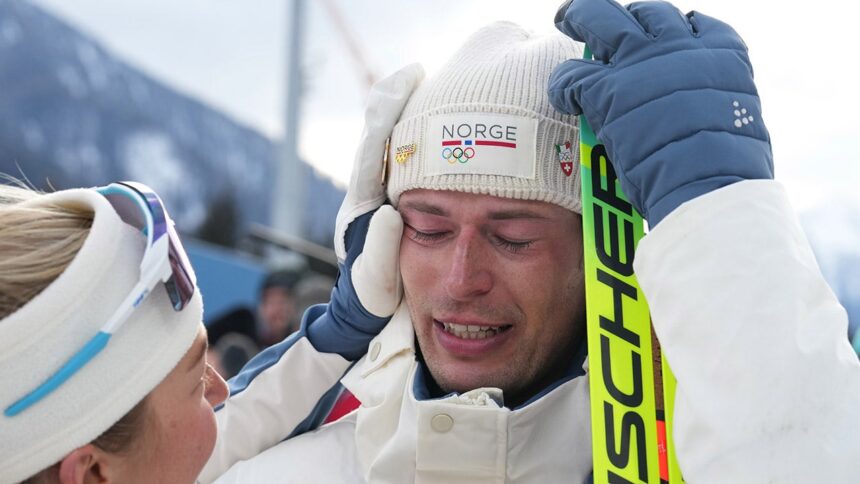
Laegreid’s performance on the track was a masterclass in precision under pressure, earning him his first individual Olympic medal. Yet, as the cameras closed in for the traditional post-victory interview, the narrative swiftly pivoted from sport to soul-searching. With the Norwegian flag still metaphorically draped over his shoulders, Laegreid fought back tears, his voice cracking with emotion. “There’s someone I wanted to share it with who might not be watching today,” he began, setting the stage for a revelation that captivated audiences far beyond the biathlon community.
He detailed meeting an extraordinary woman six months prior, describing her as “the most beautiful and kindest person in the world.” Then came the gut punch: “Three months ago, I made my biggest mistake and cheated on her.” This was not a leaked rumor or a tabloid exposé; this was a voluntary, public admission from an athlete at the zenith of his career, choosing a global platform to confront his personal failing. The juxtaposition was stark: Olympic bronze medal in one hand, the self-proclaimed “biggest mistake of my life” weighing heavily on the other.
Expert Analysis: The Psychology of Public Apology
To understand the weight of Laegreid’s actions, we must look beyond the sports page. Dr. Anya Petrova, a sports psychologist specializing in athlete mental health and public image, provides crucial insight. “What we witnessed here is extraordinarily rare,” Dr. Petrova explains. “Elite athletes are trained to project invincibility, to compartmentalize personal life from performance. Laegreid did the opposite. He deliberately fused them in the most public way possible.”
This raises critical questions about motive and impact. Dr. Petrova outlines several potential drivers for such a public emotional interview:
- Genuine Catharsis: The immense pressure of the Olympic stage may have shattered his emotional barriers, leading to an uncontrollable need for honesty.
- Pre-emptive Accountability: In an era where scandals are often uncovered, not confessed, this could be a strategic move to control the narrative and demonstrate immediate remorse.
- A Plea for Reconciliation: The statement, “someone… who might not be watching,” is a direct, if agonizing, communication to the injured party, a Hail Mary pass played out on international television.
“The risk,” Dr. Petrova notes, “is that the apology, however heartfelt, becomes a secondary spectacle to the scandal itself. His athletic achievement is now permanently linked to this personal failing, a complex legacy for any Olympic medalist to carry.”
Fallout and Predictions: Career at a Crossroads
The immediate aftermath of Laegreid’s confession creates a ripple effect with uncertain endpoints. The sports world is now watching two parallel stories unfold: the career of a champion biathlete and the fragile fate of a private relationship.
For his professional trajectory, the impact may be nuanced. Norwegian sports culture values humility and team ethos. His raw honesty, while exposing a grave error, may ultimately resonate with a public that respects accountability. Sponsorship deals, however, often hinge on a clean, family-friendly image, and some brands may distance themselves. His performance on the biathlon circuit will now be scrutinized through a dual lens: can he maintain elite focus with this personal turmoil public knowledge?
For the personal realm, the predictions are even more fraught. By choosing a global stage for his apology, Laegreid removed any private space for reconciliation. His partner, unnamed and unwillingly thrust into the spotlight, now faces immense public pressure and sympathy. The path to forgiveness, if it exists, is now a matter of public record. This act may be seen as the ultimate grand gesture or a profound violation of privacy, compounding the original betrayal.
The Unforgiving Spotlight: Morality Tales in Modern Sport
Laegreid’s story is the latest chapter in a long history of athletes navigating personal failings in the public eye. It forces a conversation about what we demand from our sports heroes. Are they solely entertainers and competitors, or are they also expected to be moral exemplars? The Norwegian biathlete‘s confession sidesteps the usual cycle of denial and scandal, presenting a messy, complicated picture of a man who is both an Olympic champion and, by his own admission, deeply flawed.
This incident also highlights the unique pressure of the Olympic Games themselves. The event is so mythologized, so tied to narratives of purity and supreme effort, that it can act as an emotional amplifier. Joy is more euphoric; grief is more profound; and, as Laegreid demonstrated, regret can become an unbearable weight demanding release at the most inopportune time.
A Legacy Defined by More Than Bronze
Sturla Holm Laegreid won an Olympic bronze medal this week. History will record that fact. But his legacy will be inextricably tied to the raw, vulnerable minutes that followed. In an age of curated social media personas and carefully managed press conferences, his unvarnished emotional breakdown was a startling anomaly. It was a reminder that behind the medals and the lycra and the perfect shots are human beings capable of extraordinary achievement and profound error, sometimes in the same hour.
Whether his confession serves as a cautionary tale about the costs of infidelity, a masterclass in public relations, or a genuine roadmap to personal redemption is a story yet to be written. The final chapter depends not on the sports commentators or the headlines, but on the quiet, private decisions of a heartbroken woman who never asked for any of this. For Laegreid, the race for forgiveness will be the most grueling biathlon of his life—one with no clear course map and no guarantee of a podium finish. His bronze medal is a testament to his physical skill and mental fortitude. The confession that followed revealed a far more complex portrait of the man who earned it.
Source: Based on news from Fox Sports.