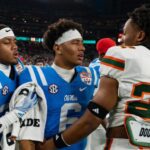
Ole Miss Quarterback Trinidad Chambliss Granted 2026 Eligibility in Landmark Court Ruling
In a stunning development that blurs the lines between collegiate athletics and the legal system, the future of Ole Miss quarterback Trinidad Chambliss has been dramatically altered. A state court judge has issued an injunction, effectively granting the signal-caller an extra year of eligibility that paves the way for him to compete for the Rebels in the 2026 season. This ruling is far more than a simple roster note; it is a seismic event that challenges the NCAA’s traditional governance, sets a complex precedent for athlete eligibility, and injects a fascinating new variable into the long-term planning of head coach Lane Kiffin’s high-octane program.
The Ruling That Rewrote the Playbook
The core of the judge’s decision hinges on an injunction against the NCAA’s eligibility clock. While specific details of the case remain under legal seal, the ruling suggests the court found compelling reason to grant Chambliss an additional year of competition. Typically, a collegiate athlete has five years to complete four seasons of eligibility, with the clock starting upon full-time enrollment. This timeline can be paused for documented medical hardships (redshirts) or, more recently, under the NCAA’s blanket COVID-19 waiver for athletes affected during the 2020-21 season.
Chambliss’s situation appears to fall outside these standard provisions, leading to the unprecedented state court intervention in NCAA eligibility. Legal experts speculate the case could involve unique circumstances such as:
- Misadvisement or administrative error that prematurely impacted his eligibility clock.
- A non-COVID medical or personal hardship deemed insufficient by the NCAA but compelling to the court.
- A challenge based on state-specific name, image, and likeness (NIL) rights laws that indirectly impacted his ability to compete.
The ruling does not simply ask the NCAA to reconsider; it forces their hand through judicial order, marking a significant shift in how athlete eligibility disputes may be settled in the future.
Immediate Impact on Ole Miss and the SEC Landscape
For Coach Lane Kiffin and the Ole Miss Rebels, this ruling is a strategic windfall. Kiffin, a master of roster construction and transfer portal navigation, now has a quarterback asset with extended developmental runway. Trinidad Chambliss, a player whose raw talent has been noted within the program, now has a dramatically altered career trajectory.
In the immediate term, this provides Ole Miss with unparalleled depth and flexibility at the sport’s most critical position. The Rebels can now manage Chambliss’s development without the pressure of a ticking eligibility clock. He can serve as a backup, gain crucial in-game experience in mop-up duty, and be groomed for a future starting role without burning a year of eligibility. This is a luxury few programs possess in the modern “win-now” environment. It also affects the transfer portal strategy for Ole Miss quarterbacks, potentially making the program more attractive to high-profile transfers knowing the long-term depth chart has been secured by judicial order.
For the SEC, it introduces a new layer of roster management complexity. Rival programs must now account for Chambliss’s presence through the 2026 season, a variable that was not on any strategic board just weeks ago. It underscores the evolving reality where off-field legal maneuvers can directly influence on-field competitive balance.
Legal Precedent and the Future of NCAA Authority
This case is arguably the most significant element of the entire saga. The judge’s injunction represents a direct challenge to the NCAA’s long-held authority as the sole arbiter of amateur athletic eligibility. While courts have intervened in NCAA matters before—most notably in cases involving athlete compensation and NIL rights—this level of involvement in a individual eligibility clock is rare, if not unprecedented.
The ruling could open the floodgates for similar eligibility lawsuits. Athletes in all sports who feel wronged by an NCAA eligibility decision may now look to state courts for remedy, especially in states with athlete-friendly legislation. This creates a potential patchwork of eligibility standards, dependent on geography and local jurisprudence, which stands in direct opposition to the NCAA’s goal of uniform national rules.
The NCAA now faces a critical choice: appeal the ruling to assert its authority, or accept it and adjust its internal processes to avoid future litigation. This case, perhaps more than any other, signals that the era of the NCAA’s unchallenged, monolithic control is not just fading—it is being actively dismantled, case by case, in courtrooms across the country.
Predictions: The Chambliss Effect Through 2026
Looking ahead, the “Chambliss Effect” will ripple through Oxford and beyond for years to come. Here are key predictions for how this saga will unfold:
- Intense Developmental Focus: With the pressure of time alleviated, Ole Miss will invest heavily in Chambliss’s technical and mental development. He transforms from a project into a long-term cornerstone of the quarterback room.
- Recruiting Ripple Effects: High school quarterback recruits considering Ole Miss will now see a potentially blocked path in 2026 and beyond. Kiffin will likely pivot to sell the opportunity to learn and develop alongside Chambliss, rather than compete directly with him immediately.
- The 2026 Season Spotlight: All narratives will lead to that season. If Chambliss seizes the starting job, every game will be framed by his unique journey through the legal system to get there. He will be one of the most talked-about players in college football.
- NCAA Rulebook Revisions: In response to this and potential future cases, the NCAA will be forced to clarify and formalize its hardship waiver processes, potentially creating more transparent avenues for appeal before legal action becomes necessary.
A New Era of Player Empowerment and Complexity
The ruling in favor of Trinidad Chambliss is a landmark moment that transcends a single player or team. It is a powerful symbol of the new era in college athletics, where athlete agency is increasingly backed by legal recourse. The playing field is no longer just between the hashmarks; it extends into courtrooms where the very rules of the game can be contested and rewritten.
For Ole Miss, it is a fortunate twist of fate that provides remarkable roster security. For the NCAA, it is a stark warning that its governance must evolve with the times, becoming more transparent and equitable. And for Trinidad Chambliss, it is a second chance, a gift of time, and an opportunity to craft a legacy that began not with a spectacular throw, but with a gavel’s fall. His journey to the 2026 season will be one of the most closely watched in college football history, a living testament to the sport’s ongoing and dramatic transformation.
Source: Based on news from ESPN.
Image: CC licensed via www.wallpaperflare.com