Uefa’s Top Refereeing Official Warns: Football Must Resist ‘Microscopic’ VAR Culture
The piercing, digital beep of the Video Assistant Referee system has become the defining soundtrack of modern football. It promises clarity but often delivers chaos, offers certainty but breeds controversy. Now, a powerful voice from within the game’s governing structure is sounding a clarion call for a fundamental philosophical shift. Roberto Rosetti, Uefa’s chief refereeing officer, has declared that football must pull back from the brink of becoming a “microscopic” forensic exercise, urging a return to the sport’s human soul.
The Forensic Fallacy: When Precision Erodes the Essence of the Game
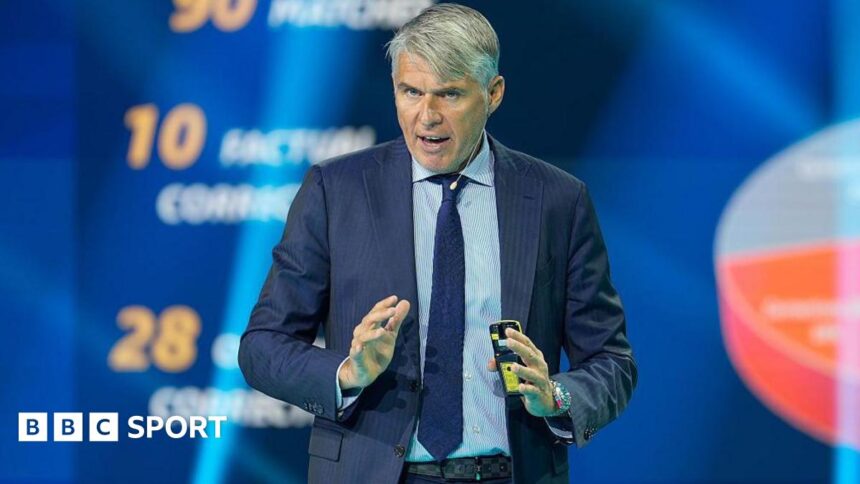
Speaking with the authority of a former elite referee and now the man overseeing officiating across Uefa’s prestigious competitions, Rosetti’s address at the Uefa Congress was a significant moment. His core argument is stark: VAR is at its best when dealing with binary, factual decisions. Did the ball cross the line? Was the attacker in an offside position? For these, technology is a powerful, uncontroversial ally.
The trouble, as Rosetti meticulously outlined, begins with subjectivity. “The game is for the players,” he implied, and when VAR intervenes to dissect every potential foul, every incidental contact, and every ambiguous handball with lab-coat precision, it strangles the flow and emotion that makes football captivating. The quest for a perfect, sterile game is, he suggests, a fool’s errand that is damaging the product. Every prolonged check for a potential penalty-box infringement transforms roaring stadiums into silent libraries of anxiety, trading raw passion for cold, clinical deliberation.
This “microscopic” approach creates a paradox: more technology and more angles can lead to less clarity and more debate, not less. When an incident is replayed dozens of times in ultra-slow motion, a minor, natural contact can be made to look like a grievous assault. The context of speed, momentum, and intent—elements a referee perceives in real-time—is lost in the digital soup.
The Handball Conundrum and the Quest for Consistency
Rosetti saved specific, pointed concern for the sport’s most vexing law: handball. He admitted that a “lot of work is needed” to find a consistent interpretation. This is a stunning admission from the top of the refereeing pyramid and highlights the core of the issue. The laws, as written, leave vast room for subjective judgment. Is the arm in a “natural position”? What constitutes “making the body bigger”?
VAR has not solved this; it has magnified the inconsistency. A decision that might have been a 50/50 call for an on-field referee is now put under a global microscope, with pundits and fans comparing it to a different incident from a different league the week before. The search for perfect consistency through technology may be impossible for inherently subjective calls. Rosetti’s call for work suggests a potential future where the law itself is simplified, moving away from forensic anatomical analysis and back towards a clearer, more intuitive understanding of deliberate action.
- Factual vs. Subjective: VAR excels on offsides and goal-line calls but struggles with fouls and handball interpretation.
- The Flow of the Game: Excessive VAR reviews disrupt match rhythm and fan engagement in stadiums.
- The “Clear and Obvious” Standard: This founding principle of VAR has been eroded by over-scrutiny.
- Global Inconsistency: Different leagues apply VAR thresholds differently, causing confusion.
The Premier League Paradox: Fewer Reviews, Same Controversy
Rosetti’s warning is underscored by a fascinating statistic. The Premier League, often considered the most intense and scrutinized league on earth, boasts the lowest VAR intervention rate in Europe’s top leagues this season—a mere 0.27 per game. This suggests a conscious effort to use the system more sparingly, theoretically aligning with Rosetti’s “less is more” philosophy.
Yet, has this lower intervention rate quelled the storms of controversy? Emphatically not. If anything, debates rage just as fiercely. Critics argue that the Premier League’s higher threshold for intervention allows “clear and obvious” errors to stand. This creates the Premier League Paradox: fewer reviews do not equal less controversy. It simply changes the nature of the complaints. The league finds itself damned if it intervenes too much and damned if it doesn’t intervene enough, trapped in a no-win narrative that frustrates clubs, players, and fans alike.
The Road Ahead: Predictions for a Post-Microscopic Era
Roberto Rosetti’s speech is not a call to abandon VAR. It is a critical intervention to redefine its purpose. Based on his direction, we can predict several potential evolutions in officiating.
First, expect a formal re-emphasis on the “clear and obvious” threshold across all competitions, possibly with stricter guidelines for VARs to discourage them from recommending reviews for borderline incidents. Second, a major simplification of the handball law is now highly likely, moving away from punishing accidental contact and towards a standard more easily understood by players, officials, and fans.
Technologically, we may see a push for faster decision-making processes—limiting the number of camera angles or replays a VAR can use for subjective calls to prevent endless forensic loops. Furthermore, Uefa could champion a more unified European approach to VAR application, reducing the current glaring differences between domestic leagues and their continental competitions.
Conclusion: Reclaiming the Heartbeat of Football
Roberto Rosetti has articulated the growing unease felt by millions of football lovers. The game is not a science experiment; it is a human drama played with intense emotion at breakneck speed. VAR was introduced as a safety net for egregious mistakes, not as a tool to re-referee every moment of contact. By warning against a “microscopic” culture, Rosetti is advocating for a restoration of balance.
The future of VAR must lie in robust support for on-field referees, not in their slow-motion replacement. It must prioritize the flow and feeling of the match alongside the pursuit of accuracy. The goal is not a perfectly officiated game—an impossibility—but a fairly officiated one that preserves the sport’s exhilarating, unpredictable, and beautifully human spirit. The whistle must breathe again, and the heart of the game must be allowed to beat, unchecked by constant digital interruption.
Source: Based on news from BBC Sport.