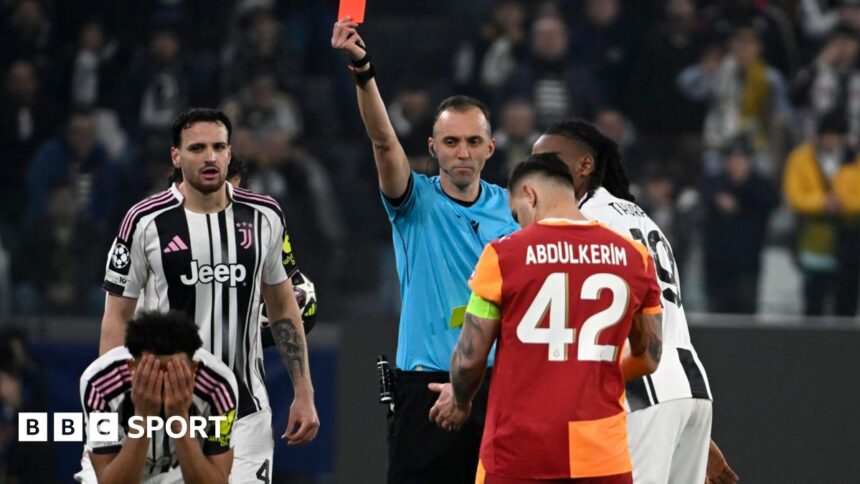
Bizarre VAR? Why Kelly’s Second Yellow Became an ‘Awful’ Straight Red
The Video Assistant Referee was introduced to eliminate the “clear and obvious error.” Yet, in a dizzying sequence during Juventus’s Europa League knockout clash with Galatasaray, VAR instead authored a moment of pure, unadulterated confusion. Lloyd Kelly’s journey from a second yellow card to a straight red, via a pitchside monitor, wasn’t just a pivotal moment in the tie—it was a case study in how the quest for technical accuracy can sometimes create a monumental procedural mess.
The Incident: A Rapid Descent into Chaos
The scene was the Allianz Stadium. Juventus, defending a slender aggregate lead, saw defender Lloyd Kelly commit a foul on Galatasaray’s Baris Yilmaz. Referee Joao Pinheiro deemed it a bookable offense, showing Kelly his second yellow card followed by the inevitable red. The decision was made, the player’s fate seemingly sealed. Then, the familiar signal. Pinheiro drew the imaginary box, indicating a VAR review was in progress. A murmur went through the crowd. For Juventus fans, hope: perhaps the initial foul was being rescinded entirely. What followed was a twist no one fully anticipated.
After a brief consultation at the pitchside monitor, Pinheiro returned. But he did not withdraw the card. Instead, he canceled the second yellow and brandished a *straight* red card. Kelly, who had been sent off for two cautions, was now sent off for a single, serious foul. The offense was upgraded from a tactical infringement to an act of denying an obvious goal-scoring opportunity (DOGSO). The outcome for Kelly and his team was identical—dismissal—but the rationale and the precedent set were profoundly different.
Pundit Panic: Dissecting an “Awful” Precedent
The reaction from analysts was swift and critical. BBC pundits, dissecting the footage, labeled the decision “awful” and “confusing.” Their critique centered not necessarily on the final color of the card, but on the bizarre VAR intervention that led to it. The core issues they highlighted include:
- Violation of the “Clear and Obvious” Threshold: VAR is meant to intervene only for blatant mistakes. If the foul was indeed a DOGSO, it raises the question of why the on-field referee did not see it as such initially. If it was *not* a clear DOGSO, then VAR overstepped by re-refereeing the incident to a microscopic degree.
- The Illusion of a “Softer” Punishment: Upgrading to a straight red feels like a harsher punishment, but in practical terms, it can be softer. A red card for two yellows results in a one-match ban. A straight red for DOGSO also typically results in a one-match ban. However, the player’s disciplinary tally is affected differently, creating a statistical distortion.
- Erosion of On-Field Authority: The sequence saw the referee overturn his own *type* of decision after being sent to the screen. This creates a surreal scenario where the official is effectively arguing against his own initial judgment call, not just correcting a factual error like an offside.
“The process looked broken,” one pundit summarized. “It created a situation where the referee’s first decision was wrong, his second decision was wrong, and only the third—after a video review—was deemed right. That’s not a system building confidence; it’s one creating serial doubt.”
The Systemic Glitch: When Protocol Creates Paradox
This incident exposes a rare but critical flaw in the VAR protocol. The system is brilliantly engineered for binary decisions: was the player offside? Did the ball cross the line? Was the contact inside or outside the box? It struggles immensely with subjective, graduated decisions like foul severity.
Herein lies the paradox. The referee gave a yellow, suggesting he saw a foul but not a red-card offense. VAR, perhaps believing the foul met the threshold for DOGSO, recommended a review. But by the letter of the law, the referee cannot simply add a second yellow via VAR; he must reconsider the entire nature of the foul. The only logical endpoint, if he agrees with VAR, is a straight red. Thus, the system forced a procedural contortion—turning two yellows into a red—to reach what it believed was the correct substantive outcome.
The psychological impact on players, coaches, and fans is significant. They witness a reversal that changes the *reason* for a dismissal but not the consequence, making the entire review process feel arcane and detached from the visceral understanding of the game.
Future Implications: A Warning for the Game
This is not a mere one-off controversy. It sets a troubling template that could have wider ramifications:
- Tactical Fouling in Limbo: Defenders will now be unsure of the calculus. A tactical foul, traditionally a yellow, could be retrospectively examined and upgraded to a straight red if a VAR official deems it DOGSO, even if the on-field referee didn’t.
- Review Creep: It opens the door for more subjective re-refereeing of cautionable offenses, slowing the game down as officials try to calibrate the exact shade of every foul.
- Focus on Process Over Outcome: The Kelly incident will be cited in future referee training and VAR protocol meetings. It highlights the need for clearer communication lines between the VAR and the referee, specifically on the *category* of offense being reviewed.
Predictions for the game’s laws are difficult, but this incident may accelerate discussions about the distinction between yellow and red card offenses in the context of VAR. We may see further clarifications that a yellow card decision for a foul cannot be upgraded to a red for DOGSO unless the on-field referee has completely missed the incident entirely—a much higher bar for intervention.
Conclusion: Clarity Sacrificed on the Altar of Precision
The Lloyd Kelly red card saga is a perfect storm of correct procedure leading to a perplexing outcome. In its zeal to use technology to find the “right” decision, the system produced a moment that felt overwhelmingly *wrong* to those watching. It sacrificed clarity, momentum, and intuitive understanding for a technical precision that, in the end, changed the label on the dismissal but not the result.
While VAR has solved many problems, this bizarre sequence in Turin is a stark reminder that football is not a series of binary data points. It is a fluid, human game of judgment. When technology intervenes to recalibrate a subjective judgment with another subjective judgment, but via a different procedural route, it risks alienating the very people it is designed to serve. The sight of Joao Pinheiro changing his mind from yellow to red may have been legally justifiable, but for the integrity of the game’s flow and feel, it was, as the pundits called it, simply awful.
Source: Based on news from BBC Sport.