Andrew Musgrave’s Gritty Sixth: A Vomit, A Viking, and a Historic British Best
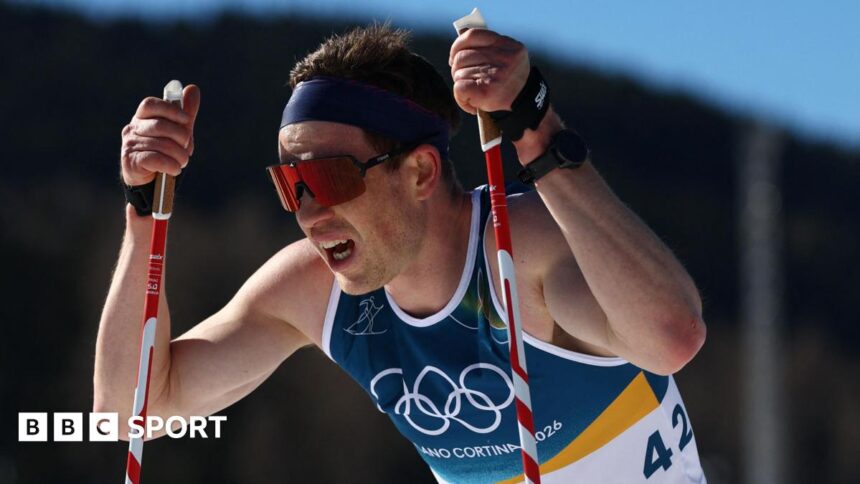
The image was as raw as it gets. Andrew Musgrave, draped in the Union Jack, his face etched with the agony of total expenditure, had to turn from a post-race interview to be violently sick. In the sanitized world of modern sport, this was an unfiltered monument to effort. At his fifth Winter Olympics, the 35-year-old Scot didn’t just compete in the men’s 10km freestyle; he waged a war of attrition against the elements, a Nordic dynasty, and his own physical limits, emerging with a historic and hard-earned sixth place—the best-ever British finish in Olympic cross-country skiing.
The Tesero Crucible: Where Heat Met Heart
Cross-country skiing in the Italian Dolomites is not supposed to be a battle against heat. Yet, in Tesero, the sun beat down on the frozen tracks, creating a paradoxical and punishing environment. For an athlete whose training is forged in the cold of Norway and Scotland, this presented a unique physiological challenge. The 10km interval start freestyle is a brutal test of sustained power and pacing, a 25-minute maximal effort where every second and every heartbeat counts. Musgrave’s strategy was precision itself, but even the best-laid plans can melt under an Italian sun.
“I went out, did the first two laps super well and everything went to plan,” Musgrave recounted to the BBC. His opening splits were competitive, placing him in the medal conversation. However, the cumulative effect of the heat began to rewrite the script. As his body fought to cool itself, precious energy was diverted, and the searing pace became unsustainable. The final lap transformed from a race to a testament of pure will, a fight to hold onto the position his early excellence had earned.
The Norwegian Wall: An Inevitable Obstacle
If the heat was one formidable opponent, the starting list presented another: the Norwegian armada. Cross-country skiing is Norway’s national pastime, and their depth is unparalleled. On this day, they didn’t just field skiers; they deployed a phalanx of gold-medal favorites. To podium, Musgrave wouldn’t just need a perfect day; he would need to slay multiple Vikings. In the end, the Norwegians executed a familiar dominance, sweeping the podium with Johannes Høsflot Klæbo taking gold.
Musgrave’s analysis was tinged with the realism of a veteran who knows the landscape. He reckoned he could have finished fourth, but too much heat and too many Norwegians counted against him. This blunt assessment isn’t an excuse but a factual reading of the race dynamics. Beating one world-class Norwegian on a good day is a monumental task; overhauling a trio of them, in conditions that favored their explosive power, was a bridge too far. His sixth place, therefore, stands as a monumental achievement—best of the rest in a race owned by the sport’s superpower.
Anatomy of a Historic Performance
To understand the scale of Musgrave’s accomplishment, one must contextualize British cross-country skiing. It is a discipline with minimal tradition, funding, or infrastructure in the UK. Musgrave’s entire career has been an act of defiant pioneering. His sixth-place finish shatters the previous British best of 13th, a gap that in Olympic terms is a chasm.
- Unprecedented Consistency: Competing at a fifth Olympics is a rare feat of longevity, especially in a grueling endurance sport.
- Technical Mastery: The freestyle technique requires immense power and efficiency; Musgrave’s time indicates a world-class level of ski preparation and fitness.
- Mental Fortitude: To push through the debilitating distress evident at the finish line requires a mindset few possess. The vomit wasn’t a sign of weakness, but a badge of honor.
His philosophical post-race summary—“Besides, fourth doesn’t afford you a medal anyway, so sixth means just the same”—reveals the mindset of an athlete who came to win, but who can also appreciate the historic value of his performance. It’s the perspective of a man who has seen it all, from the anonymity of early Games to the precipice of the Olympic podium.
The Legacy and What Comes Next for British Skiing
Andrew Musgrave’s performance in Tesero is more than a personal best; it is a beacon for British winter sports. It proves that with singular dedication and the right environment—Musgrave lives and trains in Norway—world-class results are possible, even in the most unlikely of disciplines. He has redefined what is achievable.
Looking ahead, the impact could be significant. While Musgrave may contemplate his future at 35, his legacy is secure. He has laid down a marker that will inspire the next generation. The challenge for British skiing’s governing bodies will be to harness this momentum, to invest in pathways that allow future Musgraves to emerge without having to relocate to Scandinavia to find competition.
Predictions for the sport’s future in Britain now carry more weight. We can expect increased media attention for cross-country events, greater interest from young athletes, and perhaps, crucially, a more compelling case for funding. Musgrave has done the hardest part: he has shown it can be done. The question is no longer “if” a British cross-country skier can mix it with the best, but “when” the next one will join him at that elite level.
Conclusion: The Price of History
Andrew Musgrave’s Olympic story did not end with a medal around his neck. It ended with his head over a barrier, his body screaming in protest after giving absolutely everything. In that visceral, unglamorous moment, he captured the true essence of Olympic spirit—not just the triumph, but the sacrifice. His sixth place is a British landmark, a result forged against the heat of Italy and the cold dominance of Norway. He is the pioneer who pushed the frontier, proving that a kid from Huntly can stand, or stagger, among the giants of the snow. His legacy is not measured in precious metal, but in the sweat, the sickness, and the undeniable proof that British cross-country skiing has finally, and indelibly, arrived on the map.
Source: Based on news from BBC Sport.