Borthwick’s Balancing Act: Defiance Amid England’s Six Nations Slide
The air in the England camp is thick with a curious, conflicting aroma. It carries the sharp, acrid scent of two consecutive, chastening Six Nations defeats, blended with the steady, almost zen-like calm emanating from head coach Steve Borthwick. As the tournament reaches its pivotal final stretch, England finds itself in a familiar, uncomfortable purgatory: title hopes extinguished, wooden spoon fears (mathematically) allayed, and a fundamental identity crisis laid bare for all to see. The question is no longer about winning the championship, but about salvaging pride and deciphering a path forward from the rubble of a campaign that promised so much more.
The Stark Reality: An Attack in Stasis, A Defence in Regression
To diagnose England’s ailment, one need not be a tactical savant. The statistics scream the diagnosis. England’s attack has been, in a word, anemic. With just eight tries in four matches—a tally bolstered by a late flurry against a broken Wales—they are the lowest try-scorers of the top four nations. The fluency and incisiveness that flickered in the World Cup has vanished, replaced by a pattern of lateral movement, slow ruck speed, and a palpable lack of clarity in the red zone. The midfield, despite its wealth of individual talent, has failed to fire, leaving a back three featuring the electric Immanuel Feyi-Waboso and Tommy Freeman starved of meaningful front-foot ball.
Conversely, and perhaps more damningly for a Borthwick team built on foundation, is the disintegration of their defensive structure. The famed ‘Wolfpack’ defence, so formidable in the World Cup, has sprung leaks from all angles. They have conceded a staggering 14 tries—more than any other team in the championship, including Italy and Wales. The systemic failures, from missed one-on-one tackles to disorganised wide-channel cover, point to a deeper issue than mere execution.
- Points For: 103 (4th in the tournament)
- Points Against: 120 (Highest in the tournament)
- Tries Scored: 8
- Tries Conceded: 14
This dual regression—an attack failing to evolve and a defence forgetting its core principles—creates a perfect storm of underperformance. It is the obvious answer to the question of what has gone wrong, yet solving it mid-tournament has proven beyond the current setup.
The Borthwick Paradox: Project Calm in the Eye of the Storm
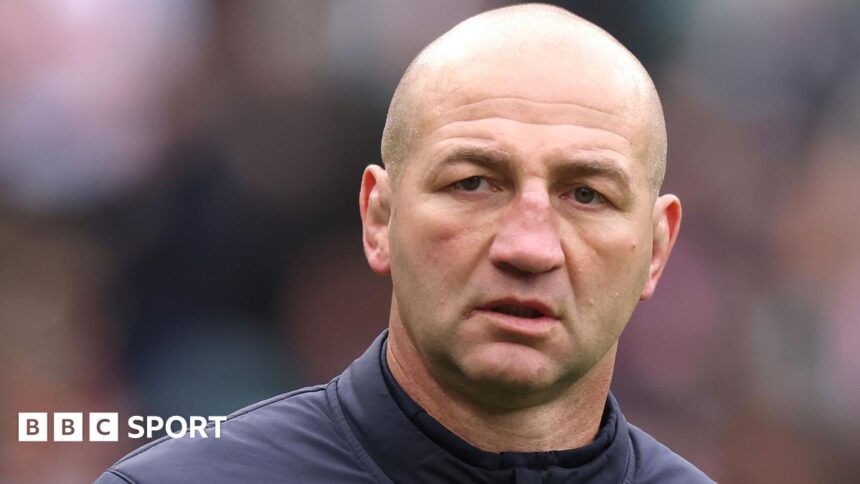
In the face of this, Steve Borthwick’s public demeanour has been a study in controlled defiance. There is no visible panic, no public recrimination of players. Instead, his press conferences have become masterclasses in measured rhetoric, focusing on “incremental growth,” “learning lessons,” and the need for “precision.” This Borthwick defiance is a deliberate strategy. He is projecting stability to protect a young, developing squad from the external cyclone of criticism.
However, this relaxed exterior belies the intense pressure he must be under. The RFU’s post-World World Cup faith was a mandate for progression in this Six Nations. While no one expected a Grand Slam, the nature of the losses—a record home defeat to Scotland and a comprehensive, error-strewn dismantling by Ireland—has shaken the confidence of the fanbase. Borthwick is effectively asking for patience and trust while the results chart a steep decline. It is a high-wire act: is his calm a sign of a long-term visionary, or a coach struggling to find immediate solutions?
His selections tell a story of searching. The integration of Feyi-Waboso is a bright spot, a clear win for future planning. Yet, the continual reshuffling at fly-half and centre, and the ongoing quest for a balanced back row, suggest a planner who is still piecing his puzzle together, even two years into the job. The Six Nations slide has exposed that process as being more painful and public than anticipated.
Crunch Time in Lyon: The France Fixture as Litmus Test
England’s final assignment, away to a resurgent France in Lyon, is no dead rubber. It is the ultimate litmus test for Borthwick’s project and his squad’s character. France, stung by their own shortcomings, will be a ferocious beast at home. For England, this is about more than avoiding a third straight loss or securing second place.
It is a chance to demonstrate that the learning lessons Borthwick speaks of are being absorbed. The performance must answer critical questions:
- Can the attack find a clinical edge and convert pressure into points?
- Will the defence rediscover its collective grit and organisation?
- Can the leadership group, led by Jamie George, impose their will when the hostile French crowd reaches a crescendo?
A courageous, coherent performance—even in defeat—could provide a kernel of hope to build upon for the summer tour to Japan and New Zealand. Another fragmented, error-riddled display, however, would cement this campaign as a definitive step backwards and intensify the scrutiny on Borthwick’s entire regime to an almost unbearable degree.
The Road Ahead: Rebuilding Trust or Facing a Crossroads?
The final whistle in Lyon will not end the inquest. This Six Nations has fundamentally altered the trajectory of England’s post-World Cup cycle. The optimism of autumn has been replaced by a fog of uncertainty. The challenge for Borthwick is now twofold: rectify the glaring tactical issues and rebuild the eroded trust with a disillusioned support base.
This requires more than a relaxed demeanour. It demands decisive action. The summer tour must be used to solidify a playing identity, making hard calls on key positions and doubling down on a cohesive game plan. The Autumn Nations Series will then be the judge; the patience of the rugby public is not infinite.
Steve Borthwick remains defiant in his belief in the long-term plan. He is relaxed in the face of the storm, a captain determined to steady his ship. But the Six Nations table does not lie. England are adrift, caught between the team they were and the team they aspire to be. The final match against France is not just for points; it is for proof. Proof that the slide can be arrested, that the plan has merit, and that this period of pain is a prelude to progress, not a permanent state of affairs. The calm may persist in the coach’s box, but out on the pitch in Lyon, England must finally play with the fire that has been so conspicuously absent.
Source: Based on news from BBC Sport.