Klaebo Enters Immortality: Norwegian Phenom Ties Olympic Gold Record with Masterful 10km Victory
The paradox of Johannes Høsflot Klæbo is that his greatest perceived weakness is, in fact, the canvas upon which he paints his most brilliant masterpieces. The Norwegian cross-country superstar, a whirlwind of explosive power and tactical cunning, has long professed a respectful dread of the solitary battle against the clock. Yet, under the warm Italian sun at the Milan Cortina Games, it was in precisely that discipline—the grueling, lonely 10-kilometer interval start—that he skied his way into the pantheon of Olympic gods.
A Surge for the Ages: Klæbo’s Calculated Conquest
On a day where temperatures in Cortina d’Ampezzo softened snow and led some competitors to shed their race suits for mere bibs, Klæbo executed a race of perfect patience and devastating finality. His winning time of 20:36.2 was not just a number; it was the culmination of a strategic blueprint. Over the first half of the Tesero course, he was measured, hovering near but not atop the leaderboard. It was a controlled burn, conserving energy for the inferno to come.
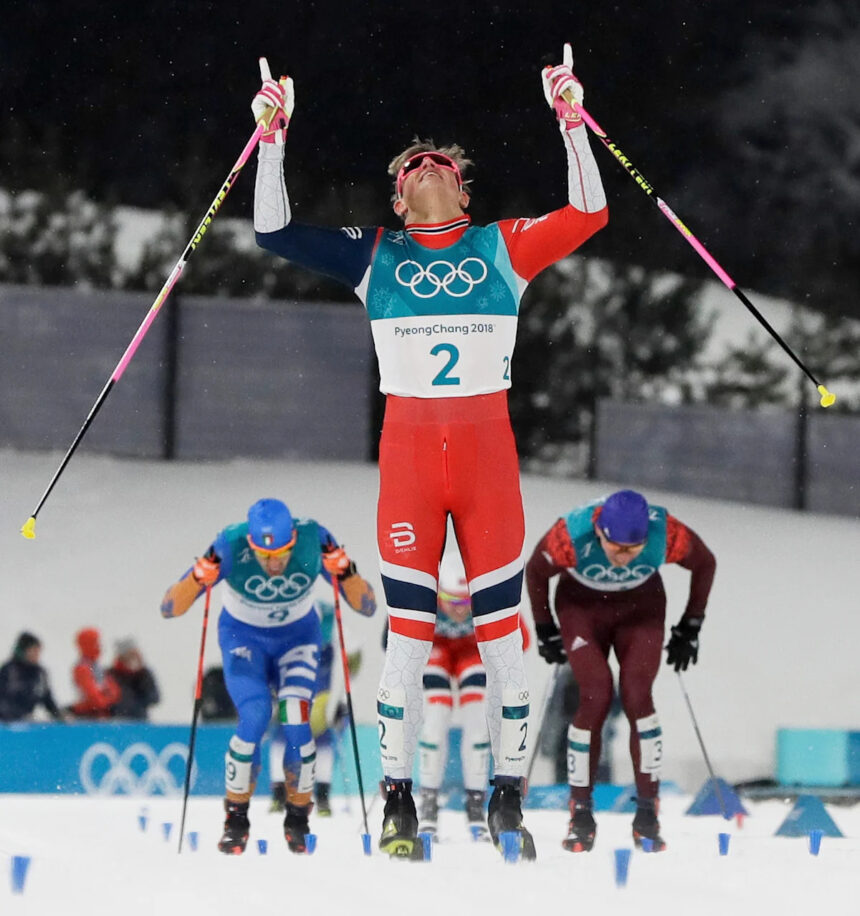
Then, as if a switch was flipped, the Klæbo surge—a phenomenon that has broken the spirits of rivals in countless sprint finishes—manifested in a time trial. His final 2.5-kilometer lap was a breathtaking display of power and technique, gaining over eight seconds on his closest pursuers. The victory was so total, so physically draining, that upon crossing the line, the 29-year-old collapsed into the snow, a spent champion acknowledging the monumental effort required to make history look so effortless.
Joining the Norwegian Mount Rushmore
This was not just another gold medal. This was career Olympic gold medal number eight, a figure that ties him with three legends of Norwegian winter sport: cross-country icons Marit Bjørgen and Bjørn Dæhlie, and biathlon king Ole Einar Bjørndalen. With this victory, Klæbo has shattered the boundary between eras, linking his name to the all-time greats whose records seemed untouchable.
The significance of this tie is profound. Bjørgen and Dæhlie are the undisputed royalty of cross-country skiing, their medal hauls built over multiple Olympic cycles. Bjørndalen’s achievement across the shooting range and ski track was considered a unique feat of biathlon dominance. Klæbo, with his blend of sprint prowess and now proven distance capability, has forged a legacy of similar weight in real-time.
- Johannes Høsflot Klæbo: 8 Golds (and counting), 3 Olympic Games.
- Marit Bjørgen: 8 Golds, 15 total medals, 5 Olympic Games.
- Bjørn Dæhlie: 8 Golds, 12 total medals, 3 Olympic Games.
- Ole Einar Bjørndalen: 8 Golds, 13 total medals, 6 Olympic Games.
Klæbo’s path has been different—a torrent of success concentrated in a shorter period, a testament to his unparalleled peak performance.
The Inevitable Ninth: What’s Next for a Legend in Motion
The most terrifying prospect for his competitors is that this historic tie is almost certainly temporary. Klæbo is scheduled to compete three more times at these Games. The record for most Olympic gold medals at the Winter Games, currently a four-way tie, is now his primary target. Analysis of his remaining events suggests the solo record is not a matter of “if,” but “when.”
His remaining program includes the Team Sprint and the 4x10km Relay, two events where Norway, anchored by Klæbo, are formidable favorites. Each presents a fresh opportunity for gold. Furthermore, his form indicates that even in other events, he will be a podium threat. The sporting world is now witnessing an active pursuit of history, a champion using every race as a stepping stone toward undisputed statistical supremacy.
This pursuit changes the narrative of the entire Milan Cortina Olympics. Every subsequent start for Klæbo is no longer just about winning a race; it is about cementing his status as the greatest Winter Olympian of all time. The pressure is immense, but if his 10km performance showed anything, it’s that Klæbo thrives under the weight of expectation, transforming pressure into pure, propulsive speed.
More Than a Record: The Klæbo Effect on the Sport
Klæbo’s achievement transcends numbers. He has revolutionized cross-country skiing, bringing a rockstar athleticism and charismatic intensity to a sport steeped in tradition. His starts are explosive, his finishes dramatic, and his willingness to engage in tactical skirmishes has made every race he enters must-watch television. He has forced a generation of skiers to adapt to his power, elevating the entire competitive landscape.
His confessed struggle with the 10km makes this gold all the more meaningful. It demonstrates a champion’s evolution. He is no longer just the sprint prodigy who burst onto the scene in PyeongChang 2018; he is a complete skier, capable of winning any race, any style, on any day. This victory is a testament to his work ethic and his team’s ability to hone his raw power into a weapon effective over varied terrains and distances.
The collapse in the snow after the finish line was the perfect postscript. It was the unvarnished truth of Olympic glory—a mix of utter exhaustion and sublime triumph. It was the image of a man who had given everything to join legends and now, with history within his grasp, allowed himself a moment of vulnerable celebration before the chase for the outright record begins anew.
Johannes Høsflot Klæbo stands on the precipice of singular greatness. His eighth gold medal was a statement of completeness and a bridge to history. The Olympic record book has a temporary logjam at the top, but the Norwegian hurricane in bib number one is just getting started. The world now watches, waits, and expects the imminent crowning of the Winter Games’ most decorated champion. The final chapter of this historic pursuit is his to write.
Source: Based on news from Yahoo Sports.