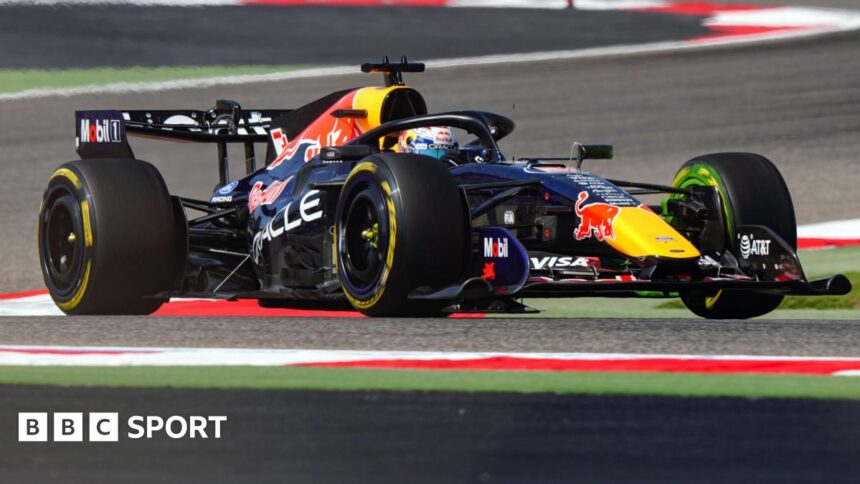
Hiding Pace or Genuine Concern? Decoding the Drama of F1’s Bahrain Pre-Season Test
The desert winds of Bahrain’s Sakhir circuit carried more than just sand during Formula 1’s first pre-season test. They carried whispers of revolution, barbs between champions, and a fundamental question about the soul of the sport itself. As the new generation of ground-effect cars, now powered by heavily revised power units, took to the track, the narrative fractured. Was this a tactical masquerade, with teams—especially the ominous Red Bull—hiding their true pace? Or had the new technical era genuinely slowed F1 to a frustrating crawl? The answer, as ever in testing, lies somewhere in the haze of data and driver sentiment.
The Red Bull Revolution: A New Beast Awakens?
All eyes were on the garage of the reigning constructors’ champions. For the first time in the hybrid era, Red Bull is running a power unit built in-house under the banner of Red Bull Ford Powertrains. This is a monumental undertaking, shifting from a customer to a manufacturer overnight. The key question wasn’t just about reliability—which appeared solid—but about performance philosophy.
Observers noted the RB20’s engine note was distinctly different, often described as smoother or more muted than the previous Honda-derived unit. While lap times are notoriously misleading in testing, the car’s consistency and lack of major drama were telling. Max Verstappen completed long runs with metronomic stability. The team’s focus was clearly on systems checks, data harvesting, and understanding the new power unit’s mapping in conjunction with the car’s revised aerodynamics. This is the hallmark of a team with supreme confidence, not one scrambling for pace. The early verdict? Red Bull isn’t hiding weakness; they are meticulously calibrating a weapon whose full potential remains deliberately sheathed.
Verstappen vs. Norris: A Clash of Philosophies
The most explosive storyline emerged not from the timing screens, but from the drivers’ mouths. Max Verstappen, the sport’s dominant force, launched a startling critique of the new driving experience. His complaint centered on the increased complexity of the 2026-spec power units, which place a heavier emphasis on energy recovery and deployment management.
“As a pure driver, I enjoy driving flat out,” Verstappen said. “And at the moment, you cannot drive like that. A lot of what you do as a driver, in terms of inputs, has a massive effect on the energy side of things. For me, that’s just not Formula 1.”
This stark assessment paints a picture of a sport where the cerebral challenge of energy management overshadows the visceral thrill of outright attack. It’s a sentiment that resonates with purists who fear F1 is becoming a high-speed efficiency contest.
Enter Lando Norris. The McLaren driver, fresh from a championship battle with Verstappen, offered a diametrically opposed view. He found the new cars “a lot of fun,” praising their responsiveness and the fresh challenge. His retort to Verstappen was as pointed as it was simple: if the Dutchman doesn’t like it, he’s welcome to race elsewhere.
This clash reveals a fascinating divide:
- The Purist vs. The Pragmatist: Verstappen champions unadulterated, foot-to-the-floor racing. Norris embraces the evolving, multi-layered technical challenge.
- Mindset of a Champion: Verstappen’s frustration may stem from a desire to push a dominant car to its absolute limit, a limit now defined by software as much as physics.
- A New Competitive Layer: Norris, perhaps sensing an opportunity, sees mastering these new systems as a potential equalizer against Red Bull’s raw pace.
Reading the Tea Leaves: What the Times Did (and Didn’t) Show
Pre-season testing is a festival of misdirection. Fuel loads, engine modes, and run plans are state secrets. However, informed analysis can separate signal from noise.
Red Bull’s RB20 looked planted, predictable, and instantly drivable—a terrifying prospect for rivals. Ferrari showed flashes of strong single-lap pace but continued their historical trend of question marks over long-run tire degradation. Mercedes appeared to have solved the fundamental “diva” characteristics of its previous cars, with George Russell reporting a much more stable platform. Aston Martin and McLaren looked closely matched in what appears to be a ferociously tight midfield battle.
The most significant takeaway wasn’t who topped the timesheets, but the broader performance envelope. Lap times were, on average, several seconds slower than qualifying poles from 2023. This confirms that the new technical regulations—aimed at reducing downforce and making the cars more efficient—have had the intended effect of slowing the cars down. Verstappen’s complaint is validated by the stopwatch; these cars are indeed slower. The debate is whether that’s a problem.
Predictions for Bahrain and Beyond: A Season of Two Battles
Based on the Bahrain test, the opening chapter of the 2025 season is set to be compelling.
1. The Sharp End: Expect Red Bull to arrive at the first race with a significant performance advantage. Their test was too serene, too focused. They are ahead in the development race. The real battle here may be internal, between Verstappen’s frustration with the machinery and his relentless will to win.
2. The Best of the Rest: A titanic fight is brewing between Ferrari, Mercedes, and potentially a resurgent McLaren for the podium places. The team that best optimizes their energy management over a race stint will gain a crucial edge. This is where Norris’s enthusiasm could pay dividends.
3. The Narrative War: The Verstappen-Norris rivalry has added a compelling psychological layer. If Red Bull is dominant, Verstappen’s complaints will grow louder. If McLaren or others close the gap through superior system management, his critique will be seen as prophetic. This philosophical debate will run all season.
Conclusion: Management or Mayhem? The Future is Now
The Bahrain pre-season test did more than shake down new cars; it shook the sport’s foundations. The revelation is that Formula 1 is at a crossroads. The Red Bull Ford engine project has passed its first quiet, confident exam. The cars are unequivocally slower and more complex to drive, validating Max Verstappen’s concerns about over-management. Yet, in that complexity, drivers like Lando Norris see a new frontier of competition.
Are teams hiding pace? Undoubtedly. But the deeper truth is that the very definition of “pace” has changed. It is no longer just about aerodynamic downforce and horsepower; it is about silicon-chip efficiency, strategic energy deployment, and a driver’s ability to be a systems manager as much as a racer. The 2025 season promises a fascinating dual narrative: a likely championship duel defined by technical supremacy, and an existential debate about the heart of Formula 1. The lights go out in Bahrain next week not just on a new season, but on a new era where every overtake will be a calculation, and every victory a masterpiece of management. The purists may wince, but the strategists are grinning.
Source: Based on news from BBC Sport.