Olympic Ice Ignites: Inside the Canada-Sweden Curling ‘Double-Tap’ Duel at Milano Cortina 2026
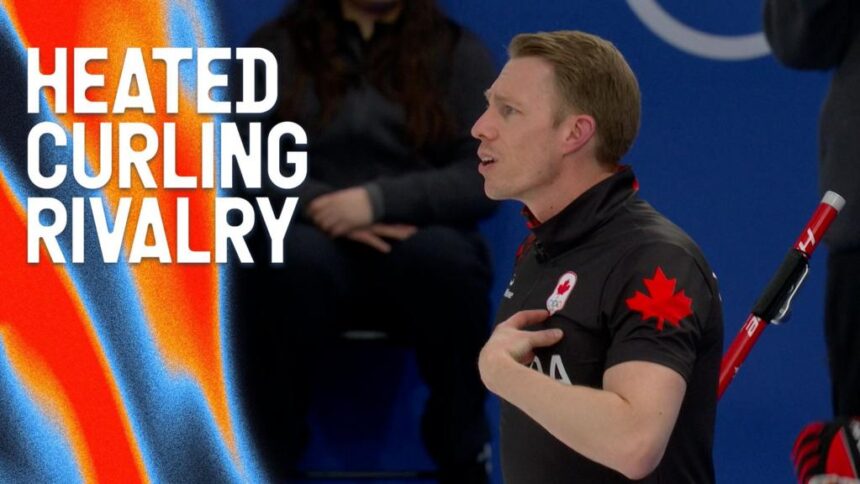
The pristine silence of the curling sheet, usually broken only by the roar of a brush and the slide of granite, was shattered by something far more volatile at the 2026 Winter Olympics: a fierce, finger-pointing dispute over the sport’s most minute technicality. In a moment that instantly went viral, the gentlemanly veneer of curling was peeled back to reveal a core of white-hot Olympic competition, as Sweden’s Oskar Eriksson and Canada’s Marc Kennedy engaged in a tense, public argument that has become the defining controversy of the tournament. The accusation? That the Canadian team was illicitly “double-tapping” their stones—a charge that strikes at the very heart of curling’s integrity and has sparked a global debate on sportsmanship, rules, and the pressure-cooker environment of the Games.
Anatomy of an On-Ice Explosion: What is “Double-Tapping”?
To the casual observer, the accusation might seem arcane. But in elite curling, the “double-tap” or “double-burn” is a serious infraction. It occurs when a player, while delivering a stone, accidentally makes contact with the granite with their hand or broom a second time after the initial push-off from the hack. This fleeting, often imperceptible touch can minutely alter the stone’s trajectory or rotation, potentially turning a missed shot into a made one. The rule exists to ensure the stone’s journey is pure from release to finish. Evidence in such cases is almost exclusively visual, relying on the sharp eyes of opponents and officials, often requiring high-definition, slow-motion replay to confirm—a technological crutch not always immediately available in the heat of battle.
The incident erupted during a critical juncture in the pivotal round-robin match. With playoff implications hanging on every stone, the Swedish team, led by the seasoned Eriksson, noticed what they believed was a pattern from the Canadian deliveries. After a particular Canadian stone curled suspiciously favorably around a guard, the Swedes called for a measurement and confronted the officials. What followed was a tense standoff between skip Eriksson and Canadian vice-skip Kennedy, their faces etched with frustration as words were exchanged centimeters from the Olympic rings on the ice. While the full transcript remains between them, the body language spoke volumes: pointed fingers, dismissive shakes of the head, and the palpable fury of athletes who believe the fundamental fairness of their contest is in jeopardy.
Expert Analysis: Gamesmanship, Pressure, and the Curling Code
We spoke to several former Olympic curlers and analysts, who requested anonymity due to the ongoing sensitivity of the event, to dissect the layers of this conflict. The consensus is that this was more than a simple rules query; it was a collision of culture, pressure, and the unwritten “Spirit of Curling.”
- The Psychological Gambit: “Accusing a team of double-tapping is one of the strongest charges you can make,” one analyst noted. “It implies not just a mistake, but a pattern of potentially gaining an advantage. In a tight game, it can be a tactical move to disrupt the rhythm and confidence of your opponent’s shooter.”
- The Pressure of the Olympic Stage: At the Olympics, where a single shot can define a career, the margin for error—and perceived error—vanishes. “Every muscle twitch is magnified under those lights,” said a former skip. “Players are so finely tuned that a micro-tap they’d never feel in a club game feels huge. The Swedes weren’t just watching the stone; they were laser-focused on the Canadian’s delivery hand.”
- A Clash of Interpretation: The experts also highlighted the subjective nature of the call. “What looks like a double-tap on one camera angle can be a shadow or an optical illusion from another. Without immediate, irrefutable proof, it becomes a ‘he-said, she-said’ rooted in trust. And at this level, that trust is fragile.”
The unwritten “Spirit of Curling”—the sport’s celebrated ethos of self-officiation and honor—was undeniably strained. The public confrontation broke from the tradition of polite, private consultation. This shift signals a new, more cutthroat era where Olympic medals outweigh old-world courtesy.
Ripple Effects: Predictions for the Rest of the Games and Beyond
This controversy is not an isolated ice chip. It will have profound repercussions for the remainder of the Olympic tournament and the future of the sport.
Immediate Fallout: For the teams involved, the psychological warfare has been escalated. Every Canadian stone delivered for the rest of the tournament will be under a microscope, not just from Sweden, but from every other team. This can either bind the Canadian squad tighter or become a debilitating distraction. For Sweden, they have publicly drawn their line in the ice. They have positioned themselves as the enforcers of purity, a stance that could rally them or paint a target on their backs.
Long-Term Implications: This incident will inevitably accelerate calls for real-time, automated sensor technology on stones. Imagine micro-sensors in the handle or embedded in the ice sheet that can detect unauthorized contact definitively. The sport’s governing body, the World Curling Federation, will face increased pressure to invest in such systems to remove human doubt and preserve the sport’s integrity from future scandal. Furthermore, we can expect a renewed emphasis on delivery technique at the highest levels, with coaches using ultra-high-speed cameras to eliminate any hint of a flaw that could be misconstrued.
A Line in the Ice: The New Cold War in Curling
The “double-tap” duel between Canada and Sweden at the 2026 Olympics is a watershed moment. It proves that no sport, no matter how polite its reputation, is immune to the fractious pressure of the Olympic quest for gold. This was not a breach of etiquette; it was a fundamental dispute over the fairness of the contest itself. While the officials may have made a ruling in the moment, the court of public opinion and sporting history is still in session.
The incident has torn away a comfortable myth about curling, revealing it for what it truly is at the Olympic level: a ferociously competitive, technically precise, and psychologically brutal battle where microns matter and trust is the first casualty. The legacy of the Milano Cortina curling controversy will be a sport forced to look in the mirror. It must now decide how to balance its cherished spirit with the unforgiving, technology-driven demands of modern elite competition. One thing is certain: the sound of that argument on the ice will echo far longer than the roar for any gold medal, changing the “Roaring Game” forever.
Source: Based on news from BBC Sport.