Collin Morikawa’s Pebble Beach Triumph: A Dream Realized Amidst 18th Hole Chaos
The walk up the 18th fairway at Pebble Beach Golf Links is the sport’s most iconic victory lap. For Collin Morikawa, it was a path he had walked a thousand times in his mind. On Sunday, as the Pacific mist swirled, that mental rehearsal collided with a bizarre and controversial reality. Morikawa’s long-awaited return to the winner’s circle at the AT&T Pebble Beach Pro-Am was not sealed with a majestic approach or a curling putt, but amidst a surreal rules imbroglio involving an opponent, a beach, and a block of ice. This was a victory forged in mental fortitude, a testament to a refined process, and a coronation momentarily frozen in confusion.
The Vision and the Validation
For over two years, the narrative around Collin Morikawa had shifted. No longer was he the young phenom who collected two major championships with robotic ball-striking. The questions centered on putting, on closing, on when—or if—he would win again. Morikawa’s response was not public frustration, but private, meticulous work. The mental coaching of Rick Sessinghaus became his anchor. In the days leading to Pebble Beach, their focus was singular: visualize the winning moment. See it. Feel it. Trust it.
This psychological groundwork manifested in a stunning third-round 62, a course-record-tying masterpiece that announced his intentions. On Sunday, battling brutal conditions and a stacked leaderboard, Morikawa’s ball-striking was, as ever, a symphony. But the difference was the clutch putting—the saves for par, the timely birdies. Arriving at the 72nd hole with a one-shot lead, the visualized moment was at hand. A par on the par-5 would likely suffice. A birdie would be a statement. The stage was set for a classic Pebble Beach finish. Then, Joseph Bramlett made a miraculous eagle ahead of him to tie the lead, and playing partner Beau Bridgeman stepped into the fairway with an outside chance of his own.
The 18th Hole Ice-Out: A Rules Controversy Unfolds
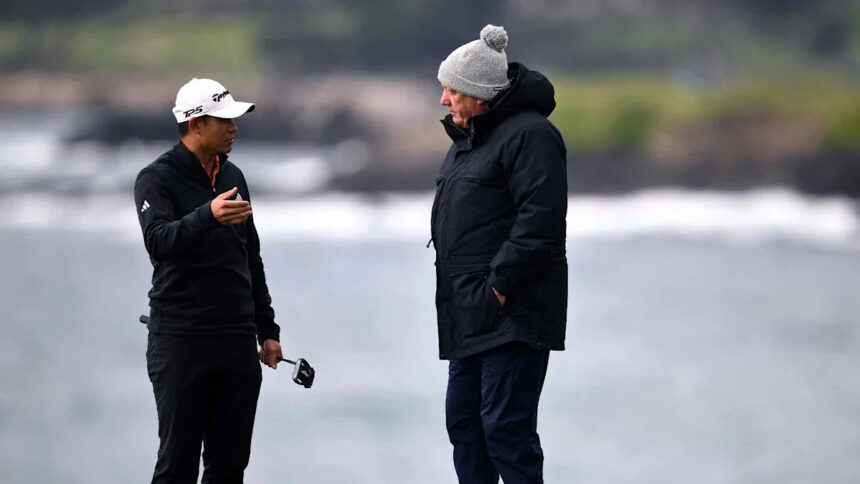
What transpired next was a sequence so strange it will be replayed in rules seminars for years. Needing an eagle to have a chance, Bridgeman launched a daring second shot that bounded over the green, down the rocks, and settled on the beach. His ball was playable, but his backswing was impeded by a large, partially melted chunk of ice—likely discarded from a spectator’s cooler.
This is where the situation turned from unfortunate to controversial. Under Rule 15.2a, a natural object like a stone or a leaf is considered a loose impediment and can be removed. Man-made ice, however, is an artificial object and is considered movable obstruction. The distinction is critical. Bridgeman and a rules official determined the ice was natural (frozen water), allowing him to remove it without penalty. He did so, played his shot, and made a commendable bogey.
The immediate backlash was fierce. Fans, analysts, and fellow players erupted on social media. The consensus was clear: ice from a cooler is not a natural part of the Pebble Beach ecosystem. Had it been deemed artificial, removing it would have incurred a penalty stroke. The PGA Tour later defended the call, stating there was “no evidence” to suggest the ice was artificial, but the controversy cast a temporary shadow over the green.
Key Points of the Controversy:
- The Rule: Natural loose impediments can be removed freely. Artificial movable obstructions can be moved, but if the ball moves as a result, it’s a one-stroke penalty.
- The Debate: Spectator-generated ice exists in a gray area. Is it “natural” because it’s water, or “artificial” because it was manufactured and placed there by human action?
- The Impact: For Bridgeman, the ruling allowed him to play a relatively straightforward shot. For Morikawa, watching from the fairway, it introduced an unexpected and lengthy delay at the most pressurized moment of his year.
Morikawa’s Mentally-Tough Response
This is where Morikawa’s months of mental preparation proved invaluable. Where others might have been rattled by the delay and the bizarre spectacle, Morikawa retreated into his process. He stayed loose, he refocused, and he trusted the visualization that had brought him here. The winning moment he dreamt of had just gotten weirder, but it was still his moment to seize.
His execution was cold-blooded. A perfect drive. A calculated second shot to the front of the green. Two putts later, a stress-free, tournament-winning par. The victory, his sixth on the PGA Tour, was official. The two-time major champion was back. In his post-round comments, Morikawa acknowledged the oddity but emphasized his own tunnel vision. “You can only control what you can control,” he stated, a mantra straight from the Sessinghaus playbook. The ice was Bridgeman’s situation; the 18th green was his.
Analysis & Predictions: What This Win Signals
This victory at Pebble Beach is a pivot point for Morikawa’s career. It’s not just about silencing the “when will he win again?” chatter. It’s about how he won.
Expert Analysis: Morikawa’s win was a complete performance. He led the field in Strokes Gained: Approach, a given. But he was also 11th in Strokes Gained: Putting. That combination is historically unbeatable. The mental leap, however, is the true takeaway. He managed a Saturday 62 without getting ahead of himself, and he navigated a chaotic Sunday finish with the poise of a veteran. This was a major championship mentality applied to a flagship event.
Predictions for 2024:
- Major Threat Re-engaged: With his confidence restored and putting solidified, Morikawa is now the undisputed favorite for The Open Championship at Royal Troon. His game is tailor-made for links golf.
- World No. 1 Pursuit: This win rockets him back into the world’s top 15. Given his consistency in majors and elevated events, a return to the top of the ranking is a realistic 2024 goal.
- U.S. Open at Pinehurst: His precision iron play will be a massive asset on Pinehurst’s demanding turtleback greens. He must be considered a top-3 contender.
Conclusion: A Champion Defined by Clarity, Not Chaos
Collin Morikawa’s victory at the AT&T Pebble Beach Pro-Am will forever have an asterisk of anecdote—the day the ice cube almost stole the headline. But for those looking beyond the bizarre, this win was a masterclass in modern championship psychology. The visualization work with Rick Sessinghaus was the unseen foundation that allowed him to stand firm when the scene descended into surrealism. He weathered not just the coastal elements and a fierce leaderboard, but a rules controversy that would have fractured a lesser competitor’s focus.
In the end, the victory was pure Morikawa: strategic, precise, and ultimately inevitable. He didn’t just reclaim a trophy; he reaffirmed his identity as one of golf’s most resilient and process-driven champions. The ice melted away, but the stature of Collin Morikawa, once again a PGA Tour winner, is now permanently solidified.
Source: Based on news from Yahoo Sports.