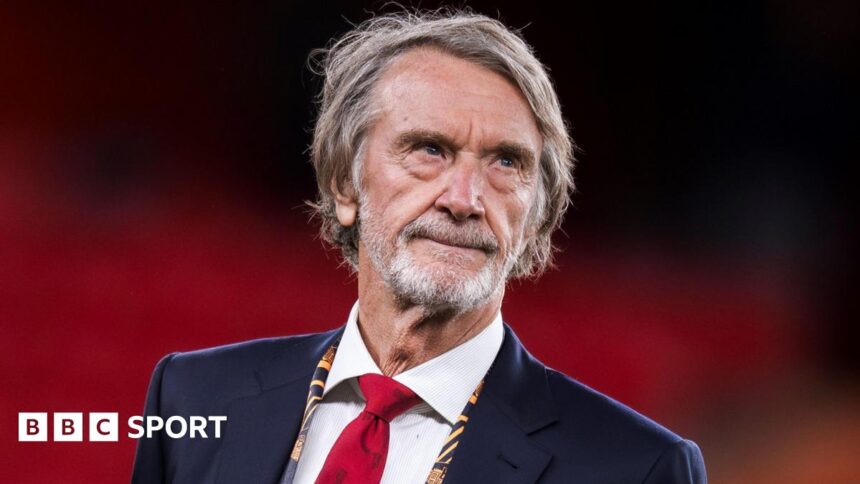
Ratcliffe’s Reckoning: How Immigration Comments Threaten the Man Utd Project
The theatre of dreams has become a theatre of awkward silence. As Sir Jim Ratcliffe awaits the Football Association’s verdict on whether his public comments brought the game into disrepute, a profound tension hangs over Old Trafford. It is not a tension born of a missed penalty or a botched transfer, but of identity, values, and the colossal weight of representing one of the world’s most iconic sporting institutions. The billionaire, born in Failsworth and raised on a council estate, now finds his every word—especially those on immigration—scrutinised not just by regulators and politicians, but by the global Manchester United family he vowed to restore.
The Comments and the Immediate Firestorm
During an interview with Sky News ostensibly focused on his vision for Manchester United, Sir Jim Ratcliffe veered into a political minefield. He stated that the UK had been “colonised by immigrants,” while citing incorrect population data. The reaction was swift and severe. The government condemned the remarks, with a Home Office source labelling them “divisive.” Anti-racism groups and community leaders expressed deep concern. The backlash transcended sports pages, becoming a front-page national conversation.
Most telling, however, was the response from within his own club. Manchester United felt compelled to issue a public statement, a move unprecedented for a club addressing its principal owner. The statement emphasised the club’s “proud history of diversity and inclusion” and its commitment to “fostering a welcoming and inclusive environment.” It was, in every sense, a public rebuke—a desperate attempt to firewall the club’s brand from the owner’s personal views.
Key Fallout Points:
- Government Condemnation: Direct criticism from political figures elevated the issue beyond a typical sports controversy.
- Club vs. Owner: The rare sight of a club publicly distancing itself from its owner’s statements highlighted the severity of the perceived damage.
- Global Brand Damage: For a club with hundreds of millions of fans worldwide, many from immigrant communities, the comments struck a discordant and alienating note.
The FA’s Dilemma: A Test of Governance and Reputation
The Football Association now holds a delicate and potentially precedent-setting decision. Its legal team must determine if Ratcliffe’s remarks reached the threshold for a breach of Rule E3.1, which concerns bringing the game into disrepute. The FA’s options are clear, but each carries significant weight.
Potential FA Actions:
- Formal Charge: This would signal a hardline stance, treating Ratcliffe like any other participant in the game. It would likely lead to a disciplinary process and a potential fine or sanction, setting a powerful example but also guaranteeing a protracted, ugly public battle with one of English football’s most powerful figures.
- Private “Reminder of Responsibilities”: A softer, more diplomatic path. This would acknowledge the issue without escalating it, but could be seen as the FA showing undue leniency to wealth and influence, undermining the rule’s credibility.
- No Action: An unlikely route that would be interpreted as the FA abdicating its responsibility to protect the game’s inclusive principles, inviting criticism from all sides.
This decision is not merely procedural; it is profoundly symbolic. The FA has actively campaigned for diversity and against discrimination for decades. To take no meaningful action against comments from a figure of such stature would be seen as undermining its own core initiatives. The governing body is caught between enforcing its rules on a powerful new stakeholder and navigating the intense political and social sensitivities of the moment.
Beyond the Fine: The Lasting Cost to Manchester United
While the FA’s ruling will dominate headlines, the true cost to Ratcliffe and Manchester United is already being tallied in less visible columns. The billionaire’s self-styled image as the pragmatic, no-nonsense local boy coming home to fix his club has been irrevocably complicated. The narrative of “Jim from Failsworth” is now competing with a more divisive portrait.
The internal impact at Carrington and Old Trafford cannot be overstated. The club’s playing and commercial staff are a mosaic of nationalities, ethnicities, and backgrounds. For them, the owner’s comments are not abstract political discourse; they are a reflection on their workplace and their employer’s values. Morale and a sense of unified purpose—the very things Ratcliffe’s sporting project seeks to build—have been dealt a blow.
Commercially, the calculus is stark. Potential partners, particularly global brands with stringent Environmental, Social, and Governance (ESG) criteria, will now conduct deeper due diligence. The club’s ability to attract the world’s best talent, both on and off the pitch, could be subtly hindered if families have reservations about the environment. The Manchester United brand is built on global appeal, and its co-owner has inadvertently introduced a note of parochial discord into that universal anthem.
Expert Analysis: A Leadership Test Unforeseen
From a sporting leadership perspective, this episode represents a catastrophic unforced error. Ratcliffe’s INEOS team was brought in for their operational expertise, their chemical plant efficiency. Yet, this crisis is one of emotional intelligence, cultural nuance, and public diplomacy—areas where a blunt, industrial approach fails.
“The remit of a modern football club owner, especially at a club like United, extends far beyond balance sheets and stadium redevelopment,” notes Dr. Sam Peters, a sports governance expert. “They are custodians of a community asset and global symbol. Ratcliffe misunderstood his podium. He spoke as a political commentator from an industrialist’s perspective, not as a steward of a culturally significant institution. The club’s statement was a necessary triage, but the wound is self-inflicted and deep.”
The fact Ratcliffe received some support for “raising the issue” is politically telling but commercially and sportingly irrelevant. Manchester United cannot afford to be a vehicle for one man’s political viewpoints. Its mission is to win football matches and unite a global fanbase, a task now immeasurably harder.
Predictions and the Path Forward
The immediate prediction is that the FA will choose the middle path: a strongly worded private reprimand and a public statement reaffirming the game’s commitment to inclusion, stopping short of a formal charge. This allows them to act without triggering a legal war with Ratcliffe.
The longer-term forecast is more complex. Ratcliffe faces a defining choice:
- Double Down: Maintain his stance, framing himself as a truth-teller. This path guarantees perpetual controversy, alienates key stakeholders, and ensures his tenure is defined by culture wars, not championships.
- Strategic Retreat: Issue a clear, unequivocal apology, not for “causing offence” but for the specific remarks. He must then engage meaningfully with the club’s foundation and community trusts, using his platform and resources to actively support inclusion initiatives. This is the only route to rebuilding burnt bridges.
The silence from Ratcliffe since the initial interview is deafening. But silence is not a strategy. The coming days require not legal manoeuvring, but genuine leadership. The son of a joiner who dreamed of owning his boyhood club now faces a challenge no business manual prepared him for: healing the division his own words created. The success of his multi-billion pound sporting project depends less on the FA’s verdict, and more on his own capacity for reflection and repair. The world is watching, and the whistle has blown.
Source: Based on news from BBC Sport.