Dolphins’ Stunning Purge: Miami Releases Tyreek Hill in Franchise-Altering Salary Cap Move
The Miami Dolphins, a team built on blistering speed and offensive fireworks, have detonated their own blueprint. In a series of moves that sent seismic waves across the NFL landscape, league sources confirmed the Dolphins are releasing superstar wide receiver Tyreek Hill, starting guard James Daniels, and receiver Nick Westbrook-Ikhine. This isn’t a tweak; it’s a tectonic shift for a franchise that has defined itself by its electric offense, headlined by the most feared deep threat in football. The release of Hill, in particular, marks the end of an era and the painful beginning of a stark financial reckoning in Miami.
While the cuts of Daniels, a reliable interior lineman, and Westbrook-Ikhine, a depth receiver, signal a roster retooling, the move involving Tyreek Hill is of a different magnitude. It is a cold, calculated, and brutal decision born from the collision of an enormous contract, a catastrophic injury, and the unrelenting pressure of the NFL salary cap. The Dolphins, facing a future of difficult cap management, have chosen to amputate their most potent weapon to salvage the body of the roster. The fallout will define the franchise for years to come.
The Financial Calculus: A $35 Million Gamble on the Future
To understand the “why,” one must look at the hard numbers. Tyreek Hill was not merely a player on the Dolphins’ roster; he was a massive financial entity. His contract, a landmark deal signed upon his arrival from Kansas City, carried a cap hit that would soon become unsustainable for a team with other expensive stars like Tua Tagovailoa, Jalen Ramsey, and Jaylen Waddle.
The decision to designate Hill as a post-June 1 release is the key to Miami’s strategy. This mechanism allows the team to spread the financial pain across two seasons. Here is the stark financial reality:
- Salary Cap Savings: The move will save the Dolphins a staggering $35.2 million on their 2026 salary cap. This is the prize. This is the oxygen the franchise needs to re-sign other key players, address gaping holes on the roster, and perhaps even attempt to retain defensive stalwarts.
- Dead Cap Hit: The savings come with a severe cost. Miami will absorb a dead cap hit of $28.2 million for Hill. This is money paid to a player who will no longer be on the team, a sunken cost that limits spending flexibility in the immediate future.
This is the ultimate NFL paradox: paying a fortune for the privilege of not having a player. The Dolphins are betting that the long-term cap health and roster-building flexibility outweigh the short-term agony of losing a Hall of Fame talent and carrying a monumental dead money charge. The release of James Daniels, a solid starter, further underscores this all-in approach to cap cleansing.
The Injury Unknown: Hill’s Cloudy Path Back to the Field
The financials alone might not have forced Miami’s hand if Tyreek Hill were coming off another 1,700-yard season. But the devastating injury he suffered late last season cast an immense shadow over his future. Hill’s year ended with a dislocated left knee accompanied by a torn ACL and other ligament damage—a complex and severe injury for any athlete, let alone a 31-year-old receiver whose game is predicated on otherworldly acceleration and agility.
The rehabilitation timeline is murky. While modern medicine has performed miracles, the specific nature of this injury raises significant questions. The Dolphins’ decision reveals their internal prognosis. It is unknown if Hill will be able to play in 2026, the first season of his post-Miami career. While the receiver has publicly stated his desire to return, the combination of his age, the severity of the injury, and his high salary created an unacceptable level of risk for the Dolphins’ front office.
By releasing him now, Miami transfers that physical and financial risk away from their books. Another team may take a chance on Hill’s recovery, but it will likely be on a heavily incentivized, prove-it deal—a far cry from the market-resetting contract he played on in Miami. This move is a sobering reminder that in the NFL, future value is always weighed against current cost, and a major injury can irrevocably alter a team’s calculus overnight.
Analyzing the Fallout: What’s Next for the Dolphins and Hill?
The immediate impact on the Dolphins’ offense is profound. For quarterback Tua Tagovailoa, this is the loss of his ultimate security blanket and the player who most defined the offense’s identity. The “Cheetah” stretched defenses horizontally and vertically in a way no other player could, creating space for Jaylen Waddle and the running game. Without that threat, Head Coach Mike McDaniel’s scheme must fundamentally evolve. Waddle will now face constant double-teams and top coverage attention, placing immense pressure on the rest of the receiving corps and the coaching staff’s creativity.
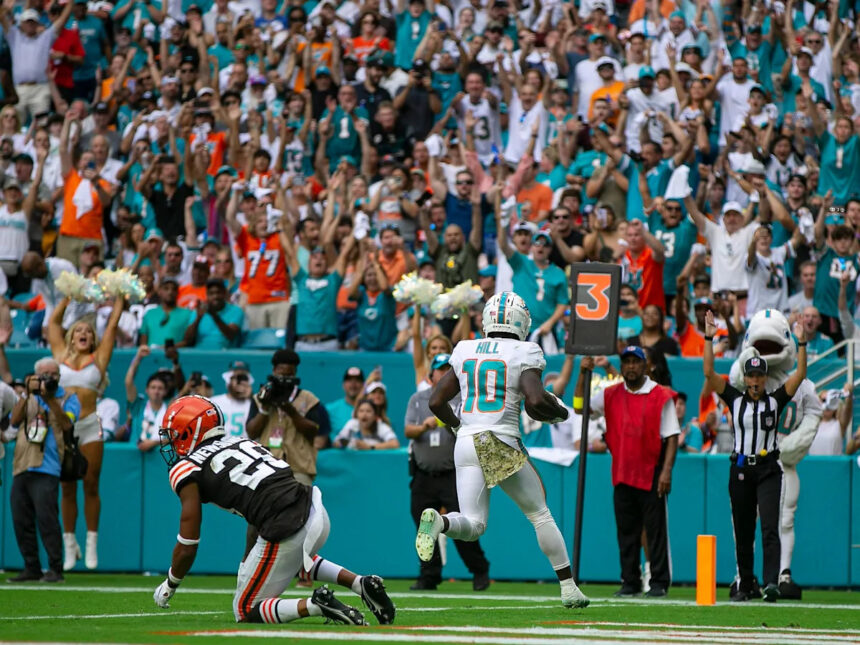
For Tyreek Hill, the future is a question mark. His legacy as one of the most dynamic playmakers in NFL history is secure. His tenure in Miami, though shorter than anticipated, was spectacular: 4,733 receiving yards and 27 touchdowns in just three seasons. He was the engine of the league’s most explosive offense. Where he lands next will depend entirely on his medical evaluations. Contenders in need of a final piece may take a flier, but his days as a team’s highest-paid player are almost certainly over.
Historically, this move will also reframe the trade that brought him to Miami. The Dolphins sent a massive haul—a 1st, 2nd, 4th, 4th, and 6th round pick—to the Kansas City Chiefs. For three years of elite production and two playoff appearances, the cost now appears extraordinarily steep, especially as the Dolphins enter a period of roster resetting where those draft picks would be invaluable.
A Franchise at a Crossroads: Predictions for the New Era
The release of Tyreek Hill is not an isolated transaction; it is a declaration. The Dolphins are pivoting from their “win-now” superteam construction to a more sustainable, cap-conscious model. The focus will now intensely shift to building in the trenches and through the draft. Predictions for the path forward:
- Offensive Reinvention: The Dolphins will likely seek a cheaper, bigger-bodied receiver in free agency or the draft to complement Jaylen Waddle, moving away from the pure speed model. The offense will run more through the backfield and intermediate passing game.
- Tagovailoa’s Prove-It Year: Tua, likely playing on a lucrative new contract, will face his biggest critic test. Can he elevate the offense and maintain elite efficiency without the ultimate weapon? His legacy in Miami will be defined by this next chapter.
- Defensive Investment: With significant cap space opening in 2026, expect General Manager Chris Grier to invest heavily on the defensive side, particularly in the pass rush and linebacker corps, to build a more balanced team.
- Hill’s Patient Market: Tyreek Hill will not be quickly signed. A team will likely bring him in late in the 2026 offseason, or even mid-season, after exhaustive medical checks, on a one-year deal laden with playing-time and performance incentives.
The Miami Dolphins chose a painful present for a more flexible future. The roar of the crowd for a Tyreek Hill touchdown strike has been replaced by the sober whir of a calculator. In the ruthless economy of the NFL, even “Cheetah”-level talent has its price, and Miami decided the cost of keeping him was too high. The team’s identity, its quarterback’s comfort, and its championship window have been dramatically reshaped in one fell swoop. The post-Hill era in Miami begins not with a bang, but with the stark, unforgiving reality of the salary cap. The gamble is placed; the results will define the franchise for a generation.
Source: Based on news from Yahoo Sports.