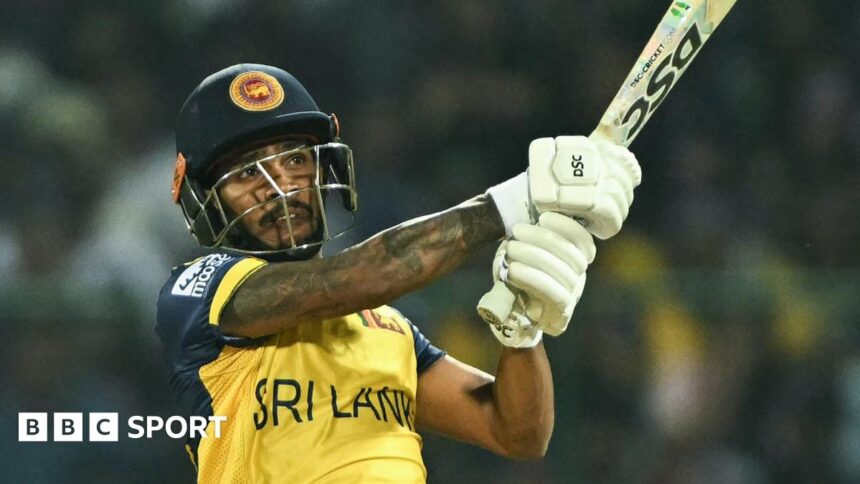
Australia on the Brink as Nissanka’s Masterclass Sends Sri Lanka Soaring
In the crucible of Pallekele, under the weight of a World Cup campaign, Pathum Nissanka authored an innings of pure, unadulterated brilliance. His stunning, unbeaten century—the first of the 2026 T20 World Cup—not only guided Sri Lanka to a thunderous eight-wicket victory but has left the mighty Australia teetering on the precipice of a stunningly early exit. This was more than a match; it was a statement, a tectonic shift in Group B that has thrown the tournament wide open and plunged Australian cricket into a state of profound crisis.
A Batting Collapse and a Glimmer of Hope Extinguished
Australian captain Pat Cummins won the toss and, predictably, chose to bat on a Pallekele surface known for its true bounce. For a fleeting period, it seemed a sound decision. Travis Head was in murderous form, tearing into the Sri Lankan attack with characteristic disdain. His 56 from a mere 29 balls, a whirlwind of cuts and pulls, propelled Australia to a flying start. Yet, his dismissal, caught brilliantly in the deep off Dhananjaya de Silva, triggered a catastrophic chain of events.
The much-vaunted Australian middle order, from Glenn Maxwell to Marcus Stoinis, failed to fire. The innings lost all momentum and direction, crumbling from a position of strength to a subpar 181 all out. The architect of the stunning collapse was the unheralded leg-spinner Jeffrey Vandersay, whose clever variations yielded three crucial wickets for 37 runs. His spell in the middle overs strangled the Australian scoring and exposed a critical flaw in their approach: a glaring inability to build partnerships once the initial blaze was extinguished.
- Key Moment: The run-out of a set David Warner, following a mix-up with Head, was the first sign of panic.
- Turning Point: Vandersay’s double-wicket over, removing the dangerous Stoinis and the struggling Tim David, broke the back of the innings.
- Final Blow: Bowling out with three balls to spare was a cardinal sin, leaving precious runs in the shed.
Nissanka’s Nirvana: A Century for the Ages
Chasing 182, Sri Lanka needed a firm foundation. What they got was a masterpiece. Pathum Nissanka, from the very first over, looked a class apart. While his opening partner, Kusal Mendis (a fluent 51 off 38), played the perfect foil, Nissanka embarked on a shot-making exhibition that will be replayed for years to come. He didn’t just score runs; he dismantled the aura of the Australian bowling attack with surgical precision.
His innings was a blend of elegance and raw power. The cover drives were poetry, the flicks off the pads were wristy genius, and when the bowlers erred in length, he dispatched them over the ropes with astonishing ease. He brought up his fifty with a six and marched relentlessly towards history. The moment he clipped a Pat Cummins delivery to the mid-wicket boundary to reach his hundred, the Pallekele stadium erupted. His unbeaten 100 came off just 52 balls, an innings laced with 12 fours and 4 sixes, and was utterly chanceless.
Expert Analysis: “This was a clinic in modern T20 batting,” remarked former Sri Lankan captain Kumar Sangakkara in commentary. “Nissanka showed the perfect tempo. He absorbed minimal pressure, rotated the strike beautifully, and picked his moments to attack the boundary riders. He never allowed a single Australian bowler to settle. Mitchell Starc’s pace was negated, Adam Zampa’s guile was decoded, and Cummins’ accuracy was punished. This was the innings of a world-class player announcing himself on the biggest stage.”
The Fallout: Australia’s World Cup in Peril
The ramifications of this defeat are seismic for the 2021 champions. With two losses from their opening three games, Australia’s fate is no longer in their own hands. Their net run rate has taken a severe dent, and they now require a series of improbable results from other group matches to have any chance of progressing to the Super 8 stage.
The post-mortem will be brutal. Questions will be asked about:
- Top-order consistency: Beyond Head’s fireworks, the batting has been fragile.
- Middle-order muddle: The roles of Maxwell, Stoinis, and David appear confused under pressure.
- Bowling penetration: The famed attack looked toothless and bereft of ideas against Nissanka.
- Strategic rigidity: Has the team’s approach, so successful in the past, been found out?
For Sri Lanka, the contrast is stark. This victory, built around a monumental individual performance and disciplined bowling, has almost certainly sealed their place in the next round. The confidence gained from defeating a giant like Australia in such comprehensive fashion makes them a dangerous, unpredictable threat for any team they face going forward.
Predictions and the Road Ahead
The landscape of Group B has been irrevocably altered. Sri Lanka, with their destiny firmly in their grasp, will look to top the group and carry this formidable momentum into the Super 8s. Their blend of youthful exuberance and experienced calm, exemplified by Nissanka and the wily Vandersay, makes them genuine dark horses.
For Australia, the 2026 T20 World Cup is on life support. They must win their final group match emphatically and then pray for favours from elsewhere. Even if they scrape through, the structural flaws exposed in Pallekele will follow them. This defeat feels like more than a loss; it feels like the end of a cycle for a golden generation of white-ball cricketers. A major team overhaul and a philosophical rethink may be imminent, regardless of the mathematical possibilities that remain.
Conclusion
History will remember the night in Pallekele for Pathum Nissanka’s sublime century—a knock that announced a new global star. But it will also be remembered as the night the Australian empire shook. Sri Lanka’s eight-wicket triumph was a display of fearless, intelligent cricket that has sent a resounding message to the rest of the tournament. As the island nation celebrates a hero and plots a course deep into the competition, Australia is left to confront a stark and unfamiliar reality: the brink of elimination, and the daunting prospect of a long, hard look in the mirror. The 2026 T20 World Cup has its first iconic performance, and it has claimed its first major scalp.
Source: Based on news from BBC Sport.