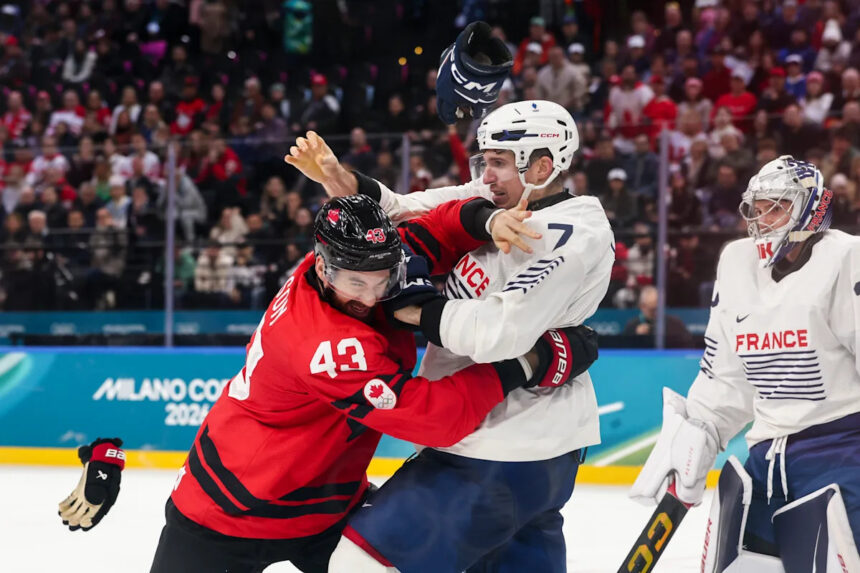
Winter Olympics 2026: French Defenseman Pierre Crinon Suspended After Brawl with Canada’s Tom Wilson
The “Friendly Games” witnessed a raw, unfriendly moment on Sunday that has reverberated through the Milan Cortina 2026 Winter Olympics. In a lopsided group play match already decided, a dangerous hit ignited a fire that the French ice hockey federation felt compelled to extinguish with decisive force. The federation suspended defenseman Pierre Crinon for the remainder of the Olympic tournament following his fight with Canadian antagonist Tom Wilson, a punishment that overruled the International Ice Hockey Federation’s initial leniency and sends a stark message about conduct on the global stage.
A Spark in a Blowout: The Incident That Crossed a Line
With Canada holding a commanding 10-2 lead and just under seven minutes remaining in the third period, the game was a formality. Then, Pierre Crinon delivered a high, dangerous hit on Canadian superstar Nathan MacKinnon along the boards. In the hockey code, such a hit in a decided game is a cardinal sin, and Tom Wilson, one of the sport’s most notorious enforcers, immediately took exception.
The retaliation was swift. Wilson confronted Crinon near the French goal, and the two quickly engaged. Displaying surprising leverage, Crinon, a 30-year-old veteran of the French league, wrestled the larger Wilson to the ice face-first. While officials intervened to separate them, Wilson broke free for a second round of pushing and shoving before order was restored. Both players received five-minute majors for fighting and game misconducts, ending their nights. Crucially, under IIHF rules, neither penalty carried an automatic suspension for the next game.
Divergent Justice: Federation Overrules International Body
In the immediate aftermath, the hockey world expected both players to be available for their next contests. Respected NHL insider Elliotte Friedman reported that the International Ice Hockey Federation would not issue supplemental discipline. For Canada, poised for a deep medal run, this was a relief. For France, facing a must-win qualification game, it meant their veteran defenseman would be available.
However, the French Olympic ice hockey federation saw the incident differently. On Monday, they issued their own verdict, suspending Crinon for the rest of the Olympic tournament. This move is unprecedented in recent Olympic hockey history, where federations typically defer to IIHF discipline. The French federation’s statement highlighted “conduct unbecoming of an Olympian and a violation of the team’s ethical code,” emphasizing that the hit and subsequent brawl “discredited the spirit of the team and the nation.”
This creates a fascinating two-tiered disciplinary system:
- IIHF Ruling: Focused on the rulebook. Fighting penalties were assessed, no automatic suspension triggered.
- French Federation Ruling: Focused on ethics and image. Deemed the actions in a 10-2 game unacceptable for a representative of France.
The federation essentially argued that the context—a hopeless game against a superior opponent—made Crinon’s actions reckless and selfish, potentially endangering an opponent’s tournament and staining France’s Olympic participation.
Expert Analysis: Code, Context, and Consequences
From a pure hockey perspective, the incident is a classic case of “the code” colliding with the Olympic ideal. “In an NHL regular season game, this sequence might have resulted in a fine or a one-game suspension at most, primarily for the initial hit,” says former professional defenseman and analyst Claude Lapierre. “But the Olympics are different. The federation isn’t just managing a player; they are stewarding a national symbol. Crinon’s hit was late-game frustration, and the federation’s suspension is a statement that representing France requires a higher standard of composure.”
The decision also strategically impacts Team France. While symbolic, the suspension is arguably practical. At 0-3, France’s tournament is likely over after their next game. Sacrificing Crinon allows the federation to champion discipline while facing minimal competitive cost. Conversely, had Canada suspended Wilson, it would have severely impacted their gold medal aspirations. The IIHF’s reported inaction there speaks to the unspoken weight of tournament stakes.
Tom Wilson’s role cannot be overlooked. A player with a long history of suspensions, he operated here within the unwritten rules as a protector of his teammate. His actions, while penalized, will be seen by many hockey traditionalists as a necessary response. The IIHF’s reported clearance of Wilson suggests they viewed the fight as a direct, if violent, consequence of an illegal hit, not as an instigated event.
Predictions and Lasting Impact
The immediate fallout is clear: France will face Germany in the qualification round without a key veteran, while Canada moves forward with its full arsenal, including Wilson. The long-term implications, however, are more profound.
- Federation Power Play: This sets a precedent where national federations may take autonomous disciplinary action for on-ice behavior they deem embarrassing, even if the IIHF does not. This could create confusion for players representing their countries.
- Olympic Spirit vs. Hockey Culture: The incident highlights the perpetual tension between hockey’s ingrained, physical “code” and the Olympic Charter’s principles of “excellence, friendship, and respect.”
- Crinon’s Legacy: For Pierre Crinon, this is a brutal coda to his Olympic career. What should have been a career highlight is now permanently marred by a suspension from his own country.
Furthermore, the French hockey federation’s suspension could be a blueprint for smaller hockey nations aiming to build programs based on discipline and structure, rather than the often-chaotic physicality of the sport’s traditional powers.
Conclusion: A Stain on the Sweater
The brawl between Pierre Crinon and Tom Wilson was a fleeting, violent episode in a blowout game. Yet, the French federation’s decisive response has transformed it into a defining moment of the 2026 Olympic hockey tournament. By suspending Crinon, France has made a powerful statement that the honor of the fleur-de-lis on the sweater supersedes the unwritten codes of the hockey rink. While the IIHF saw a routine scrum, the French saw a breach of Olympic ideals. In the end, Crinon’s suspension is less about the fight itself and more about the unacceptable context in which it occurred—a moment of lost composure that, in the eyes of his federation, cost him the right to wear the colors. The message to every Olympic athlete is now clear: you represent more than yourself, and that representation carries a responsibility that can outweigh the rulebook.
Source: Based on news from Yahoo Sports.