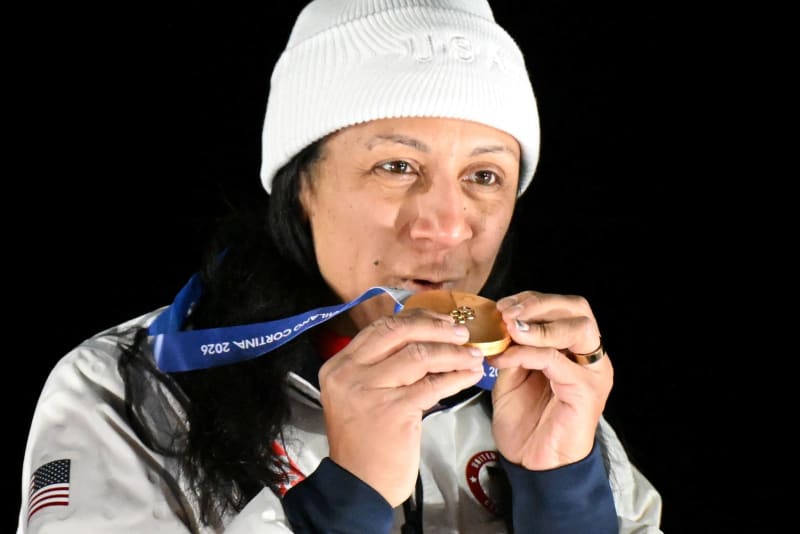
Elana Meyers Taylor’s Golden Redemption: A Monobob Triumph Forged in Resilience
The icy chute of the Cortina sliding track is a place of pure physics, a roaring, unforgiving test of speed and nerve. But on a historic Monday at the Milan/Cortina Winter Games, it became the stage for a story that transcended sport. Elana Meyers Taylor, a 41-year-old American legend carrying the weight of a career defined by being second-best, finally found the one thing that had eluded her: Olympic gold. Her victory in the inaugural women’s monobob was not merely a win; it was a cathartic release, a testament to unwavering perseverance, and a powerful declaration that a champion’s timeline is her own.
The Long Road to the Top of the Podium
For over a decade, Elana Meyers Taylor has been the formidable constant in women’s bobsled, a powerhouse athlete whose medal collection was missing only the hue of gold. With three Olympic silver medals and two bronze across three previous Games, her legacy was already secure as one of the greatest bobsledders of all time. Yet, the “almost” narrative clung. She was the relentless challenger, the pilot who could always find the podium but never quite the top step when it mattered most. The introduction of women’s monobob for the 2026 Games presented a unique opportunity—a solo discipline where the outcome rested entirely on her own skill, strength, and mental fortitude. This was her chance to write a new ending.
The journey to this start line was unlike any other. Meyers Taylor is not just an athlete; she is a mother to two young sons, Nico and Noah. Her eldest, Nico, was born with Down syndrome. Both boys are deaf due to a genetic mutation. Her training blocks were interspersed with doctor’s appointments, speech therapy sessions, and the beautiful, demanding chaos of parenthood. The pandemic further isolated her from her team and resources. There were moments, as she confessed, where the dream felt impossible. “There were so many moments I thought it wasn’t possible,” she said, her voice cracking with emotion after the race.
A Masterclass in Pressure and Precision
From a technical standpoint, Meyers Taylor’s gold medal run was a masterclass in monobob driving. The monobob, a one-person sled, eliminates the push athlete variable, placing supreme importance on the driver’s start—where Meyers Taylor’s explosive power is legendary—and their line down the track. Over four heats across two days, she displayed a consistency that her rivals could not match.
- Dominant Start Times: Meyers Taylor consistently posted some of the fastest push starts, building crucial hundredths of seconds of advantage before even boarding the sled.
- Technical Fluidity: Her runs were characterized by a clean, efficient line, minimizing contact with the walls to preserve speed. In a sled where the driver is also the ballast, her ability to make micro-adjustments with her body weight was paramount.
- Mental Steel: Entering the final heat with a narrow lead over Germany’s Laura Nolte, the pressure was immense. Meyers Taylor laid down a flawless, aggressive final run, forcing the young German to chase. Nolte, the last competitor, made a critical error, sealing Meyers Taylor’s victory.
As Nolte’s time flashed on the board, confirming the gold, Meyers Taylor crumpled, years of pursuit melting away in a flood of tears. She was immediately embraced by her family, sharing the moment with her two sons. “It actually happened,” she whispered, the reality slowly dawning. “I can’t even put into words what this means.”
More Than Gold: A Legacy of Representation and Resilience
While the gold medal is the tangible prize, the resonance of Meyers Taylor’s victory echoes far beyond the bobsled track. She has become a symbol for parents of children with disabilities, proving that elite athletic pursuit and dedicated, compassionate parenthood are not mutually exclusive. She spoke directly to this community in her post-race comments, highlighting the global support that fueled her.
“People from all over the world reaching out and telling me their stories, and how they had kids with Down syndrome, they had deaf kids, and how they believed in me, too,” she said. This connection transforms her victory from a personal achievement into a shared one. She has visibilized the challenges and joys of her family’s journey, advocating for inclusion and shattering preconceived notions about the capabilities of athletes who are also mothers to children with unique needs.
Furthermore, her triumph is a victory for longevity in women’s sports. At 41, she is the oldest female bobsled medalist in Olympic history. In a sporting culture often obsessed with youth, Meyers Taylor’s peak performance on the world’s biggest stage is a powerful rebuke, illustrating that experience, wisdom, and a hard-earned mental edge are invaluable assets.
The Future of Women’s Bobsleigh and Meyers Taylor’s Path
Elana Meyers Taylor’s monobob gold fundamentally alters the landscape of her sport. It cements the monobob as a premier event and establishes the United States as a leading force in the discipline. For Meyers Taylor personally, the question turns to what comes next. Having achieved the singular goal that drove her for a fifth Olympics, she may finally allow herself to consider a transition.
Potential paths forward could include:
- Continued Competition: The fire still burns brightly. She may aim for the 2027 World Championships or even an unprecedented sixth Olympic appearance in 2030.
- Coaching and Development: Her expertise is unparalleled. She is poised to become a transformative coach, guiding the next generation of American pilots, particularly in the monobob.
- Expanded Advocacy: With an Olympic gold amplifying her platform, her work as an advocate for children with Down syndrome, deaf and hard-of-hearing communities, and athlete mothers will likely reach new heights.
Regardless of her immediate choice, her role as a pioneer is secure. She has not only won gold but has also fundamentally expanded the definition of what an Olympic champion looks like and the life they can lead outside the arena.
A Golden Chapter Closes, A Lasting Legacy is Forged
Elana Meyers Taylor’s long-awaited ascent to the top of the Olympic podium is a narrative of sublime payoff. It is a story for every athlete who has ever wondered if their moment had passed, for every parent balancing an audacious dream with profound responsibility, and for anyone who believes that resilience is the ultimate currency. Her tears at the finish line were not just of joy, but of relief, of validation, and of profound gratitude.
She arrived in Cortina as the greatest Olympic medalist in U.S. bobsled history without a gold. She leaves as a complete Olympic champion, having conquered the one summit that remained. But more importantly, she leaves as an icon whose true victory was sculpted long before she stepped into the monobob sled—in the quiet determination of a relentless career, in the fierce love for her family, and in the unwavering belief that the hardest paths often lead to the most meaningful destinations. The gold medal is the exclamation point on a sentence she has been writing her entire life: one of power, purpose, and unparalleled perseverance.
Source: Based on news from Yahoo Sports.