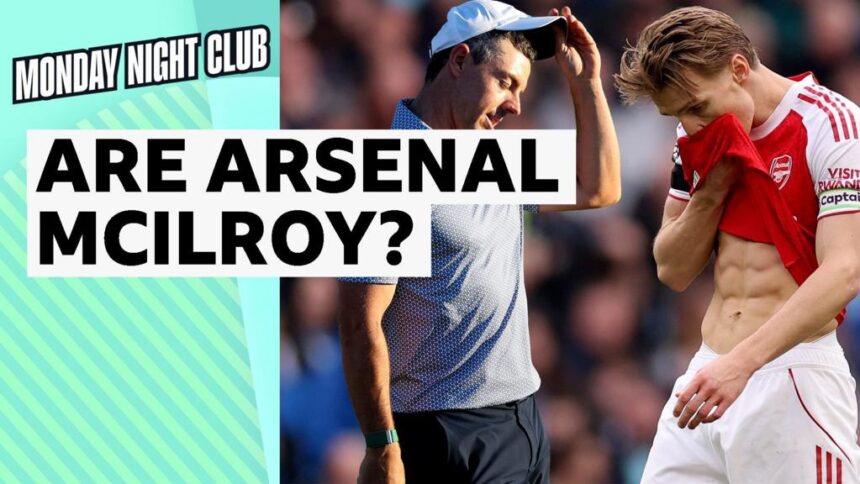
Parallel Paths of Pain: Is Arsenal’s Title Chase the Premier League’s Version of McIlroy’s Masters Agony?
The final stretch of a championship race is not merely a test of skill, but a profound examination of nerve. In the rarefied air of contention, where history is written and legacies are defined, the psychological burden can become the heaviest opponent. This week, a fascinating cross-sport parallel emerged on BBC’s Monday Night Club, as host Mark Chapman and pundit Andros Townsend dared to ask: is Arsenal’s current Premier League season unfolding like Rory McIlroy’s agonizing pursuit of the 2025 Masters?
The comparison is not about the sports themselves, but about the haunting specter of a specific, all-consuming quest. For McIlroy, it is the career Grand Slam, with the Masters green jacket the elusive final piece. For Mikel Arteta’s Arsenal, it is the Premier League title, a trophy the club has not held for two decades. Both narratives are defined by brilliant performance punctuated by the crushing weight of expectation and the fear of a near-miss.
The Anatomy of a Near-Miss: Pressure in the Crucible
Imagine the scene: Rory McIlroy, in a 2025 Masters playoff against the seasoned Justin Rose. Every drive, every putt, is magnified under the Augusta pines. The quest isn’t just to win a tournament; it’s to complete a destiny. The psychological burden is unique, transforming routine shots into monumental challenges. This is the “McIlroy Paradigm”—a state where supreme talent meets a singular, historic hurdle.
Now, transpose that to the Emirates and grounds across England. Arsenal’s young squad, for the second consecutive season, is locked in a brutal title fight with the machine that is Manchester City. Every match is a playoff. Each dropped point feels catastrophic. The quest isn’t just for points; it’s to end a generational drought and overcome a dominant rival. The weight of history hangs on every action, from a goalkeeper’s distribution to a striker’s finish. As Manchester City close in, the sensation is identical to watching a leaderboard rival sink a birdie on the back nine.
Parallel Symptoms: Brilliance, Nerve, and the Ruthless Edge
The comparison gains credence when we examine the shared symptoms between McIlroy’s major chase and Arsenal’s title run.
- Sublime Foundation Play: McIlroy’s driving is often majestic. Similarly, Arsenal’s structural play under Arteta—their defensive organization, midfield control, and pressing triggers—is routinely world-class. They build a platform for victory better than almost anyone.
- The Crucial Moment: This is where the analogy bites. For McIlroy, it has sometimes been a missed putt inside ten feet or a wayward iron at a critical juncture. For Arsenal, as analyses like Will lack of a ruthless match-winner cost Arsenal the title? posit, it can be a proliferation of chances not converted. It’s not a lack of chances created, but the cold, finishing instinct in a split-second moment that defines championships.
- The Ghost of Past Stumbles: Both entities carry the memory of recent heartbreak. McIlroy has his close calls at Augusta; Arsenal have last season’s late stumble. This memory becomes an opponent in itself, requiring constant mental management.
Andros Townsend’s point on the MNC likely cut to this core: it’s about operating in a space where past failure informs present tension. The football isn’t played in a vacuum; it’s played against the backdrop of “what if it happens again?”
The Key Divergence: The Nature of the Quest
However, a critical difference exists. McIlroy’s Masters quest is a personal, career-defining saga. While team-based, it is ultimately an individual sport. His battle is internal, against his own demons and history.
Arsenal’s challenge, while burdened by club history, is a collective, evolving story. This is a young team, not a veteran individual. Their “near-miss” last season was, in fact, a massive overachievement. The question is whether this group learns and grows from that experience, or whether it becomes a psychological block. The presence of a relentless pursuer like Manchester City—a team that has “been there and done it” repeatedly—adds a layer of external pressure McIlroy doesn’t face from a single, consistent rival.
Predictions: Collapse or Coronation?
So, will Arsenal’s season end like a McIlroy playoff loss, or can they script a different ending? The prediction hinges on mentality.
If Arsenal view themselves as plucky challengers succumbing to a predestined fate, they will likely falter. The ruthless match-winner conversation is valid; in games where control isn’t enough, you need a moment of individual magic to seize three points. This is their version of McIlroy draining a 25-foot putt to win.
However, there is a path through. This Arsenal squad has shown greater resilience and tactical flexibility this season. Winning while not playing well is a champion’s trait they have occasionally displayed. To avoid the “McIlroy Masters” comparison, they must:
- Embrace the tension as a privilege, not a burden.
- Find goals from unexpected sources in tight games.
- Treat each match as a final, not as a step toward a final.
Conclusion: A Legacy Waiting to Be Written
The Monday Night Club comparison is a stroke of analytical genius because it captures the intangible essence of Arsenal’s run. They are living in the “McIlroy Zone”—a place of exquisite talent tormented by the one gap on the resume. The final holes of their season are now playing out.
But football, unlike golf, is a team sport defined by a long campaign. Arsenal’s story is still being written. The heartbreak of Rory McIlroy at Augusta has, so far, been a recurring chapter. Arsenal, however, have the chance to author a new one. They can either become a Premier League parable of brilliant, bridesmaid futility, or they can use the acute pain of their near-miss as the final, hardening fire needed to forge a championship mentality. The putt, now, is on their blade.
Source: Based on news from BBC Sport.