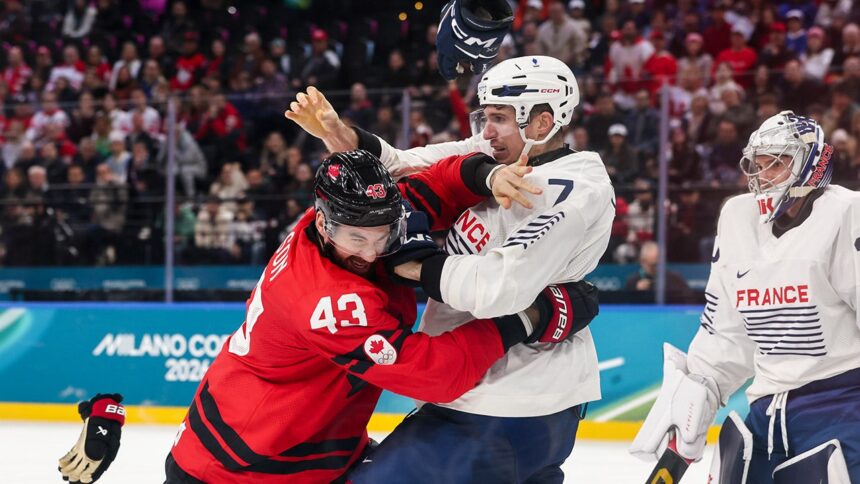
Olympic Honor or Reckless Gamble? Why a Canadian Star Risked It All for a Fight
The Olympic stage is built for moments of pristine skill and soaring sportsmanship. But sometimes, the raw, unfiltered code of hockey—a sport with its own deeply ingrained sense of justice—collides with the pristine ideals of the Games. This past weekend, that collision occurred when Team Canada’s Tom Wilson, knowing full well the potential consequences, dropped his gloves with France’s Pierre Crinon in a lopsided contest. In doing so, he ignited a firestorm of debate about honor, risk, and the unwritten rules that transcend any official handbook.
The Calculated Risk in a Blowout Victory
With Canada leading France 10-2 and just seven minutes left on the clock, the game’s competitive outcome was a foregone conclusion. For most players, this is a time to manage the clock and avoid unnecessary risks. For Tom Wilson, a premier power forward and noted enforcer for the Washington Capitals, it was a moment that demanded action. France’s Pierre Crinon, a physical player known for walking the line, had been involved in several incidents throughout the game that Wilson and his Canadian teammates deemed over the line.
Under strict International Ice Hockey Federation (IIHF) and Olympic rules, fighting carries an automatic game misconduct penalty. Both Wilson and Crinon were ejected, their nights over. But the risk for Wilson was far greater. As an NHL star and key component of Canada’s gold medal aspirations, his presence on the ice is invaluable. Ejection from a single game is one thing, but a potential suspension hanging over the remainder of the tournament could have derailed both his and Canada’s Olympic dreams. He knew the precedent; he knew the stakes. Yet, he fought.
Understanding the “Code” and the Catalyst
To the casual observer, a fight in a 10-2 game seems senseless. But within hockey’s ecosystem, actions are governed by an unwritten but fiercely upheld player code of conduct. This code often mandates that players police the game themselves when they perceive that officials have lost control or that an opponent has violated the boundaries of acceptable physical play.
While specific details of the preceding play are key, sources close to the team indicate a pattern of behavior from Crinon that included:
- Late hits and questionable contact on Canadian star players.
- Actions perceived as attempts to injure or intimidate in a game already decided.
- A general disregard for the safety of opponents, which the Canadian bench felt needed addressing.
“You have to stand up for your teammates,” Wilson explained in a post-game press conference. “It doesn’t matter the scoreboard. When someone is taking liberties, especially in a game like that, you send a message. You make sure everyone goes home in one piece. My job is to protect my guys, and sometimes that job comes with a cost.”
This sentiment underscores the core of the conflict: the clash between Olympic decorum and hockey’s internal justice system. The French federation, taking a much harsher stance than the IIHF, subsequently suspended Crinon for the remainder of the Games, validating the Canadian perspective that his actions were beyond the pale.
Expert Analysis: Weighing Leadership Against Liability
We spoke to several former NHL players and Olympic analysts to break down the strategic and moral implications of Wilson’s decision.
Mike Millbury, former NHL defenseman and analyst: “It’s a terrible risk for a player of Wilson’s caliber. But let me tell you, in that locker room, he’s a hero. He told every guy on that bench, ‘I’ve got your back, no matter what.’ That builds a kind of trust that fuels a championship run. The French player was out of line, and he got what was coming to him. The suspension proves it.”
Hayley Wickenheiser, four-time Olympic gold medalist for Canada: “The Olympic context changes everything. We’re taught to represent our country with class and composure. While I understand the instinct to protect teammates, you have to be smarter. Your team needs you on the ice, not in the dressing room or suspended. There are other ways to respond within the rules of the game.”
The analysis reveals a clear generational and philosophical divide. Old-school hockey minds see Wilson’s action as necessary team leadership, a sacrificial play for the greater good of group cohesion. Modern analysts, particularly those versed in the unique atmosphere of the Olympics, view it as a dangerous and potentially costly liability.
Predictions: Ripple Effects for Canada and Olympic Hockey
Wilson’s gamble appears to have paid off in the short term. He avoided a supplementary suspension from the IIHF and is eligible to play in Canada’s crucial upcoming games. The long-term effects, however, are more nuanced.
- Team Morale Surge: Canada will likely play with increased confidence and unity, knowing their most physical player has set a tone of accountability and sacrifice.
- Target on His Back: Officials will now watch Wilson with heightened scrutiny. Any borderline hit he makes will be magnified, potentially leading to more penalty calls against him.
- Opponent Strategy: Future opponents may try to bait Wilson into taking retaliatory penalties, knowing his willingness to engage and his value to the Canadian lineup.
- Olympic Policy Review: This high-profile incident may prompt the IIHF to review its disciplinary procedures for fighting, potentially implementing harsher, more automatic suspensions for future tournaments to better align with Olympic standards.
The immediate prediction is that this moment galvanizes Team Canada. They have transformed from a collection of elite talent into a bonded unit with a shared cause. However, the shadow of “what if” will linger. What if Wilson had been suspended? The calculation would have been viewed as a catastrophic error in judgment.
A Defining Moment of Duality
Tom Wilson’s decision to fight Pierre Crinon is not a simple story of right or wrong. It is a defining moment of duality, a perfect encapsulation of the two worlds elite hockey players inhabit. On one hand, they are Olympians, ambassadors of sport representing their nations on a global stage that celebrates pure competition. On the other, they are hockey players, bound by a culture and a code that has governed their sport for generations—a code that sometimes demands personal risk for collective safety and respect.
Wilson chose the code. He bet on his team’s need for protection and moral fortitude over the pristine ideal of Olympic passivity. The French federation’s severe punishment of Crinon suggests the transgression that provoked Wilson was real. In the end, this was more than a fight; it was a statement. It declared that even in the rarified air of the Olympics, certain lines cannot be crossed without consequence. Whether this moment is remembered as a pivotal act of leadership or a reckless gamble will ultimately be decided by the color of the medal Canada hangs around its neck when the Games conclude.
Source: Based on news from Fox Sports.