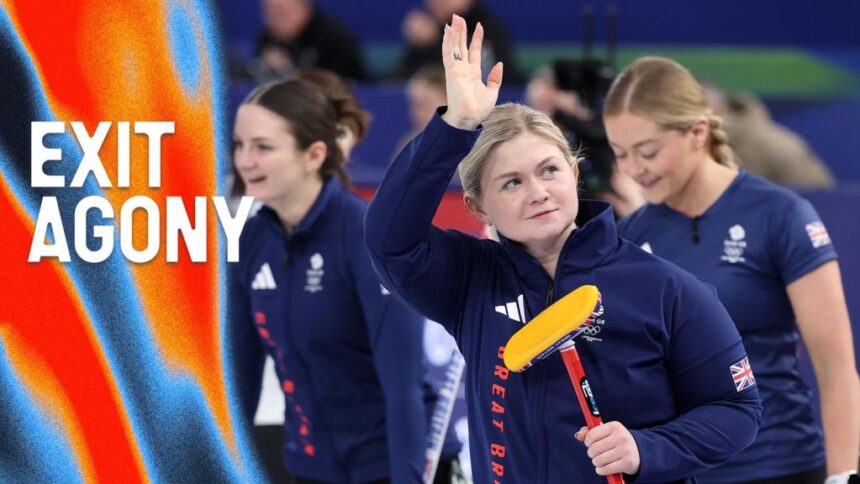
GB’s Olympic Dream Shattered in Inches as USA Clinches Epic Extra-End Thriller Over Swiss
The line between agony and ecstasy in curling is measured in millimeters. In a heart-stopping, tournament-altering showdown that will be replayed for years, the United States women’s curling team etched their name into the 2026 Winter Olympic semifinals, while simultaneously ending the dreams of a nation. In a game of breathtaking tension and tactical brilliance, the Americans needed an extra end to fend off a resilient Switzerland, winning 7-6 and, in the process, sending Great Britain—who were watching helplessly—crashing out of medal contention.
A Live Wire of Tension: The Deciding Draw to the Button
The atmosphere in the ice arena was electric, a palpable wave of pressure descending upon the house in the extra end. With the score tied 6-6 and the final stone of the match in her hand, US skip Jamie Sinclair faced a cluttered scene. Two Swiss stones sat threateningly in the four-foot. The path was narrow, the margin for error nonexistent. Sinclair’s final pressure draw needed to be perfect—threading the needle through a port, navigating the sweeping calls, and stopping with surgical precision. As the stone slid down the sheet, the roar of the crowd built. It curled, it traveled, and as it came to rest, it was visibly closer to the button than the Swiss shot stone. After a tense measurement confirmed it, the US bench erupted. They had snatched victory from the jaws of a tie-breaker. For the Swiss, it was a devastatingly close defeat. For Great Britain, watching from elsewhere, it was the final, cruel calculation that ended their Olympic journey.
Expert Analysis: The Tactical Pivot That Sealed the Game
This was not a game won on the last stone alone. The pivotal moment came in the eighth end, with the US holding a slender lead. Swiss skip Silvana Tirinzoni, a reigning Olympic champion, executed a spectacular double takeout to sit three. Facing a potential multi-point steal that could have broken the game open, Sinclair was forced to play a difficult freeze to limit the damage. While Switzerland scored two to tie, limiting it to a deuce was a monumental save. “That was the championship moment, even before the extra end,” a veteran curling analyst noted. “The US showed their mental fortitude there. They absorbed Switzerland’s best punch, kept the game within one, and stayed in control of the hammer. That resilience set the stage for the finale.”
The game’s key strategic battles were:
- Hammer Management: Both skips were near-flawless in protecting the hammer (last-stone advantage) through the middle ends, leading to the inevitable dramatic conclusion.
- Freeze Game Precision: The ice conditions demanded exquisite weight control. The number of successful freezes and taps-back was exceptionally high, a testament to the skill level on display.
- Front-End Dominance: The US lead and second consistently out-curled their Swiss counterparts in the early ends, setting cleaner centers and forcing Switzerland into reactive play.
The Domino Effect: Great Britain’s Agonizing Near-Miss
While the US and Swiss athletes battled on the ice, the true sting of this result was felt thousands of miles away by the Great Britain squad. Their fate was never in their own hands. Needing a Swiss victory to keep their semifinal hopes alive, the British team was forced to become spectators. Every US score was a dagger; every Swiss counter, a fleeting moment of hope. The final measurement that confirmed the US win was also the measurement that ended the British Olympic campaign. It is a brutal aspect of round-robin play: a team’s destiny can be decided by the performance of others. For a British team that had fought valiantly throughout the week, coming within literal inches of the semifinals through another team’s result is a uniquely painful Olympic memory.
Looking Ahead: Semifinal Predictions and the New Gold Medal Landscape
With this seismic result, the women’s curling semifinal picture is now complete, and the dynamics have shifted dramatically. The United States, riding the immense high of this victory, carries formidable momentum. However, they will likely face an even sterner test.
Our predictions for the medal rounds:
- The US as the Dangerous Underdog: They have just slain a giant. The confidence flowing through Team Sinclair will make them a nightmare matchup for any favorite. Their shooting percentage in clutch moments is currently red-hot.
- Switzerland’s Path to Redemption: Do not count out the reigning champions. The loss, while crushing, eliminates any complacency. A team of Tirinzoni’s caliber will use this as fuel. They remain a complete and deadly unit.
- The Psychological Factor: Which team recovers better? The US from their euphoric high, or Switzerland from their devastating low? The first few ends of the semifinal will be a masterclass in emotional management.
- New Favorite Emerges: With Switzerland now potentially in a tougher bracket and Britain eliminated, the door is wide open for teams like Canada or Sweden to seize control of the tournament. They will have watched this thriller and noted every weakness.
Conclusion: The Fine Line of Olympic Glory
The 2026 women’s curling tournament has delivered its defining moment. In a sport where victory and defeat hinge on the polish of a stone, the angle of a brush, and the calm of a skip’s nerve, the United States proved their championship mettle. For Switzerland, it was a testament to their greatness that even in an off-game, they pushed their opponents to the absolute limit. And for Great Britain, this will be remembered as the “what if” Games—a campaign of immense skill that ended not with a missed shot, but with a measurement on a sheet they weren’t even playing on. The Olympic curling semifinals are now set, forged in the drama of an extra-end thriller that reminded the world why this chess-on-ice captivates millions. The pursuit of gold continues, but the echoes of this epic battle will linger long after the final stone is thrown.
Source: Based on news from BBC Sport.