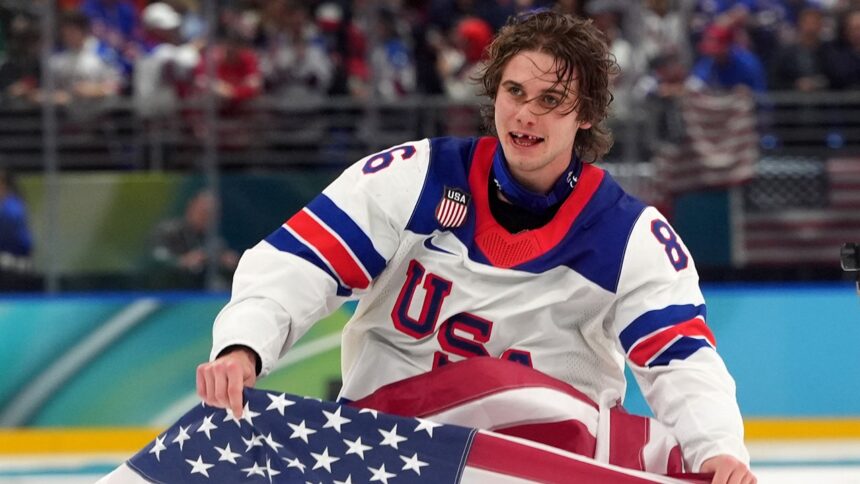
Jack Hughes’ Golden Goal: A New Miracle and a Patriotic Roar for Team USA
The echoes of 1980 have found a new voice, and it belongs to Jack Hughes. In a moment of heart-stopping, history-laden drama at the Milano Santagiulia Ice Hockey Arena, the American star etched his name into Olympic legend. Hughes’ overtime goal against arch-rival Canada didn’t just secure a 3-2 victory and the gold medal; it snapped a 46-year drought, reigniting the flame of American hockey pride with a seismic blast. On the exact anniversary of the “Miracle on Ice,” a new generation delivered its own immortal moment, and its author was left breathless with patriotic fervor.
From Milano to Lake Placid: An Echo Through History
February 22nd is now a dual pillar in American sports history. In 1980, a band of college kids in Lake Placid stunned the world, defeating the seemingly invincible Soviet Union. In 2026, a team of NHL stars, led by its brightest young talent, stared down the sport’s other eternal powerhouse. The symmetry is almost too perfect to be scripted. Hughes’ goal, a swift, precise shot that beat Canadian netminder Jordan Binnington, didn’t just win a game; it connected two generations separated by nearly five decades.
Jack Hughes, in the immediate, chaotic aftermath, was overcome. “You grow up seeing that ‘Miracle’ footage, you get chills every single time,” Hughes said, his voice cracking with emotion. “To think we just did something on that same day… for your country, with this group of guys, it’s the pinnacle. This is for every kid dreaming on a pond back home. This is USA Hockey.”
Deconstructing the Golden Moment: A Masterclass in Pressure
The game itself was a classic chess match, a testament to the ferocious and nuanced rivalry between the two North American giants. Canada’s physicality was met by Team USA’s transitional speed. The lead changed hands, tension mounted with each shift, and overtime felt like an inevitability. When the extra period began, the air was thick with the weight of history.
The sequence leading to Hughes’ game-winning goal was a microcosm of modern hockey excellence. A quick breakout, a subtle hold at the blue line to maintain possession, and a crisp cycle below the Canadian goal line. A pass found its way to the high slot, where Hughes, lurking with the predatory patience of a superstar, collected the puck. In one fluid motion, he sidestepped a sliding defender and released a wrist shot that cleanly beat Binnington’s blocker. The analysis is simple: under the most immense pressure imaginable, Hughes executed with technical perfection.
- Key Factor: Special Teams – Team USA’s penalty kill was flawless, neutralizing Canada’s potent power play at critical moments.
- Key Factor: Goaltending Duel – While Binnington was stellar, American goaltender Jake Oettinger made several season-saving stops to force overtime.
- Key Factor: Youthful Resilience – Unlike veteran-laden teams of the past, this U.S. squad thrived on the energy of its young core, refusing to be intimidated.
The Hughes Era and the Reshaped Landscape of USA Hockey
This victory is more than a single medal; it’s a potential turning point. For decades, American hockey success was framed as an underdog story. The 1980 miracle was exactly that—a miracle. The 1996 World Cup win was a breakthrough. But the 2026 Olympic gold, won with a roster of players in their prime against a full-strength Canadian team, signals a shift. The United States is not just a contender; it is a sustainable hockey powerhouse.
Jack Hughes, at just 24 years old at the time of the 2026 Games, now becomes the face of this new era. His combination of elite skill, hockey IQ, and now, proven clutch performance on the absolute biggest stage, cements his legacy. This gold medal validates the decades of development in American youth hockey and the NHL’s influx of star talent from the United States. The “Miracle” is no longer a once-in-a-lifetime anomaly; it is a foundation upon which consistent excellence is being built.
Looking Ahead: Rivalry Re-ignited and the Road to 2030
What does this mean for the future? The USA-Canada hockey rivalry, already the sport’s most intense, has just been injected with rocket fuel. Canada will view this loss as a profound disappointment, a gold medal lost on home ice (in a North American context, as the Games were in Milan). The response will be fierce and focused. For Team USA, the challenge now is to build a dynasty, to transition from chasing gold to defending it.
Predictions for the next Olympic cycle, looking toward 2030, must start with these two nations. The core of this American team—Hughes, his brother Quinn, Adam Fox, Auston Matthews—will still be in their prime. Canada will return with a vengeful roster, likely featuring Connor McDavid, who will be more motivated than ever. The battle in Milan may have been the climax of one story, but it is undoubtedly the thrilling prologue to the next chapter of this epic rivalry. European powers like Sweden and Finland will remain formidable, but the path to gold will almost certainly run through this North American clash.
A Patriot’s Promise Fulfilled
In the end, beyond the strategy and the predictions, lies the raw emotion captured in Jack Hughes’ words. His patriotic message after the game wasn’t manufactured for the cameras; it was the spontaneous overflow of achieving a lifelong dream for his country. Team USA’s victory in Milan is a “Miracle” for a new generation—not one of amateur over professional, but one of excellence meeting destiny on a date circled by history. They didn’t just win a hockey game. They carried the weight of 46 years and laid it gently at the feet of a legacy, proving that the spirit of Lake Placid is alive, well, and now wearing gold.
Source: Based on news from Fox Sports.