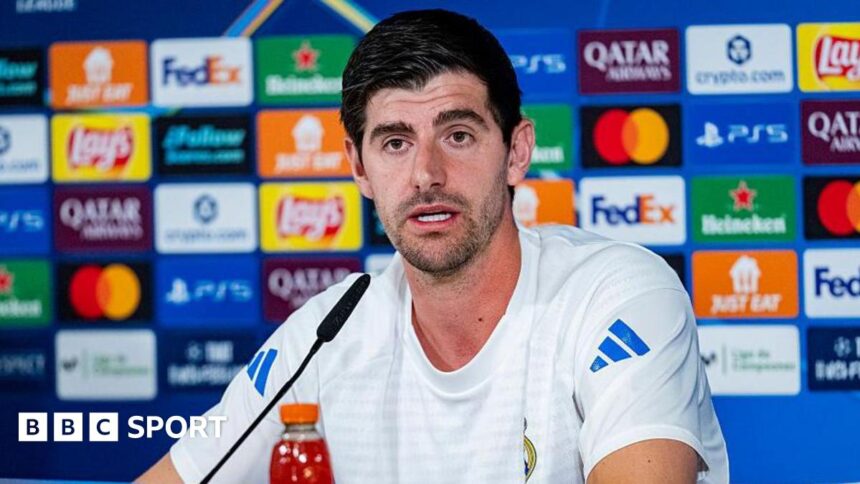
Courtois’ Defense of Vinicius Jr. Exposes Football’s Ugly Double Standard
The beautiful game has always been a theater of raw emotion. The ecstasy of a last-minute winner, the agony of a missed penalty—these moments are the sport’s lifeblood. Yet, in 2024, we are forced to have the same tired, infuriating debate: when a Black player, specifically Vinicius Jr., dares to express that joy, why is his celebration weaponized against him, used to excuse the inexcusable? Real Madrid goalkeeper Thibaut Courtois, a veteran of European football’s biggest stages, cut to the heart of the issue following last week’s Champions League clash with Benfica. His defense of his teammate wasn’t just club solidarity; it was a stark indictment of a persistent failure to protect players from racism.
The Incident: A Moment of Brilliance, Followed by a Familiar Shadow
In the 84th minute of a tense knockout tie in Lisbon, Vinicius Jr. produced a moment of magic. Receiving the ball on the left, he danced past a defender and unleashed a stunning, curling strike into the far corner. It was a goal worthy of winning any Champions League match. His subsequent celebration, turning to face the roaring Benfica supporters, was immediate and instinctive. For this, he received a yellow card. The real controversy, however, erupted after the final whistle.
Vinicius alleged that Benfica’s young Argentine winger, Gianluca Prestianni, racially abused him following that decisive goal. Prestianni denied the accusation, but UEFA’s subsequent actions spoke volumes: a provisional one-game ban for the Benfica player, pending a full investigation. The narrative, however, had already begun to twist in some corners. Was Vinicius’ celebration provocative? Did it “justify” the response? Thibaut Courtois, who joined Real Madrid from Chelsea in 2018 and has seen football’s myriad cultures, delivered a powerful rebuttal.
Courtois’ Unwavering Stance: Separating Celebration from Abuse
“It bothers me that Vinicius’ celebration is being used against him,” Courtois stated plainly. “A celebration does not justify a suspected act of racism. Full stop.” In that simple sentence, the Belgian goalkeeper dismantled the flawed logic that has plagued discussions about Vinicius for years. Courtois’ analysis is crucial because it comes from a respected figure within the dressing room, not from an external pundit.
His perspective highlights several critical points:
- The Celebration is a Red Herring: By focusing on whether Vinicius “provoked” anyone, the conversation dangerously shifts away from the alleged racist act itself. It creates a false equivalency between emotional exuberance and racial abuse.
- Experience in the Cauldron Having played in England, Spain, and Belgium, Courtois understands the intense atmosphere of derbies and European nights. Celebrating in front of away fans is as old as the sport itself. It is gamesmanship, not a criminal offense.
- Protecting the Teammate: Courtois’ public support is a textbook example of squad unity. It sends a message to Vinicius and to the world that the player’s well-being and dignity are non-negotiable, regardless of on-field antics.
This is not an isolated incident for Vinicius Jr., who has been subjected to vile racist abuse repeatedly in Spain. Courtois’ intervention reframes the issue: the problem is not the celebration; the problem is the racism that seeks to punish him for it.
The Bigger Picture: A Pattern of Victim-Blaming in Football
What happened in Lisbon is a microcosm of a global sickness. Time and again, Black players are told to “be the bigger person,” to not react, to play on. When they do react—with a celebration, a gesture, or a complaint—they are framed as the instigators. This victim-blaming playbook is exhausting and effective at muddying the waters.
UEFA’s decision to provisionally suspend Prestianni is a positive, if belated, step. It indicates a recognition that the allegation is credible and serious. However, football’s governing bodies have a long history of handing out punishments for racism that feel like slaps on the wrist—partial stadium closures or fines that are mere rounding errors for elite clubs. The provisional ban must be the start of a rigorous process, not the end of it.
The yellow card for Vinicius’ celebration is also telling. While referees must manage tensions, the automatic booking of a player for celebrating in the direction of opposing fans feels anachronistic. It inadvertently lends credence to the idea that the player did something “wrong” first, providing a flimsy pretext for those looking to deflect from the core issue of abuse.
Looking Ahead: What This Means for Real Madrid and Football
As the teams prepare for the second leg at the Santiago Bernabéu, the focus should be on a fantastic Champions League tie. Yet, the shadow of the first leg will linger. For Real Madrid, the incident has further galvanized the squad around Vinicius. The public support from a leader like Courtois is invaluable. It transforms Vinicius from a target into a protected and cherished asset.
My predictions for the fallout and future are as follows:
- Increased Vigilance: UEFA will be under immense pressure to deliver a decisive ruling on Prestianni. A strong sanction would set a needed precedent.
- A Fortress Bernabéu: The Madrid fans will undoubtedly turn their stadium into a bastion of support for Vinicius on Wednesday, using the incident as fuel to push their team to the semi-finals.
- No Change in Vini’s Game Crucially, we will see no apology in Vinicius’ playing style or passion. To expect him to dim his light is to concede defeat to his abusers.
The long-term challenge remains systemic. Football must move beyond reactive punishments and toward proactive education and zero-tolerance policies that are enforced consistently. Clubs must be held truly accountable, and players must feel empowered to speak out without fear of being told they “started it.”
Conclusion: The Celebration is Not the Crime
Thibaut Courtois did more than defend his teammate. He issued a challenge to football’s ecosystem: to stop confusing cause and effect. A goal celebration is an expression of joy and competitive fire. Racist abuse is a hateful act that has no place in society, let alone sport. Linking the two is not only illogical but deeply harmful.
Vinicius Jr.’s brilliance on the pitch is a gift to football. His right to enjoy that brilliance, to celebrate it without being subjected to racial epithets, is non-negotiable. As the sport grapples with this latest incident, the message from the Real Madrid dressing room is clear. The problem was never Vinicius turning to the crowd after scoring a wondrous goal. The problem was, and always is, the bigotry that awaited him. It’s time football finally, unequivocally, dealt with the real issue.
Source: Based on news from BBC Sport.