Beyond the Handshake: The Scheduling Snag and Political Shadow Behind the U.S. Hockey Team’s White House Visit
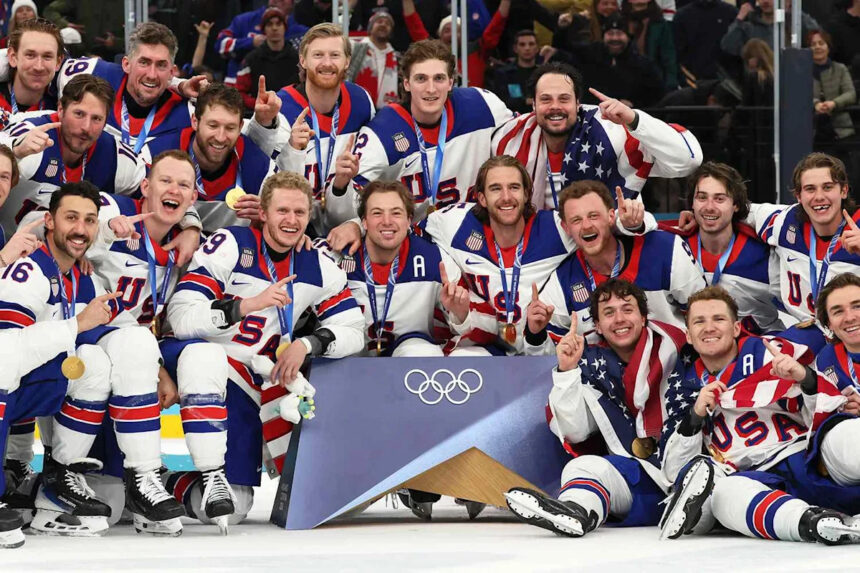
The image was one of triumph and tradition: President Donald Trump, standing in the White House, shaking hands with members of the 2026 U.S. Men’s Olympic Hockey team, their gold medals gleaming. This ceremonial visit, a staple for American champions, preceded the president’s State of the Union address on February 24. Yet, a closer look at the team photo revealed a notable gap. Five members of the 25-man roster were absent. In the hyper-charged political atmosphere of the time, their missing faces ignited immediate speculation. Was this a silent political protest, or was the explanation rooted in the relentless, apolitical grind of professional sports? The truth, as uncovered through the facts, reveals a complex intersection of professional obligations, personal choice, and the unavoidable political polarization that the White House visit ritual now embodies.
The Official Reason: The Unforgiving NHL Schedule
For the majority of the team who attended, the visit was a whirlwind celebration. Flying into Washington D.C. after their monumental Olympic victory, they partook in a moment of national recognition. However, the core logistical fact underpinning the absences is undeniable: NHL regular season games were scheduled for February 25, the day after the State of the Union. For the five absent players, their professional teams were scattered across the continent, requiring early travel for pre-game preparations, meetings, and morning skates.
This wasn’t a matter of mere inconvenience. The NHL season is a marathon of precision, with teams battling for playoff positioning. Missing a mandatory team function or arriving late could result in fines, benching, or disruption to a team’s chemistry. The professional athlete’s dilemma was clear: honor a symbolic invitation or fulfill a multi-million dollar contractual obligation to their home franchises. In this calculus, the demands of their day jobs prevailed for those five individuals.
- Contractual Primacy: An NHL player’s primary commitment is to his club team, which pays his salary and dictates his schedule.
- Logistical Reality: Travel from D.C. to cities like Vancouver, Denver, or New York on a tight turnaround before a game is professionally irresponsible.
- Team Protocol: NHL teams have strict travel and preparation schedules; stars are rarely exempt.
The Unspoken Context: The Politicization of the White House Visit
While the scheduling conflict provides a clean, official explanation, to ignore the political elephant in the room would be journalistically naive. The tradition of championship teams visiting the White House has become increasingly fraught in the 21st century, particularly during the Trump administration. Several teams across sports, including the NBA’s Golden State Warriors and the NHL’s Pittsburgh Penguins, had public debates or outright boycotts of visits during his tenure.
This historical context means that any absence, regardless of reason, is instantly scrutinized through a political lens. The players who skipped were undoubtedly aware their decision would be interpreted by a segment of the public and media as a political statement. Whether it was intended as one is known only to them. This ambiguity is a powerful feature, not a bug, of modern sports diplomacy. A player can cite “scheduling” while quietly acknowledging personal views, shielding themselves from direct controversy while allowing their absence to speak volumes to those who wish to listen. This creates a form of plausible deniability that has become a common tool for athletes navigating the intersection of sport and state.
Expert Analysis: Navigating the New Normal in Sports
“We are far past the era where a White House visit is an automatic, apolitical honor for every athlete on a team,” notes Dr. Elena Rodriguez, a professor of Sports Sociology at Georgetown University. “Today, it is a conscious decision, a calculated risk. For some, it remains the pinnacle of civic recognition. For others, it’s an endorsement of a political figure they may disagree with. The ‘scheduling conflict’ has become the most diplomatic tool in an athlete’s kit—it is both factually valid and politically convenient.”
This incident underscores the evolving role of the athlete. They are no longer just entertainers; they are brands, activists, and influencers with immense platforms. The decision to attend or skip a White House event is now a part of their public persona management. For the 20 who attended, they participated in a historic ritual. For the five who did not, they exercised a form of silent agency, whether motivated purely by logistics or a blend of factors. The key takeaway is that player agency is now central to these events. The days of the unified team automatically filing into the Rose Garden are over, replaced by a more complex, individualized decision-making process.
Predictions: The Future of Championship Visits
Looking ahead, the precedent set by this hockey team—a majority attending with a minority absent for stated professional reasons—is likely to become the standard model, regardless of the occupant of the Oval Office. The normalization of selective attendance will continue. We can expect:
- Increased Use of “Scheduling”: The NHL conflict is a perfect, non-confrontational precedent. Other leagues will see similar justifications.
- Team Neutrality: Team management and USA Hockey will likely take an officially neutral stance, supporting each player’s right to choose without organizational pressure.
- Focus on the Majority: Media and political coverage will highlight the attendees, treating absences as a minor footnote rather than a central drama, defusing potential controversy.
- Continued Polarization: The ritual itself will remain polarized. Future invitations may see more dramatic boycotts or more enthusiastic endorsements, depending on the political climate and the president in power.
Conclusion: A Medal-Winning Moment of Modern Complexity
The story of the five missing gold medalists is not a simple tale of protest nor a purely logistical footnote. It is a microcosm of modern American sports culture, where professional demands and political identity are in constant tension. The 2026 U.S. Men’s Hockey team’s visit to the White House successfully honored a cherished tradition, but the incomplete roster told a parallel, equally important story. It highlighted the immense pressures on today’s athletes and the now-ingrained understanding that such ceremonies are no longer mandatory celebrations of nation, but optional events filtered through personal and professional calculus. Their gold medals were won in unison on the ice, but their path to the White House was navigated individually—a testament to the complex game athletes now must play off the rink.
Source: Based on news from Yahoo Sports.