Adrian Newey’s Grave Warning: Honda Engine Vibrations Risk Permanent Nerve Damage to Aston Martin Drivers
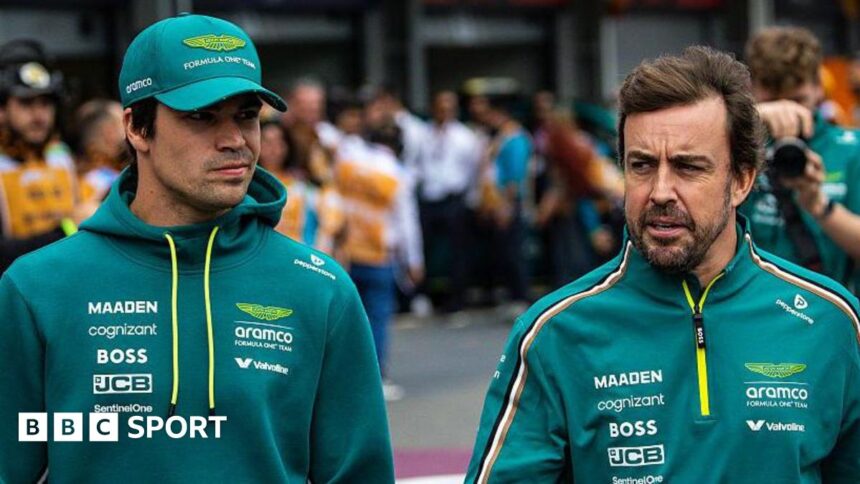
The glitz and glamour of a new Formula 1 season often masks the brutal, unseen battles fought within the machinery. For Aston Martin, the 2025 campaign is beginning not with a roar of ambition, but with a shudder of profound concern. In a startling revelation on the eve of the season-opening Australian Grand Prix, the team’s newly appointed principal, the legendary designer Adrian Newey, has issued a dire warning: the Honda power unit is not just unreliable—it is a potential health hazard to drivers Lance Stroll and Fernando Alonso.
A Crisis of Vibration: More Than Just a Performance Issue
Pre-season testing is meant to be a period of optimization, a final shakedown to iron out the creases. For Aston Martin, it was a stark exposure of a fundamental flaw. The team completed the lowest mileage of any squad, a statistic that immediately raised red flags. Newey, in his characteristically analytical yet blunt manner, laid bare the root cause: debilitating vibrations emanating from the Honda engine.
This isn’t merely an annoyance or a threat to component lifespan. Newey’s analysis points to a grave physiological risk. “The vibrations from their Honda engine are risking permanent nerve damage for their drivers within 25 laps of running,” he stated. This transforms the narrative from a technical setback into a critical safety and welfare issue. The constant, high-frequency shaking is transmitted directly through the chassis and into the drivers’ bodies, particularly their hands and arms.
Medical experts in motorsport have long studied the effects of vibration on drivers. Prolonged exposure can lead to Hand-Arm Vibration Syndrome (HAVS), a permanent condition causing numbness, reduced grip strength, and white finger. For an F1 driver, whose tactile feedback and millisecond reactions are paramount, such damage could be career-altering.
Newey’s Diagnosis: Reliability in Tatters, Potential Crippled
Adrian Newey’s remarks have pulled back the curtain on a partnership, between Honda and Aston Martin, that is already in crisis. His technical assessment was scathing and precise.
- Chassis Integrity Under Threat: “That vibration into the chassis is causing a few reliability problems,” Newey confirmed. This means ancillary parts—sensors, electronics, hydraulic lines—are being shaken loose or to failure.
- Performance Paralyzed: With such fundamental instability, the team cannot begin to explore the performance window of their new car. Set-up work, tire understanding, and fuel load runs are all secondary when the core power unit cannot run cleanly.
- Strategic Nightmare: The specter of not finishing races, or being forced into conservative engine modes that sacrifice lap time, now hangs over the team. The goal shifts from points to mere survival.
For drivers of the caliber of Fernando Alonso, a two-time champion in the twilight of his career, and Lance Stroll, this situation is a profound frustration. Their feedback, crucial for development, is being drowned out by a problem they cannot drive around.
The Australian GP: A Weekend of Damage Limitation
Melbourne’s Albert Park circuit, with its mix of high-speed sweeps and brutal stop-start sections, is a severe test of a car’s integrity. For Aston Martin, the weekend is already compromised. The team’s potential is not merely reduced; it is being dictated by a health and safety protocol that doesn’t yet officially exist.
We can expect to see several telling signs of the crisis in the Aston Martin garage:
- Severely Limited Running: Practice sessions will likely see the cars return to the garage early, not for set-up tweaks, but to assess driver well-being and component wear.
- Aggressive Power Unit Management: Honda engineers will be forced to run the engine in detuned modes to dampen vibrations, sacrificing crucial horsepower.
- The 25-Lap Threshold: Newey’s specific mention of “within 25 laps” will become a key metric. Will drivers be physically pulled from the car if symptoms arise? This creates an unprecedented strategic and ethical dilemma mid-race.
The team’s objective is no longer about beating a rival like McLaren or Mercedes. It is about reaching the checkered flag without inflicting harm on their drivers or suffering a terminal mechanical failure. Points would be a miraculous bonus.
Long-Term Implications: A Partnership on Shaky Ground
The ramifications of this crisis extend far beyond the time sheets in Melbourne. Adrian Newey, brought in as a visionary to elevate Aston Martin to championship contention, has immediately been handed his greatest challenge—one rooted not in aerodynamics, but in a partner’s fundamental mechanical failing.
Honda’s reputation, rebuilt through successful years with Red Bull, is now under intense scrutiny. The question being asked up and down the paddock is not about horsepower, but about basic engineering duty of care. Can the vibration issue be solved with a short-term fix, or does it require a fundamental redesign—a process that could take months?
For the drivers, the season becomes a physical and mental marathon. Alonso, renowned for his relentless motivation, must now weigh his competitive fire against the risk of long-term injury. Stroll faces the same harrowing calculation. The team’s morale and development trajectory are at severe risk of stalling before the season has properly begun.
Conclusion: A Warning Heard Around the Paddock
Adrian Newey has done more than outline his team’s pre-season troubles. He has sounded an alarm that resonates at the very intersection of technology and human performance in Formula 1. The issue at Aston Martin is no longer about lap times or podium finishes; it is about the duty of care a team owes to its drivers. The vibrations from the Honda engine represent a clear and present danger, threatening not just reliability, but the long-term health of two athletes. As the lights go out in Melbourne, the world will be watching not just to see who wins the race, but to see if Aston Martin can simply survive it. The 2025 season has begun under a cloud for the team in green, a cloud filled not with rain, but with the ominous, debilitating hum of a crisis that must be solved before ambition can ever be realized.
Source: Based on news from BBC Sport.