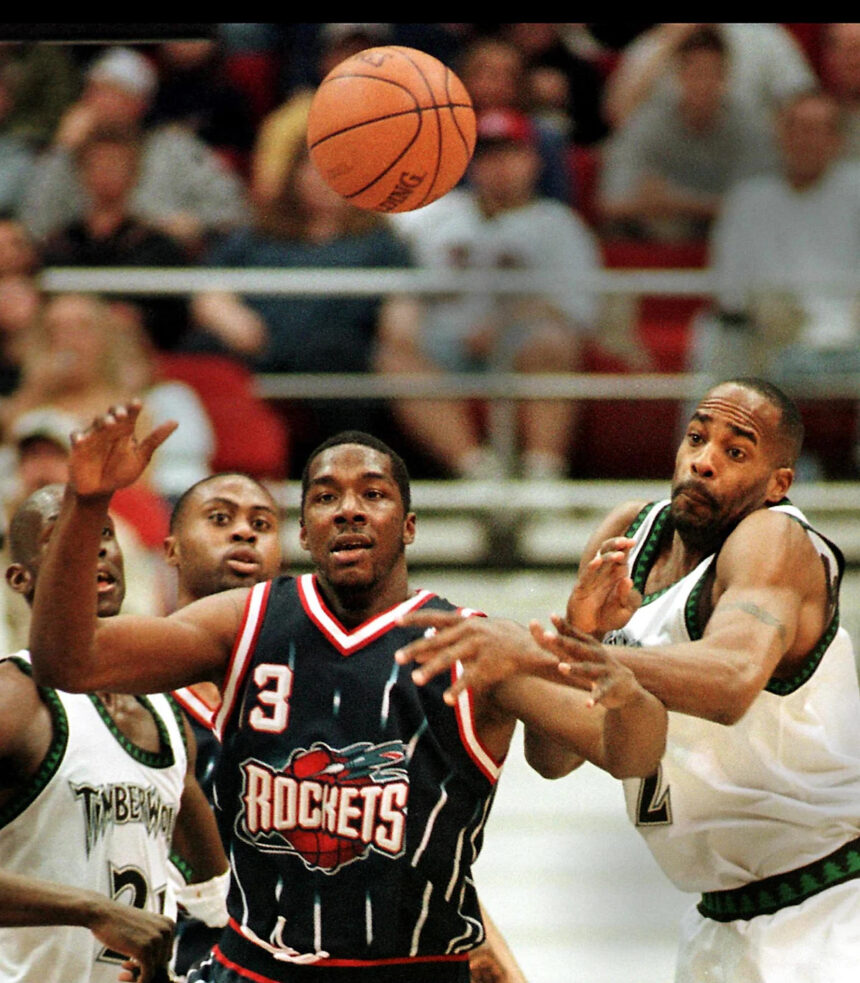
Anthony Miller and the No. 9: A Brief, Unforgettable Chapter in Houston Rockets Jersey History
In the vast tapestry of the Houston Rockets franchise, woven with the threads of Hall of Famers, championship parades, and retired jerseys hanging from the rafters, there exists a rich, often overlooked substrata of players. These are the journeymen, the role players, the brief flashes in the pan whose contributions, however fleeting, are stitched into the fabric of the team’s identity. To honor this complete history, we continue our deep dive into every jersey number ever worn. With 52 different jersey numbers donned by nearly 500 players since 1967, each digit carries a story. Today, we focus on jersey No. 9 and one of its twenty bearers: forward Anthony Miller, whose two separate tenures with the Rockets in the 1999-2000 season encapsulate the transient nature of professional sports.
The No. 9 Legacy: More Than a Number in Transition
Before examining Miller’s unique path, it’s crucial to understand the context of the number he wore. In Houston, jersey No. 9 has never been immortalized by a single franchise icon. Instead, it has been a number of transition, worn by a diverse group of players from different eras—from early 70s guard Mike Newlin to modern-era guard Eric Gordon, who helped define the “Seven Seconds or Less” revival. It’s a number that represents the constant churn of an NBA roster, a digit waiting for a permanent home but often serving as temporary lodging. Anthony Miller’s relationship with the Rockets and the No. 9 is a perfect case study in this nomadic legacy. His story isn’t one of statistical dominance, but of resilience, timing, and the complex mechanics of NBA roster management at the turn of the millennium.
Anthony Miller’s Winding Road to Houston
Anthony Miller’s journey to Clutch City was anything but direct. A standout at Michigan State, he was selected 39th overall in the 1994 NBA Draft by the Golden State Warriors, only to be traded on draft night to the Los Angeles Lakers. After two seasons in L.A. and a stint with the Atlanta Hawks, the Benton Harbor, Michigan native found himself as a free agent in the lockout-shortened 1999 season. The Rockets, navigating the twilight of the Hakeem Olajuwon era and seeking athletic, defensive-minded depth, signed Miller. He was a 6-foot-9 forward known for his energy, rebounding, and ability to defend multiple positions—a classic “glue guy” for a team in flux.
Miller’s first stint in Houston during the 1999-2000 season was brief. He played 31 games, averaging 2.6 points and 2.8 rebounds in limited minutes. His role was specific: provide defensive intensity, crash the boards, and complement offensive talents like Olajuwon and Steve Francis. However, in a move that highlights the business side of the league, Miller was waived in February 2000 and promptly returned to the Atlanta Hawks. This, however, was not the end of his Rockets saga. In a twist of fate, the Hawks waived him just over a month later, and the Rockets, still in need of his specific skill set for a playoff push, re-signed him in April 2000. This unique double-dip in a single season makes Miller one of the more curious footnotes in franchise history.
- Draft Pedigree: Second-round pick (39th overall) in 1994 by Golden State.
- Pre-Houston Career: Played for Lakers and Hawks, establishing himself as a defensive specialist.
- 1999-2000 Season Arc: Signed with Rockets, waived and signed with Hawks, waived and re-signed with Rockets—all within a single campaign.
- On-Court Profile: Energy big, defensive versatility, and rebounding off the bench.
Expert Analysis: The Value of the “Interim” Player
From a historical and team-building perspective, Anthony Miller’s tenures exemplify the critical role of the interim player. The late 90s Rockets were a team caught between eras. Analyzing this period, one sees a franchise trying to extend its championship window while simultaneously integrating young stars. Players like Miller were essential buffers. They were low-cost, high-effort veterans who could stabilize the second unit, mentor younger players through their professionalism, and absorb difficult defensive assignments. While his per-game stats for the Rockets—3.0 points and 3.2 rebounds over 44 total games—won’t headline any record books, his value was in the intangible stability he provided during a season of roster instability.
Furthermore, his quick return to the team in April 2000 is a testament to how well he fit the specific, unglamorous needs of the roster. The front office, led by then-General Manager Carroll Dawson (whose own legacy includes a non-numbered jersey honor), identified a known quantity who understood the system and could contribute immediately without a learning curve. In the modern analytics-driven NBA, we might call this “minimizing transaction costs.” In Miller’s day, it was simply about finding a reliable professional when you needed one most.
Predictions: The Future of Jersey No. 9 in Houston
The legacy of jersey No. 9 in Houston is poised for a fascinating evolution. While Anthony Miller and others have worn it well, the number recently gained significant prominence during Eric Gordon’s long and impactful tenure, which included a Sixth Man of the Year award and key playoff performances. Gordon’s success has redefined the modern memory of the number, associating it with clutch shooting and veteran leadership. Looking ahead, the prediction for No. 9 is that it will continue to be a number of weight and expectation, not one relegated to obscurity.
Future Rockets who choose No. 9 will inherit a digit with a more storied recent past. It is unlikely to be retired in the near future, but it may become a number sought by confident players looking to carve their own path while acknowledging the gritty contributors like Miller and the prolific scorers like Gordon who came before them. The number now carries a dual narrative: the journeyman’s resilience and the specialist’s excellence.
Conclusion: An Essential Thread in the Fabric
Anthony Miller’s chapter in Houston Rockets jersey history is short, but it is profoundly instructive. It reminds us that a franchise’s story is not written solely by its superstars. It is compiled through the collective efforts of every player who checks into a game, every practice player who pushes the starters, and every professional who wears the logo, even if twice in one season. Miller’s No. 9 represents the relentless churn of an NBA season, the strategic calculations of a front office, and the quiet dignity of a player ready to contribute whenever called upon.
As we continue to chronicle the 52 different jersey numbers and the just under 500 players who have worn them, we honor the full spectrum of contribution. The retired jerseys of Hakeem Olajuwon, Clyde Drexler, and Yao Ming tell the story of peaks reached. The jersey of Anthony Miller, and the No. 9 he wore during his transient, two-stint season, tells the story of the journey itself—a vital, unglamorous, and completely essential part of Houston Rockets history.
Source: Based on news from Yahoo Sports.