George Russell’s Masterclass: A VSC Gamble Propels Mercedes to Dominant 1-2 in Melbourne
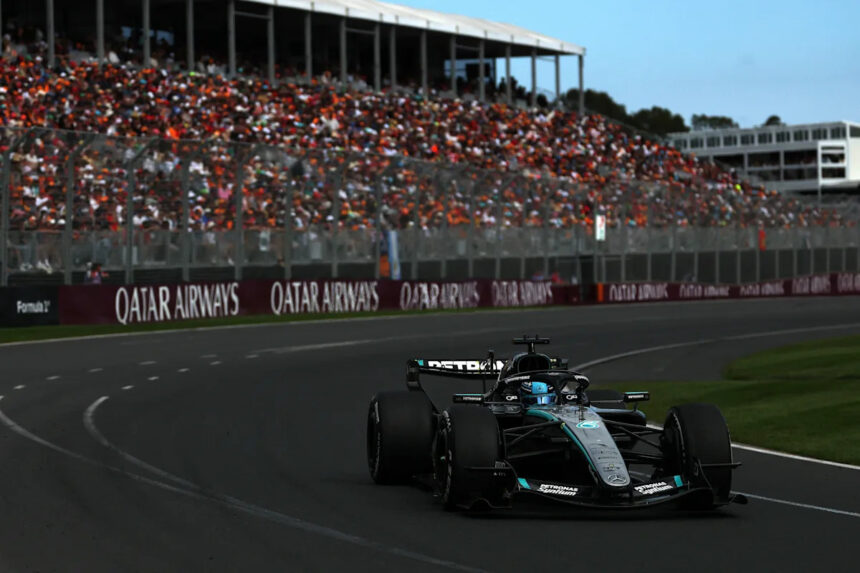
The roar of Albert Park was silenced, replaced by the calculated whispers of pit wall strategy. In a season-opening Australian Grand Prix that hinged on a fleeting digital signal, George Russell transformed a bold gamble into a commanding victory. The 2026 Formula 1 season ignited not with wheel-to-wheel fireworks, but with a cerebral demonstration of strategic foresight from Mercedes, as Russell and rookie teammate Kimi Antonelli seized an early Virtual Safety Car to orchestrate a stunning 1-2 finish, leaving the scarlet Ferraris chasing shadows in their wake.
The Decisive Moment: A Digital Opportunity Seized
From pole position, Russell faced immediate pressure from Charles Leclerc’s Ferrari. The opening laps were a tense duel, the lead trading hands as each driver probed for weakness. The race’s pivotal moment arrived not from a pass, but from a failure. On Lap 12, Red Bull’s Isack Hadjar succumbed to an engine issue, parking his car and triggering a Virtual Safety Car. The entire grid faced a binary, high-stakes decision: pit now for cheap time loss, or commit to the long game.
Mercedes’ call was instantaneous and decisive. Both Russell and Antonelli dived into the pits for fresh rubber. Ferrari, with Leclerc and Lewis Hamilton, stayed out. “It was a split-second call,” Russell explained post-race. “We saw the VSC notification and immediately knew it was our window. The team was flawless.” This understated move created the foundation for victory. Pitting under VSC, where cars must slow significantly, saves precious seconds compared to a stop under full green-flag racing conditions.
The critical consequence unfolded later. When the leading Ferraris eventually made their solitary stops under full racing speed, their time loss was far greater. The Mercedes duo, now on a different strategic sequence, emerged with a net advantage. They had used the sport’s digital caution period to build an invisible, yet decisive, buffer.
Tyre Preservation and Pace: The Dual Mercedes Masterstroke
Mercedes’ early pit stop presented a new, seemingly insurmountable challenge: making a set of tyres last for a mammoth 46-lap final stint. The prevailing pre-race wisdom deemed it impossible. Ferrari, committed to a one-stop strategy themselves, surely expected the Silver Arrows to fade into a costly second stop.
This is where Mercedes’ hidden strength exploded into view. The W15 possessed not just raw speed, but a kindlier temperament towards its Pirelli rubber. Russell, with a championship contender’s poise, managed his pace with metronomic precision. He carved through the necessary lap times while nursing his tyres with a surgeon’s care. The anticipated performance drop-off never came. Instead, Russell maintained a gap that neutered any strategic threat from Leclerc.
Key Mercedes Advantages:
- Strategic Agility: The instant decision to double-stack under the VSC.
- Race Pace: The ability to run at a competitive pace while preserving tyre life.
- Car Kindness: The W15’s inherent design, which is less punishing on its tyres over long stints.
- Driver Discipline: Russell’s expert management of gaps and tyre resources.
Antonelli, in only his second Grand Prix start, mirrored his teammate’s discipline to secure a dream podium, completing a result that signals a potent shift in the team’s competitive dynamic.
2026’s Early Landscape: Ferrari’s Conundrum and the Chasing Pack
While Mercedes celebrated, Ferrari was left to analyze a race of “what-ifs.” Their SF-26 clearly had the qualifying pace, but their race strategy proved rigid. By not reacting to Mercedes’ VSC stop, they handed their rivals the strategic initiative. Leclerc and Hamilton, finishing third and fourth respectively, were never able to truly challenge despite having theoretically the correct one-stop plan. Their dilemma underscores a new era where strategic reactivity may be as important as outright car performance.
Further back, the narrative was one of damage limitation. 2025 champion Lando Norris labored to a distant fifth for McLaren, a sobering reality check after last year’s triumphs. Max Verstappen’s weekend was one to forget for Red Bull; a qualifying crash left him 20th on the grid, and a recovery drive to sixth, while spirited, highlighted that the reigning constructors’ champions face a steep climb to reclaim their dominance.
The early 2026 championship odds, which had already installed Russell as the favorite, will now solidify around the Briton. This victory was a statement of intent: he possesses the speed, the strategic mind, and now, the machinery to mount a sustained title challenge.
Expert Analysis & Predictions: Is This Mercedes’ Year?
This Melbourne victory was a textbook display of modern Formula 1 supremacy. It wasn’t won purely on Saturday, nor solely on Sunday afternoon. It was won in the factory, through simulations that calculated the VSC gamble’s viability, and in the driver’s mind, through flawless execution. Mercedes demonstrated a holistic package that Ferrari currently lacks: a fast car that is also a kind car, paired with razor-sharp strategic wit.
Looking ahead, the 2026 season promises a fascinating duel. Ferrari has the one-lap speed and must now match Mercedes’ strategic flexibility. For Mercedes, the challenge is to prove this performance is replicable across different circuit layouts and tyre compounds. The pressure now shifts to Kimi Antonelli; can the prodigy consistently deliver results that support a team championship bid?
Season Predictions:
- The Mercedes vs. Ferrari battle will define the constructor’s championship, with Mercedes holding the early psychological edge.
- George Russell enters as the clear driver’s championship favorite, with a mature, complete performance in Melbourne.
- Red Bull and McLaren have significant ground to recover, potentially turning the early season into a two-team fight.
- Strategy, and capitalizing on “freestyle” moments like VSCs and Safety Cars, will be more crucial than ever.
Conclusion: A New Era Dawns in Albert Park
The 2026 Australian Grand Prix will be remembered as the day Mercedes announced its full return to the pinnacle of the sport. George Russell’s victory was a triumph of intellect over instinct, of patience over pure aggression. By masterfully leveraging a virtual safety car and then defying tyre-wear physics, he and his team authored a victory that resonates with strategic brilliance. While Ferrari licks its wounds and the chasing pack regroups, Mercedes leaves Melbourne with maximum points and a potent message: they are not just fast, they are smart. And in the complex, high-stakes chess game of modern Formula 1, that combination may be the most formidable advantage of all. The season is long, but the first move, decisively, belongs to George Russell and Mercedes.
Source: Based on news from Yahoo Sports.