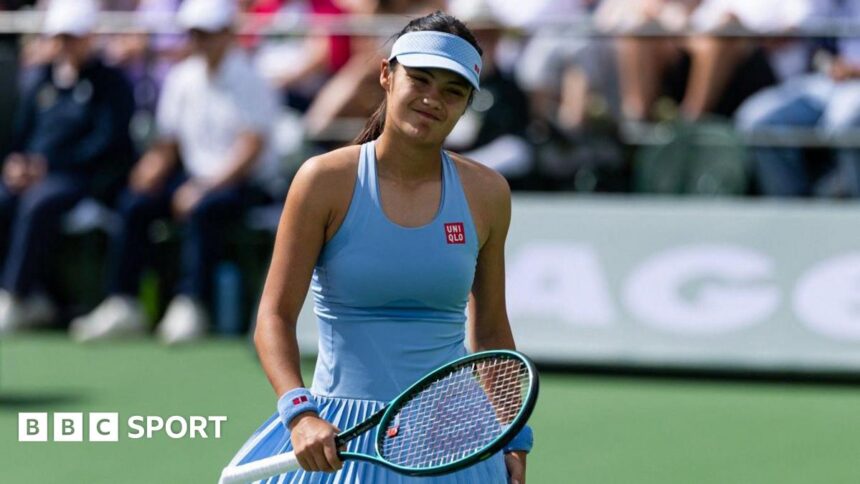
Raducanu Overpowered in 52-Minute Indian Wells Thrashing by Anisimova
The bright California sun at the BNP Paribas Open offered no warmth for Emma Raducanu. In a stark, 52-minute demonstration of power and precision, the British star was dismantled 6-1, 6-1 by a resurgent Amanda Anisimova, a result that lays bare the brutal realities of the sport’s top tier and raises urgent questions about Raducanu’s current trajectory.
A Match Unraveled From the First Ball
From the moment Raducanu’s opening service game was broken, an ominous pall settled over Stadium 1. This was not a match of epic rallies or gradual momentum shifts. It was a systematic deconstruction. Anisimova, the American sixth seed playing with a point to prove after a mental health hiatus, came out with ferocious intent. Her blistering groundstrokes, particularly a searing cross-court backhand, pinned Raducanu deep behind the baseline, robbing her of time and any offensive footing.
The first set was a statistical nightmare for the 2021 US Open champion. She managed to win just 11 total points as Anisimova’s aggressive returning and first-strike tennis proved unanswerable. Raducanu’s serve, often a barometer for her confidence, lacked pop and placement, offering Anisimova sitting ducks to punish. The pattern was relentless: deep return, forcing shot, error or winner from the American. The set was over in a blink, a 6-1 scoreline that felt even more dominant than it read.
Anisimova’s Relentless Onslaught: A Masterclass in Pressure
This was not merely a case of Raducanu playing poorly; it was a case of Anisimova refusing to let her play at all. The American’s performance was a textbook display of controlled aggression. She executed a flawless game plan with chilling efficiency.
- First-Serve Dominance: Anisimova’s powerful first serve consistently set up short replies, which she devoured with her forehand.
- Returning Prowess: She stood inside the baseline to receive Raducanu’s second serve, applying immediate pressure and dictating the point from shot one.
- Minimal Unforced Errors: Crucially, this was smart, disciplined power. Anisimova kept her error count remarkably low, forcing Raducanu to be the one to produce miraculous shots—a near-impossible task.
For Raducanu, there were no rhythms to find, no chinks in the armor to exploit. Every attempted shift in tactic was met with a louder, cleaner winner from the opposite side of the net. The second set followed an identical pattern, with Raducanu falling 3-0 behind before finally registering a hold of serve—a small consolation that barely slowed Anisimova’s march to victory.
Expert Analysis: Where Does Raducanu Go From Here?
This loss, particularly its emphatic nature, is a significant data point in Raducanu’s complex post-US Open journey. The analysis must move beyond a single bad day. The core issue exposed was a glaring gap in firepower and match readiness against the tour’s elite ball-strikers. While Raducanu’s variety and feel are assets, they are neutralized when she is perpetually on the back foot, unable to implement her own game.
Her physical development remains a key narrative. Competing against athletes like Anisimova, who can generate effortless power, requires a foundation of strength and explosive movement that allows for proactive, not just reactive, tennis. Furthermore, the constant changes in her coaching team have led to questions about the long-term technical and tactical stability in her game. In matches like these, ingrained patterns and a clear, default game identity are crucial for survival.
Contrast this with Anisimova, who has returned to the tour with a clear mind and a refined, powerful game. Her performance signaled not just a win, but a statement that she is once again a legitimate threat on the WTA Tour. For her, this is a springboard. For Raducanu, it is a stark reminder of the mountain still to climb.
Predictions and the Road Ahead
The immediate aftermath of this defeat will require careful management. The mental resilience Raducanu has shown in the past will be tested as she processes a performance where she was, frankly, not competitive. The key will be to frame this not as a catastrophe, but as a clear diagnostic of the work required.
Looking ahead, her schedule and preparation for the clay and grass seasons will be scrutinized. Does she need more matches at a slightly lower level to build confidence and match sharpness? Or is the only way through continued baptism by fire against top-20 opponents? The prediction here is that Raducanu and her team will likely seek a balance—targeting events where she can string together wins to rebuild, while understanding that breakthroughs come from confronting the very challenges Anisimova presented.
For Amanda Anisimova, predictions now shift to deep tournament runs. With this brand of tennis, she has the weapons to challenge anyone. Her draw at Indian Wells has opened up, and she instantly becomes a dark horse for the title. Her journey back adds a compelling layer to the WTA landscape.
Conclusion: A Sobering Lesson in the Desert
Emma Raducanu’s 52-minute defeat at Indian Wells was a sobering spectacle. It was a match that highlighted the unforgiving nature of professional tennis, where technical and physical gaps can be exploited mercilessly. While days like these happen to every athlete, the task for Raducanu is to ensure it becomes an outlier, not a pattern.
The path forward is arduous. It demands a commitment to physical development, tactical consistency, and the patience to build a game robust enough to withstand, and eventually counter, the Anisimovas of the tour. This thrashing in the California desert is not the end of her story, but it may well be remembered as a pivotal, painful chapter that forced a necessary reckoning. The response to this adversity will define the next phase of Emma Raducanu’s career.
Source: Based on news from BBC Sport.