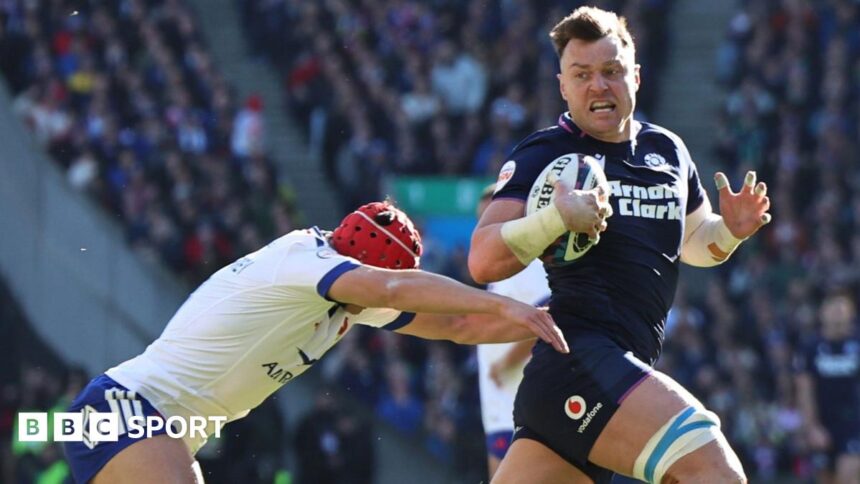
From Roman Ruin to Parisian Prowess: Scotland’s Stunning Six Nations Resurrection
The image was one of abject despair. Under a deluge in Rome, Scotland’s players stood motionless, hands on heads, as Italian jubilation swirled around them. The 31-29 defeat to Italy in Round Three of the 2024 Six Nations wasn’t just a loss; it felt like a terminus. The spectre of a Wooden Spoon loomed, and the obituaries for Gregor Townsend’s tenure were being drafted. The narrative was set: another promising Scottish campaign had crumbled under the weight of its own inconsistency. Yet, in the space of one transformative month, that narrative has been ripped up and rewritten in the most spectacular fashion. From the brink of disaster, Scotland now stands on the edge of glory, one monumental Parisian performance away from a historic championship.
The Roman Monsoon: A Campaign Under Water
To understand the scale of the turnaround, one must first revisit the depth of the crisis. The Stadio Olimpico defeat was a microcosm of Scotland’s perennial flaws. A bright start evaporated, defensive structure disintegrated, and crucial moments swung against them. The post-mortem was brutal and universal. Questions about leadership, tactical rigidity, and mental fragility were not just asked but screamed. The weather was Biblical, and the criticism felt equally unrelenting. With a trip to Dublin to face an all-conquering Ireland next on the docket, the championship threatened to spiral into humiliation. The team had hit rock bottom, but as the cliché goes, it provided the solid foundation from which to rebuild.
Key Failings in Rome:
- Defensive Disintegration: Missed tackles and systemic breakdowns allowed Italy easy gains.
- Game Management: Lost composure and control during the critical final quarter.
- Set-Piece Vulnerability: The platform for Scotland’s attack was inconsistently secured.
The Dublin Catalyst: A Performance of Grit and Belief
Facing an Ireland side chasing a historic back-to-back Grand Slam, Scotland were written off as cannon fodder. What transpired was the antithesis of Rome. This was a performance forged not in fluent attack, but in granite-like defiance. The defence, so porous in Italy, became an impenetrable wall. Players like Rory Darge and Jack Dempsey put in heroic, tackle-heavy shifts. The line-out, a weakness, became a strength. They played the territory game with a savvy that belied their chaotic previous outing. Although they lost 17-13, the performance was a revelation. They had gone toe-to-toe with the world’s best and proved they could win the arm-wrestle. The defeat yielded something more valuable than points: an unshakeable belief and a clear identity. The disaster had been averted; a new path was charted.
Analysing the Blueprint: How Scotland Learned to Stretch Teams
The newfound confidence from Dublin exploded into a breathtaking attacking display against England at Murrayfield. Here, the strategic evolution under Townsend became crystal clear. Scotland had developed a clear plan to stretch France and every other opponent, moving away from one-off runners to a multi-phase, multi-threat system. The analysis is compelling:
By using Finn Russell as a first receiver deeper in the pocket, they bought time and opened passing lanes. The introduction of Kyle Rowe and the form of Duhan van der Merwe gave them lethal width. Crucially, the forwards were no longer just carriers; they became key distributors, with players like Grant Gilchrist and Pierre Schoeman executing subtle tip-ons and soft passes to fix defenders. This created the “stretch” – forcing defences to make impossible choices between committing to the inside channel or fanning out to cover the speedsters wide. The result was gaps appearing everywhere, most famously for Van der Merwe’s stunning long-range try. The plan was no longer just hope; it was a repeatable, devastating formula.
The Parisian Finale: One Game for Glory
And so, the stage is set for a finale few could have imagined after that sodden evening in Rome. Scotland travels to Paris knowing a victory with a bonus point, coupled with other results falling their way, could deliver a first Six Nations title since the last Five Nations in 1999. The challenge is Herculean: France in Paris remains one of the ultimate tests in rugby, even with Les Bleus’ own stuttering campaign. But this Scotland side is now armed with something more powerful than mere talent: proven resilience and a tactical blueprint that works.
Key Battlegrounds for Victory in Paris:
- Win the Collision Zone: Match the physicality of the French pack to provide Russell with a platform.
- Discipline Under Fire: The cauldron of the Stade de France demands cool heads and low penalty counts.
- Execute the Stretch: Faithfully implement the width-based gameplan that has unlocked every defence since Dublin.
- Embrace the Moment: Channel the pressure of the occasion into focused intensity, not nervous inhibition.
The prediction is fraught with difficulty, but the trend is undeniable. This Scottish team has shown an incredible capacity to learn and adapt. They will not fear France. They will back their system, their rediscovered defensive grit, and their mercurial playmaker to orchestrate the play. A championship win may require fortune elsewhere, but securing a historic victory in Paris is now a tangible, achievable goal.
Conclusion: A Phoenix Forged in Adversity
Scotland’s journey from the Roman ruins to the edge of glory is a masterclass in sporting resilience. It is a story of a squad and coaching staff staring into the abyss, choosing unity over fracture, and meticulously engineering a revival. They transformed a crisis of identity into a clarity of purpose, replacing fragility with a formidable, dual-edged style of play. Whether or not the final chapter of this Six Nations story ends with a trophy, the transformation is already complete. They have shed the ‘nearly-men’ tag, proving they can win ugly in Dublin and win beautifully at Murrayfield. The rain in Rome now seems not like an ending, but a necessary cleansing. As they walk out in Paris, they carry not the burden of past failure, but the hard-earned belief of a team reborn. From the brink, they have arrived at the edge. Now, they have one final, glorious step to take.
Source: Based on news from BBC Sport.