From the Pitch to Asylum: How Five Iranian Soccer Players Found Refuge Amid Geopolitical Tension
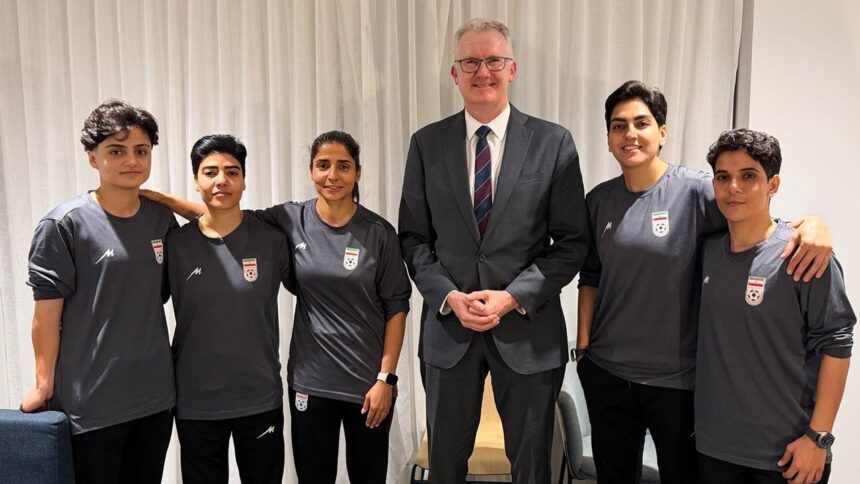
The world of international sports is often a stage for geopolitics, but rarely does the drama unfold with such high-stakes consequences. In a move that underscores the intersection of athletic courage, human rights, and global power plays, five members of the Iranian women’s national soccer team have been granted asylum in Australia. This decision, announced by Australian Home Affairs Minister Tony Burke, followed a perceived political stand by the athletes and direct pressure from former U.S. President Donald Trump. Their journey from a hotel in Gold Coast to a “safe location” under federal police escort is more than a sports story; it is a stark emblem of the ongoing struggle for freedom and the complex ways in which that struggle is amplified on the world stage.
The Defiant Gesture and the Swift Political Backlash
The seeds of this asylum case were sown during the Women’s Asian Cup. While details of the players’ specific actions remain guarded for their safety, reports indicate they engaged in a quiet but unmistakable gesture of solidarity with the “Woman, Life, Freedom” movement that has swept Iran. In the hyper-scrutinized environment of international sport, where Iranian athletes are often seen as extensions of the state, even a subtle act of defiance carries immense risk.
The repercussions were swift. The players faced immediate threats of reprisal upon any potential return to Iran. Their situation became a geopolitical flashpoint when former President Donald Trump publicly pressured the Australian government to offer them protection. This unusual intervention from a foreign political figure catapulted their personal plight into the arena of international diplomacy. Australia’s asylum decision, therefore, was not made in a vacuum. It was a calculated humanitarian response made under the glare of significant global attention and political pressure, balancing moral imperative with diplomatic considerations.
A Broader Canvas: AI, Strikes, and the Shadow of Conflict
To understand the full gravity of this asylum story, one must view it against the tense backdrop of U.S.-Iran relations. Concurrently, discussions in U.S. policy circles reveal a technological hardening of stance. Greg Allen, director of the CSIS Wadhwani AI Center, recently detailed on ‘The Will Cain Show’ how the United States is utilizing artificial intelligence to identify and strike Iran’s mobile missile launchers with increasing speed and precision.
This creates a profound dichotomy in how Iran is engaged by Western nations:
- Military & Strategic Pressure: The use of advanced AI for counter-proliferation strikes represents a high-tech, lethal form of state-to-state pressure aimed at degrading military capabilities.
- Symbolic & Humanitarian Pressure: Granting asylum to female athletes who defy the regime represents a soft-power, values-driven form of pressure aimed at highlighting human rights abuses and supporting civil society.
These five soccer players, perhaps unwittingly, became pawns—and then symbols—in this multifaceted confrontation. Their asylum is both a life-saving act and a political statement, echoing the same fundamental criticisms of the Iranian regime that underpin the AI-driven military strategy.
Expert Analysis: The Precedent and the Message
Sports policy and human rights analysts see this event as a significant precedent. “This isn’t just about five athletes,” notes Dr. Anya Petrova, a scholar of sport and geopolitics. “It signals to dissident athletes worldwide that if their profile is high enough and the political winds are right, sanctuary is possible. However, it also risks politicizing asylum in a way that could be problematic.” The direct link to Trump’s pressure raises questions about the consistency of humanitarian responses and whether similar athletes without such high-profile advocacy would receive the same treatment.
The message to Tehran is multifaceted. On one hand, it demonstrates international support for those challenging the regime’s norms. On the other, it could lead to even tighter restrictions on athletes traveling abroad, potentially isolating Iranian sports further. The Australian federal police operation to spirit the women to safety was a clear acknowledgment of the credible and immediate threat they faced, validating the concerns raised by their supporters.
The Future: Predictions for Sports and Dissent
This incident will likely have ripple effects across international sport and diaspora politics. We can anticipate several developments:
- Increased Scrutiny on Iranian Athletes: Iranian sports delegations at future events will be under a microscope, both by their own minders and by international media watching for signs of protest.
- Asylum as a Potential Pathway: Other Iranian athletes, and possibly artists and academics, may see seeking asylum during international travel as a viable, though perilous, option.
- Retaliation and Rhetoric: Iran will likely condemn Australia’s move as a “politically motivated stunt” and may impose sporting bans or other penalties on the athletes in absentia.
- Normalization of Tech-Enabled Pressure: The parallel tracks of AI-driven military strategy and symbolic humanitarian support will continue to define Western policy toward Iran, creating a constant state of multi-domain pressure.
The lives of these five women are forever changed. Their careers as national team players for Iran are almost certainly over, but new chapters—and potentially powerful advocacy roles—now begin. They join a growing diaspora of Iranian women who have used global platforms to speak out against oppression.
Conclusion: A Victory with Complex Roots
The asylum granted to these five Iranian soccer players is a profound human victory, a testament to their bravery and a lifeline seized from the jaws of political turmoil. Their safe haven in Australia is a cause for celebration. Yet, the path to that safety was paved with complex and uncomfortable realities: the instrumentalization of their plight by a U.S. political figure, and its occurrence alongside discussions of AI-targeted missile strikes.
Their story is a powerful reminder that in today’s interconnected world, a gesture on a soccer field can resonate in the halls of power, and the fight for individual freedom is inextricably linked to the vast and often chilling landscape of international conflict. They are now free, but their journey highlights a world where the beautiful game and the brutal calculations of geopolitics are forever intertwined.
Source: Based on news from Fox Sports.