Police Chief’s Blunt Rebuke: A Watershed Moment for the Old Firm and Scottish Football?
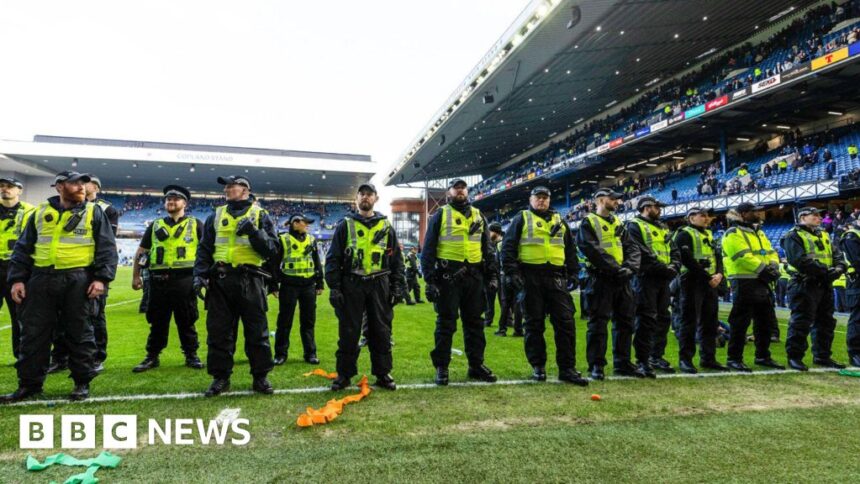
The final whistle had blown, the penalty shootout drama was settled, but the most troubling chapter of Sunday’s Old Firm clash was only beginning. As scenes of pitch invasions and violent disorder unfolded at Ibrox, casting a long shadow over Celtic’s victory, a familiar and grim narrative took hold. Yet, the response that followed has sparked a new and potentially more consequential controversy. Scotland’s most senior police officer has taken the unprecedented step of publicly censuring not just the fans involved, but the institutions of Celtic and Rangers themselves, accusing them of a “deafening silence” that speaks volumes.
A Condemnation Vacuum: The Chief Constable’s Unprecedented Stand
In a stark intervention at the Scottish Parliament, Chief Constable Jo Farrell moved the debate beyond the immediate arrests and injuries. Her core accusation was one of leadership failure. “No-one from either club has come out to condemn the disorder,” she stated, framing the clubs’ public relations silence as a critical part of the problem. For the head of Police Scotland to explicitly call out the two most powerful entities in Scottish sport by name marks a significant escalation. It signals that the authorities now view club responsibility and public condemnation not as optional goodwill gestures, but as fundamental components of fan behavior and public safety. Farrell’s revelation that she had not spoken to either club since Sunday further underscored a concerning communication chasm at the highest level.
The disorder itself was severe. Police officers and supporters were injured in chaotic scenes that spilled from the stands onto the pitch. This wasn’t mere exuberance; it was violence that left physical and reputational scars. The Chief Constable’s message was clear: ensuring safety is a shared burden. “More needs to be done to allow people to attend matches without fearing for their safety,” she asserted, placing the onus squarely on the clubs to be active partners in that mission, starting with the simple, powerful act of unequivocal denunciation.
Beyond the Bad Apples: Systemic Issues in the Old Firm Dynamic
To understand the weight of Farrell’s criticism, one must look beyond the isolated incidents. The Old Firm fixture’s unique societal pressure creates a tinderbox where historical rivalry, sectarian tension, and sporting passion combust. Expert analysis suggests that club communications do not operate in a vacuum; they are a key tool in either calming or inflaming this atmosphere.
- Leadership Signal vs. Fan Interpretation: A swift, joint, and unequivocal statement from both clubs condemning violence, irrespective of rivalry, sets a normative standard. Silence, or delayed condemnation, can be misinterpreted by factions within support as implicit tolerance.
- The “Condemnation Calculus”: Clubs often wrestle with a fear of alienating their own support bases. There is an unspoken anxiety that strongly worded rebukes might be seen as betraying “the faithful.” Farrell’s intervention challenges this calculus, positioning public safety as a non-negotiable priority above this perceived risk.
- Accountability Escalation: Police Scotland’s direct appeal to Parliament suggests traditional behind-the-scenes lobbying may have failed. This public framing moves the issue from a football disciplinary matter to one of broader public order and civic duty.
The question now is whether the clubs have historically viewed their role as shepherds of their community’s culture, or as entities merely reacting to it. The Chief Constable’s comments demand they embrace the former.
Predictions and Repercussions: What Happens Next?
The fallout from this public rebuke will define the next era of Old Firm governance and fan relations. Several likely outcomes and pressure points are now in play.
Immediate Repercussions: Both Celtic and Rangers will almost certainly now issue detailed statements. The tone will be scrutinized: will they be generic appeals for calm, or will they specifically address the failures highlighted by Police Scotland? The Scottish FA and SPFL will be under pressure to launch their own investigations and consider sanctions that extend beyond fines, potentially impacting stadium operations or allocations.
Medium-Term Shifts: Expect intensified dialogue, likely mandated by governing bodies, between clubs, police, and government about a renewed, formal safety and security covenant. This could include:
- Pre-agreed protocols for joint, immediate public communication following any significant incident.
- Co-investment in enhanced stewarding training and pitch invasion deterrent technology.
- Explicit, club-driven campaigns that decouple fierce sporting rivalry from antisocial and violent behavior, championed by players and managers.
Long-Term Cultural Challenge: Ultimately, no police statement or club condemnation can instantly erase deep-seated issues. The true test is whether this moment becomes a footnote or a catalyst. Will both clubs consistently use their immense platforms to model a better, safer rivalry? Or will we witness a cyclical return to blame and recrimination when the next incident inevitably occurs?
A Line in the Sand: The Imperative for Leadership
Chief Constable Jo Farrell has drawn a very public line in the sand. Her testimony was not merely a report on disorder; it was a profound critique of leadership vacuum. The message to Celtic and Rangers is unambiguous: your social and civic responsibilities are as consequential as your sporting and financial ambitions. The safety of supporters and police officers is paramount, and your voice is a critical tool in preserving it.
The coming days will reveal whether the giants of Scottish football have listened. Will they retreat into fortress mentality, or will they seize this uncomfortable moment as an opportunity for genuine, collaborative leadership? The future safety of the Old Firm fixture, and the reputation of the Scottish game, hinges on their next move. The world is watching, and the silence, as the Chief Constable made devastatingly clear, is no longer an option. True rivalry thrives on passion, not violence, and it is the duty of those at the helm to protect that distinction.
Source: Based on news from BBC Sport.