Scotland Shake Up Pack for Monumental Dublin Mission in Six Nations Title Chase
The scent of history is in the air, but it is laced with the formidable challenge of a green mountain to climb. As Scotland’s rugby squad lands in Dublin, they carry not just their kit bags, but the burgeoning hope of a nation and the crushing weight of a stark statistical reality. Following a breathtaking, record-breaking 50-40 victory over France, Gregor Townsend’s men have engineered a shot at a first Six Nations title in 25 years. To seize it, they must achieve what no Scottish side has managed since 2010: conquer Ireland at the Aviva Stadium. Townsend has responded to this titanic task with three pivotal changes to his pack, signalling a clear intent to meet fire with fire.
A New-Look Engine Room: Williamson’s Debut and Gilchrist’s Steel
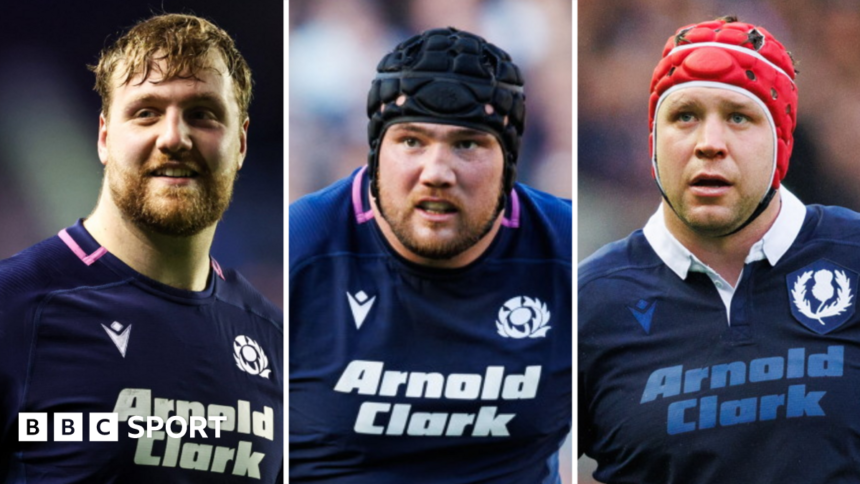
The most significant, and boldest, selection comes in the second row. With the experienced Richie Gray ruled out, Townsend has not opted for a like-for-like replacement. Instead, he has promoted 21-year-old Max Williamson to make his first international start, partnering the veteran Grant Gilchrist. This is a calculated gamble of immense proportions.
Williamson, of the Glasgow Warriors, represents the future. His selection is a testament to his rapid development and the coaching staff’s belief that his athleticism, lineout agility, and raw physicality can disrupt the Irish set-piece. Alongside him, Gilchrist provides the necessary grit, leadership, and tactical know-how. This new-look second row combination of youthful exuberance and grizzled experience is designed to challenge an Irish lineout that has been a cornerstone of their success. The duo’s primary mission will be to negate the influence of Tadhg Beirne and Joe McCarthy, a battle within the war that could dictate the flow of possession.
The return of Zander Fagerson to the starting tighthead prop berth is the other critical pillar of Townsend’s strategy. After featuring off the bench against France, Fagerson’s reinstatement brings back Scotland’s most destructive scrummaging force. His direct confrontation with Ireland’s Andrew Porter will be a visceral, set-piece showdown. A stable, or even dominant, Scottish scrum is non-negotiable to secure the platform required to unleash their electric backline.
- Max Williamson: The bold call. Athleticism and potential tasked with a Herculean debut.
- Grant Gilchrist: The steadying hand. Experience vital for composure in the Dublin cauldron.
- Zander Fagerson: The cornerstone. His scrum power is fundamental to Scottish parity.
The Stark Reality: History, Hype, and a French Favour
While the changes are intriguing, the historical context is daunting. Scotland’s sensational victory at Murrayfield has ignited belief, but the road to a title is littered with obstacles of their own making and others beyond their control.
Firstly, the Ireland hoodoo is a formidable psychological barrier. Scotland have lost their last 11 consecutive matches against Ireland, a run stretching back to 2017. Their last victory in Dublin was a 23-20 result in 2010, a lifetime ago in rugby terms. Furthermore, they have never won four games in a single Six Nations campaign—a feat they must achieve on Saturday.
Secondly, the championship equation is complex. Even a historic win in Dublin does not guarantee the trophy. Scotland also need defending champions France to slip up at home to England in the evening kick-off. This dual requirement—managing their own monumental task while hoping for a favour in Paris—adds a unique layer of tension.
Townsend has been keen to manage the external hype, deliberately playing down any “cup final” talk. “We’re fresh, we’re loving playing together,” he stated, focusing on performance rather than the prize. This mindset is crucial. The moment this Scottish side becomes consumed by the magnitude of the occasion and the weight of history is the moment Ireland, the world’s number two side, will pounce.
Tactical Tussle: Can Scotland’s Flair Overcome Irish Precision?
The match-up presents a classic clash of styles. Scotland, buoyed by scoring 50 points against France, will look to play at a high tempo, using the inventive distribution of Finn Russell and the broken-field threats of Duhan van der Merwe and Kyle Steyn. Their ruck speed and willingness to play from anywhere will be key.
Ireland, however, are the masters of controlled pressure. Under Andy Farrell, they execute a relentless, phase-based game suffocated by a brutal defensive line speed led by the likes of Peter O’Mahony and Caelan Doris. The key for Scotland will be winning the gain-line battle. If Fagerson’s scrum and the Williamson-Gilchrist partnership can secure clean ball, Russell has the tools to ask questions. If Ireland dominate the collision, they will strangle Scotland’s flow and grind them down through penalties and territory.
Scotland’s discipline will be under the microscope. Conceding cheap penalties against this Irish side is a death sentence, as they possess the kicking accuracy of Jack Crowley and the mauling prowess to convert every opportunity into points. The visitors must be as clinical in their defence as they are audacious in attack.
Prediction: A Bridge Too Far or a Date with Destiny?
This is the ultimate test of Scotland’s evolution. The victory over France proved their world-class attacking credentials and mental fortitude. However, Dublin is a different beast. The Aviva Stadium, with its expectant home crowd, is a fortress where Irish precision and physicality are magnified.
The smart money, given the historical data and Ireland’s consistent excellence, must lean towards a home victory. Ireland’s system and cohesion, even in transition, are a level above. They are unlikely to be as defensively porous as France were.
Yet, this Scottish team has a unique spark. If their new forward configuration fires, if they can weather the initial Irish storm and stay within a score heading into the final quarter, the pressure of the occasion could shift. The prediction is a brutal, tense, and physically exhausting contest.
Likely Outcome: Ireland to win by a margin of -7 to -10 points, their power game and home advantage proving decisive in the final third. Scotland will likely secure a try bonus point in a valiant effort, leaving them to rue the mathematics of the table and rue that elusive fourth championship win once more. However, in sport, logic is there to be defied. If Scotland can finally slay their Irish dragon, regardless of events in Paris, they will have authored one of the greatest chapters in their storied history.
Conclusion: More Than Just a Game
Saturday in Dublin transcends a mere rugby match. For Ireland, it is about finishing a campaign with a statement and honouring their departing icons. For Scotland, it is about confronting ghosts, breaking cycles, and proving that the exhilarating brand of rugby that dismantled France can travel and triumph on the grandest stages.
The three changes—Williamson, Gilchrist, Fagerson—are not just tactical tweaks; they are a declaration. A declaration that Scotland intends to fight for every inch, contest every set-piece, and meet Irish physicality head-on. Whether it will be enough remains the captivating question. Win or lose, this Scottish side has rekindled a flame. But in the cauldron of the Aviva, they have the chance to turn that flame into an inferno that burns away thirteen years of disappointment and lights the path to an impossible dream. The stage could not be more perfectly, or brutally, set.
Source: Based on news from BBC Sport.