Golf’s New Hard Line: Two-Shot Penalty for Misconduct Looms at The Open
The genteel world of professional golf has long traded on a currency of respect, etiquette, and self-governance. But after a season marred by visible outbursts, foul language, and damaged turf, the sport’s governing bodies are sending a clear signal: the patience has run out. In a landmark shift that will reverberate through the fairways of Royal Portrush this July, R&A chief executive Mark Darbon has confirmed that players guilty of on-course misconduct could face a two-shot penalty at The Open Championship.
- The Incidents That Forced Golf’s Hand
- What the Two-Shot Penalty Means for Players
- Expert Analysis: Is This a Necessary Evolution or an Overreach?
- Predictions: How the Open Championship Will Be Different
- The Bigger Picture: Golf’s Future in the Age of Accountability
- Conclusion: The Two-Shot Penalty Is Here to Stay
This is not a gentle tap on the wrist. This is a statement. For decades, golf has been reluctant to police emotion, preferring to rely on a player’s internal moral compass. But after a series of high-profile incidents at the season’s opening major—including Bob MacIntyre’s middle-finger gesture and Sergio Garcia’s tee-box tantrum—the sport is pivoting toward a zero-tolerance policy. As a journalist who has covered major championships from St. Andrews to Augusta, I can tell you: this is the most significant behavioral crackdown since the slow-play rules were tightened.
The Incidents That Forced Golf’s Hand
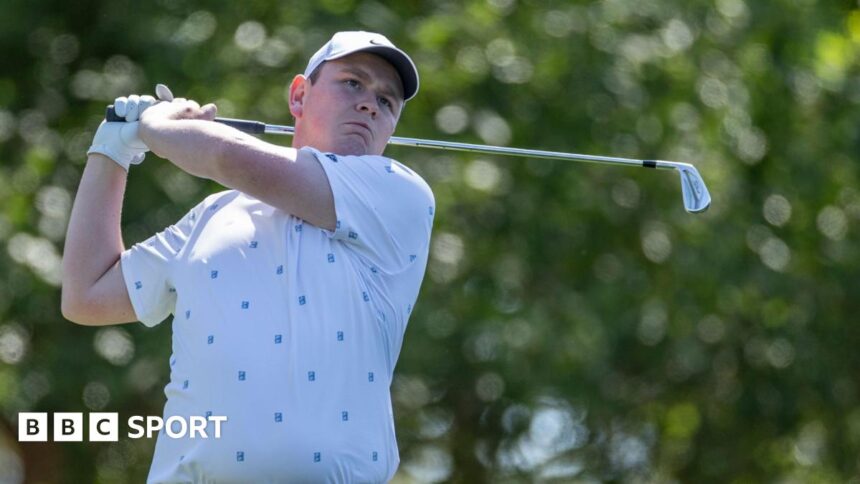
The 2024 Masters was supposed to be a celebration of the game’s traditions. Instead, it became a case study in emotional unraveling. Bob MacIntyre, the talented Scot known for his fiery competitiveness, endured a catastrophic first-round 80 at Augusta National. Television microphones captured him swearing and gesturing angrily. But the moment that truly raised eyebrows came when MacIntyre was seen gesturing towards a green with his middle finger. Augusta officials quickly issued a warning, but the damage to the sport’s image was done.
Just days earlier, Sergio Garcia—no stranger to controversy—provided his own exhibit. After an errant tee shot on the second hole of his final round, the Spaniard reacted with fury, slamming his club into the tee box and leaving visible damage to the turf. It was a flashback to his younger, more volatile years, and it came at a time when the sport was already grappling with questions about player conduct in the social media age.
These two incidents, occurring within the same week at the sport’s most hallowed venue, became the tipping point. They brought player behaviour into sharp focus during a season where the four major tournaments—the Masters, US PGA, US Open, and The Open—have agreed to implement a new, unified code of conduct.
What the Two-Shot Penalty Means for Players
Let’s be clear about the stakes. A two-shot penalty in a major championship is not a symbolic gesture. It can be the difference between making the cut and packing your bags on Friday evening. It can turn a top-ten finish into a missed opportunity. In the context of The Open, where wind and rain already punish the slightest error, an added two-stroke penalty for misconduct is a game-changer.
According to Mark Darbon, the new policy is designed to target “deliberate and repeated” breaches of conduct. That means a single curse word muttered under your breath is unlikely to trigger a penalty. But a visible obscene gesture, intentional damage to the course, or abuse of officials will now carry a tangible cost. The R&A is essentially telling players: control your emotions, or control your scorecard.
I predict this will create an immediate psychological shift. Players who have historically used anger as a release valve—think of a young John Daly or the fiery Ian Poulter—will now have to find new coping mechanisms. The risk-reward calculation has changed. Is that moment of catharsis worth two strokes on a leaderboard that is often separated by a single shot?
Expert Analysis: Is This a Necessary Evolution or an Overreach?
From my vantage point as a journalist who has walked the fairways with dozens of major champions, I see both sides of this debate. On one hand, golf has always prided itself on being a sport of honour and self-regulation. The old guard will argue that players should be allowed to show emotion—that passion is part of what makes the game compelling. Was Seve Ballesteros any less of a legend because he threw a club now and then? Probably not.
But the modern reality is different. Every swing is captured by high-definition cameras. Every muttered word is picked up by boom microphones. Social media amplifies every outburst within seconds. The sport’s image is now under a microscope, and sponsors are increasingly sensitive to behavior that could be considered toxic or unprofessional. The two-shot penalty is, in many ways, a defensive move to protect the commercial integrity of the majors.
Furthermore, the unified code of conduct across all four majors is a historic development. For years, the Masters, PGA of America, USGA, and R&A operated with slight variations in their disciplinary protocols. Now, they are aligned. This means a player cannot escape punishment by moving from one major to another. The consistency will create a clear deterrent.
However, I have concerns about enforcement. Will every incident be reviewed by a committee? Will there be video replay challenges? The R&A must be careful not to create a culture of constant surveillance that stifles the natural emotion of competition. The line between a frustrated sigh and a deliberate obscenity must be clearly defined before the first tee shot at Royal Portrush.
Predictions: How the Open Championship Will Be Different
Looking ahead to the 152nd Open Championship, I expect to see a noticeably more subdued atmosphere in the early rounds. Players will be hyper-aware of their body language. You will see fewer club slams, fewer angry stares at the gallery, and a lot more deep breaths after bad shots. The two-shot penalty threat will hang over the field like a coastal mist.
I predict that Bob MacIntyre, in particular, will be a fascinating case study. He is a player of immense talent—his performance at the 2023 Ryder Cup proved that—but his temper has been both a strength and a weakness. If he can channel that fire into focus, he could contend. If he lets it boil over, he could be the first high-profile casualty of the new rules.
As for Sergio Garcia, this might be the final push he needs to mature completely. At 44, with a major championship already on his resume (the 2017 Masters), he has little to prove. But his reputation for volatility has followed him for two decades. A clean, disciplined performance at The Open would silence critics and show that even the most passionate players can adapt.
The Bigger Picture: Golf’s Future in the Age of Accountability
This is not just about The Open. The two-shot penalty for misconduct sets a precedent that will likely trickle down to the PGA Tour, DP World Tour, and even amateur events. Golf is entering an era where accountability is paramount. The days of “boys will be boys” are over. The sport is sending a message that the integrity of the game matters more than any individual’s emotional release.
Will this make golf less entertaining? Possibly. There is a certain raw drama in watching a player snap under pressure. But the sport’s leadership has decided that the cost of that drama—in terms of reputation, sponsorship, and youth participation—is too high. They are betting that a cleaner, more respectful game will attract a wider audience and retain its status as a sport for gentlemen and gentlewomen.
Conclusion: The Two-Shot Penalty Is Here to Stay
As the golf world turns its eyes to Royal Portrush this July, one thing is certain: the players will be on their best behavior—or they will pay the price. The R&A’s two-shot penalty is not a suggestion; it is a mandate. Bob MacIntyre and Sergio Garcia may have been the catalysts, but the change is bigger than any single player. It is a declaration that the majors will no longer tolerate misconduct, no matter the name on the scorecard.
For the fans, this means a more polished product. For the players, it means a new level of discipline. And for the sport itself, it marks a pivotal moment in its long, storied evolution. The Open will always be a test of skill, nerve, and resilience. This year, it will also be a test of character. And the penalty for failing that test? Two strokes—and maybe a whole lot more.
Source: Based on news from BBC Sport.