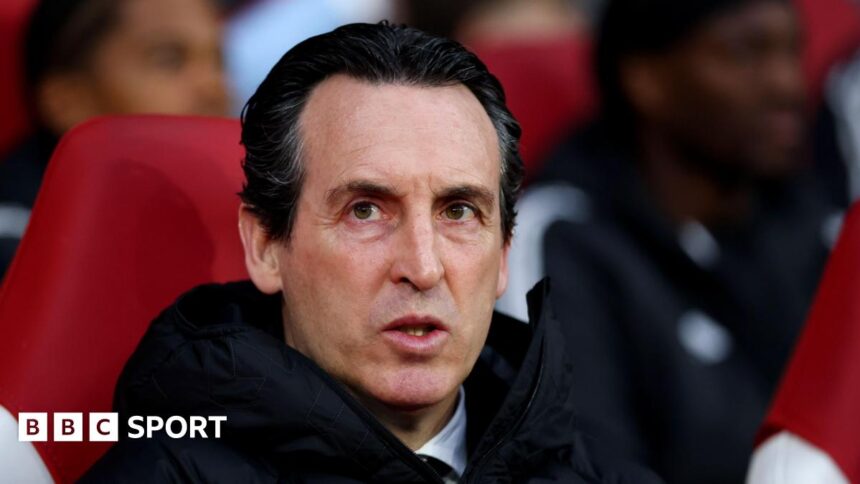
Unai Emery’s Aston Villa Revolution: The Fastest Century and a European Dream
The roar that greeted the final whistle at Villa Park last Thursday night was about more than just a 2-1 victory over Lille. It was the sound of a historic milestone being smashed, of a sleeping giant being roused with thrilling conviction, and of a manager’s unique blueprint being executed to perfection. With that Europa Conference League quarter-final first-leg win, Unai Emery didn’t just edge his team closer to a European semi-final; he became the fastest manager to 100 wins in Aston Villa’s storied history. In a club adorned with legends from Rinder to Ramsey, Saunders to Gregory, it is the meticulous Spaniard who has set a new pace for excellence, forging a record-breaking win ratio and positioning Villa as a genuine force on the continental stage once more.
A Century at Breakneck Speed: The Numbers Behind the Milestone
To understand the magnitude of Emery’s achievement, context is crucial. Reaching 100 victories at a single club is a testament to consistency, resilience, and quality. To do it faster than any of his predecessors speaks of a transformative impact. When Emery arrived in October 2022, Villa were languishing just above the relegation zone. The project wasn’t about gradual improvement; it demanded an immediate and systemic overhaul.
The statistics now paint a picture of a stunning ascent:
- Record-Breaking Win Ratio: Emery’s win ratio of 55.2% stands alone as the best in the entire 149-year history of Aston Villa Football Club. This isn’t just a good run of form; it’s a sustained level of performance unprecedented at Villa Park.
- Elite Premier League Company: Since his appointment, only three Premier League managers have racked up 100 wins. The company is telling: Pep Guardiola (137), Mikel Arteta (118), and Unai Emery. He is operating in the stratosphere of modern managerial excellence.
- The European Catalyst: Significantly, that 100th win came in European competition, Emery’s natural habitat. It underscores the dual-front success he has engineered, making Villa’s home a fortress in the Premier League while simultaneously navigating the complexities of a European knockout tie.
This numerical dominance translates to tangible success: a sensational seventh-place finish and European qualification in his first partial season, followed by a sustained top-four challenge and now a deep European run in his first full campaign.
The Emery Effect: Tactical Identity and Cultural Shift
How has Emery achieved this so swiftly? The answer lies in a clear, repeatable process. Unlike his ill-fated stint at Arsenal, where his ideas struggled to take root, at Villa he has found a club and squad perfectly aligned with his footballing religion. Emery is a Europa League specialist, a title earned through four victories in the competition, and his methodology is tailor-made for success across two games.
His Aston Villa are defined by a structured, almost choreographed approach. He is a master of the micro-detail, providing players with exhaustive dossiers on opponents and specific in-game scenarios. On the pitch, this manifests as a team that knows exactly when to press with ferocious intensity, orchestrated by the tireless John McGinn, and when to absorb pressure before striking with devastating transitions. The full-backs are weapons, Ollie Watkins has evolved into a complete, goal-scoring machine under his tutelage, and the collective understanding is palpable.
Beyond tactics, Emery has instilled a winning mentality where doubt once resided. The fear of losing has been replaced by a detailed plan for winning. Players speak of a new level of professionalism and preparation. The Holte End feeds off this structured passion, creating a symbiotic relationship between a tactically astute team and a fanbase starved for this kind of purposeful success. The culture has shifted from hope to expectation.
The Road Ahead: Can the Dream Become Reality?
The immediate future for Emery’s Villa is a thrilling prospect, laden with possibility but also immense challenge. The prediction for the remainder of this season is twofold: a fierce battle for a Champions League spot in the Premier League and a genuine push for European silverware.
In the league, the intensity of the schedule, compounded by European travel, will test the squad’s depth. However, Emery’s rotational nous and the squad’s belief make them formidable contenders to finish in the top four. In Europe, they are now undeniable favourites for the Europa Conference League. Emery’s record in these competitions is a psychological weapon; opponents know they are facing a manager who treats two-legged ties as a high-stakes chess match he is accustomed to winning.
Looking further ahead, the project’s trajectory points upwards. With Champions League football a realistic target, the allure for higher-caliber players increases. Emery’s proven track record in the transfer market—see the acquisitions of Pau Torres, Youri Tielemans, and the revelation that is Leon Bailey’s resurgence—suggests he will be backed and will spend wisely. The ultimate goal is clear: to re-establish Aston Villa as a permanent member of England’s and Europe’s elite.
A New Golden Era Forged in Detail and Belief
Unai Emery’s record as the fastest to 100 wins at Aston Villa is not merely a statistical footnote. It is the headline of a remarkable story of restoration. He has done more than improve results; he has installed a modern, elite-level footballing structure at a club with a glorious past. He has provided a tactical identity, a cultural reset, and a tangible pathway back to the summit.
In the pantheon of Villa greats, Emery is carving a unique legacy. He is not a former playing hero; he is a tactical architect. His connection with the fans is built not on nostalgia, but on the palpable sense of a detailed, sustainable plan coming to fruition. As Villa stands on the cusp of a Champions League return and with a European trophy a distinct possibility, the message is clear: under Unai Emery, the past 100 wins have been just the foundation. The fastest century in Villa history was simply the opening act. The main event—a new, golden era defined by tactical brilliance and silverware—is now firmly within view.
Source: Based on news from BBC Sport.