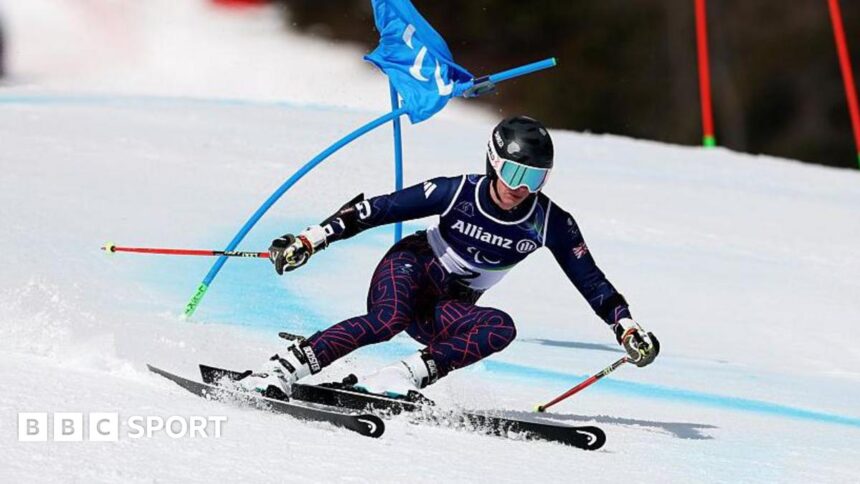
Simpson and Poth Pay the Price: A ‘Costly’ Error Derails Paralympic Giant Slalom Dream
The thin, cold air of the Italian Alps is a realm of razor-thin margins. For visually impaired skiers and their guides, hurtling down an icy mountain at 80 km/h, trust is the tether, communication the compass, and precision the only path to glory. For Britain’s Neil Simpson and his guide, Rob Poth, that delicate balance was shattered in a heartbeat on Friday. Full of momentum and medal hopes, their opening giant slalom run at the Milan-Cortina Paralympics ended not with a time, but with a devastating “Did Not Finish.” A single, “costly” error—a misjudged line, a missed gate—swallowed their race whole, a stark reminder of the brutal physics and profound psychology of elite Para Alpine skiing.
From Silver Lining to Sudden Heartbreak
Just days before, the British duo stood on the podium, the taste of Alpine combined silver medal glory fresh and affirming. That victory, powered by the fastest slalom run in the field, was a testament to their synergy and skill. Simpson, the 23-year-old phenom born with nystagmus, a condition causing involuntary eye movement, and Poth, his eyes and tactical voice, were in sublime sync. They arrived at the giant slalom start gate not just as contenders, but as potential pacesetters, their confidence buoyed by proven speed.
The early stages of their run confirmed that status. They were attacking, setting a pace that threatened the leaders. The radio crackle between them was a stream of calibrated instructions and confirmations. Then, in an instant, the geometry of the course defeated them. A fractional miscommunication, a minute delay in reaction, or a subtle shift in balance—the exact catalyst known only to them—led to taking the wrong line. The consequence was immediate and irreversible: a missed gate. Their race was over before the halfway point, a jarring full stop to a narrative that seemed destined for the podium.
“There was some good skiing up to the time we made the error,” a palpably disappointed Simpson stated afterwards. His summation was both gracious and gutted: “But it was a costly one.” In Paralympic sport, where preparation is measured in years and opportunities in mere seconds, “costly” is an understatement of profound depth.
Expert Analysis: The Anatomy of a “Costly” Error
To understand the magnitude of this mistake, one must dissect the unique partnership of visually impaired skiing. This is not a solo endeavor; it is a high-speed, high-stakes duet performed on a frozen stage.
- The Guide as Sensory Extension: Rob Poth is far more than a vocal GPS. He is Simpson’s primary source of external data, processing terrain changes, gate distances, snow conditions, and optimal racing lines, then distilling it into clear, immediate commands. Any break in this continuous data stream is catastrophic.
- Nystagmus and the Racing Line: Simpson’s nystagmus adds a layer of complexity. While his functional vision is significantly reduced, the involuntary eye movement can affect depth perception and focus, especially under the intense vibration and G-forces of a GS course. The “wrong line” they took likely materialized from a micro-second of compromised spatial awareness, a gap in the feedback loop that even this elite partnership could not recover from in time.
- The Psychological Whiplash: Coming off a medal performance, managing expectation and focus is a skill in itself. The shift from the technical, rhythmic slalom to the sweeping, power-demanding giant slalom requires a mental reset. Did the confidence from Tuesday’s silver subtly alter their risk calculus? Experts suggest that sometimes, peak form can lead to over-aggression, where the fine line between attacking and over-driving is crossed invisibly until a gate is missed.
This error was not a lack of skill or preparation. It was a fracture in the perfect execution required at this level, a testament to how the Paralympic Games demand not just athletic excellence, but flawless symbiotic communication under extreme duress.
Looking Ahead: Resilience and the Road to Redemption
For Simpson and Poth, the immediate aftermath is about processing the disappointment. However, the schedule of the Paralympics waits for no one. This setback, while severe, is not the end of their Milan-Cortina campaign, nor does it define their partnership.
The true test of a champion is not in avoiding falls, but in the manner of their rise. The duo must now engage in a rapid psychological debrief. They will analyze video, not to dwell on the error, but to isolate the moments leading to it and reinforce their communication protocols. The trust that is their foundation has been stressed, but not broken; in fact, navigating this shared adversity can fortify it.
Their remaining events offer clear avenues for redemption. Simpson’s prowess in speed events—the Super-G and Downhill—is well-documented. These disciplines, while terrifyingly fast, offer a different rhythm. The turns are broader, the lines more sweeping, potentially providing a canvas better suited to harnessing their aggressive style without the gate-dense technical demands that tripped them up in the GS. The slalom, their silver-medal strength, now becomes a focal point of immense anticipation. Can they channel their frustration into a flawless, attacking performance to close their Games?
Conclusion: The Unforgiving Beauty of Paralympic Sport
The story of Neil Simpson and Rob Poth in Milan-Cortina is a Paralympic parable. It encapsulates the soaring highs of silver-lined achievement and the crushing, instantaneous lows that ice can deliver. Their “costly” error is a raw display of the vulnerability that exists alongside the extraordinary courage in Para sport. There are no participation trophies here; only the unforgiving chronology of the clock and the strict geometry of the gate.
Yet, within this heartbreak lies the essence of their appeal and the reason we watch. Their journey is human, amplified. It is about overcoming a biological challenge (nystagmus), mastering a profound partnership, and facing down a mountain. Friday’s giant slalom was a chapter of defeat, but their story is far from over. How they respond in the coming days will reveal more about their character than any podium ever could. The world will be watching, not just to see if they ski fast, but to witness the resilience required to listen for your guide’s voice in the wind again, and to push out of the start gate, once more, into the void.
Source: Based on news from BBC Sport.