Divisive, Ruthless, Brilliant: The Uncompromising Method Behind Fabien Galthié’s French Revolution
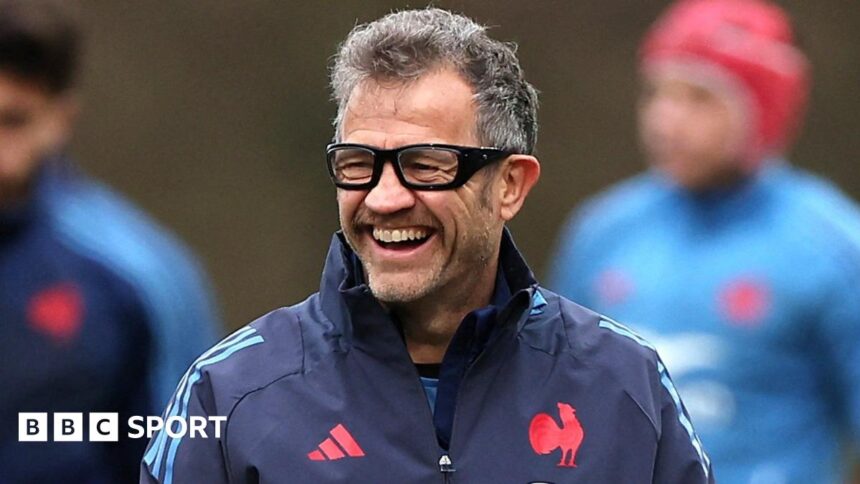
The Stade de France is a cauldron of blue fury, a symphony of Allez Les Bleus shaking the very foundations. At the heart of the maelstrom, orchestrating the chaos with a cold, calculating gaze, stands Fabien Galthié. The architect of France’s rugby renaissance is a man of stark contradictions: a former scrum-half genius revered by fans, and a head coach whose ruthless management style can freeze the blood of his most gifted players. To understand how France rediscovered its mojo, you must first understand the price Galthié demands for excellence. The case of Matthieu Jalibert is not an anomaly; it is the blueprint.
The Jalibert Flashpoint: Ruthlessness as a Coaching Tool
In the glittering aftermath of France’s 2023 World Cup campaign, one narrative was quietly buried beneath the roar: the profound personal trial of Matthieu Jalibert. Thrust into the first-choice fly-half role after Romain Ntamack’s cruel injury, the pressure was galactic. Yet, it was after the tournament, in November 2024, that a more telling drama unfolded. Dropped to the bench against Japan, Jalibert’s frustration boiled over. He vented to attack coach Patrick Arlettaz and the team’s psychologists—a normal human reaction in a high-stakes environment.
But in Galthié’s France, nothing stays in the therapy room. The head coach was informed. What followed was a masterclass in psychological brinkmanship. “He told me he sensed I was not doing very well… that I could go home,” Jalibert revealed. This was not a suggestion; it was a grenade rolled at the feet of a key player. Galthié’s message was unequivocal: self-pity is a luxury this team cannot afford. The collective mindset is sacrosanct. Player management under Galthié is not about coddling talent; it’s about forging it in the hottest, most uncomfortable fire.
- The Ultimatum: Galthié framed Jalibert’s frustration as a threat to team unity, offering the door as a stark alternative.
- Psychological Pressure: The move publicly tested Jalibert’s resilience and commitment, separating personal grievance from professional duty.
- Re-establishing Hierarchy: It reminded everyone, star or not, that the coach’s authority and the team’s ethos are absolute.
Galthié’s Blueprint: From Chaos to Cohesion
This incident is not an isolated power play. It is a deliberate strand in the DNA of Galthié’s France. When he took over in 2019, he inherited a squad brimming with talent but riddled with fragility and inconsistency. His mission was to build a winning mentality that could withstand the brutal pressures of a World Cup on home soil. He did so by implementing a system where accountability is relentless and selection is perpetually earned, never given.
Galthié and his staff, including the influential Shaun Edwards, constructed an environment that mirrors the coach’s own playing persona: intense, disciplined, and fiercely intelligent. The French rugby revival is built on a defensive granite unseen in previous generations, and an attack that balances structured plays with moments of individual flair—but only within the system. Jalibert’s flair is welcome, but only if his mindset aligns. Ntamack’s genius is celebrated, but his shirt is not his birthright. This constant, healthy tension keeps the entire squad on a knife-edge of performance.
Expert Analysis: “Galthié understands that modern Test rugby is won in the mind as much as on the pitch,” notes a former international who played under him. “His methods seem divisive from the outside because they are uncomfortable. He creates intentional discomfort. By challenging Jalibert so publicly after a private complaint, he wasn’t just managing one player; he was sending a signal to the entire group about the standards required. It’s a high-risk strategy, but for a generation that had known only underachievement, it provided the clear, hard edges they needed.”
The Results: Justifying the Hard Edges
The proof, as always, is in the results. Since Galthié’s appointment, France has:
- Won a first Six Nations Grand Slam in over a decade (2022).
- Secured a historic series win in Australia (2021).
- Consistently beaten the Southern Hemisphere giants, including New Zealand and South Africa.
- Become the world’s most feared and consistent side, reaching number one in the rankings.
This success validates the method. Players speak of a profound clarity and a brotherhood forged in the fire of Galthié’s demands. The Jalibert episode, rather than fracturing the squad, likely strengthened it. It demonstrated that no individual is bigger than the project. For Jalibert, the confrontation served as a brutal reset. It refocused his energy from internal frustration to external performance, a necessary evolution for a player destined to be the long-term conductor of the French backline.
Predictions: Can Ruthlessness Sustain a Dynasty?
The immediate future for France is blindingly bright. With a core of players entering their prime and a coaching philosophy deeply ingrained, they are favorites for every Six Nations and are building ominously towards the 2027 World Cup. The key question is sustainability. Galthié’s ruthless approach requires constant renewal of hunger.
We predict two potential trajectories:
1. The Dynasty Path: Galthié successfully transitions from building a winning team to cultivating a winning culture that outlasts his intense personal management. Younger players like Posolo Tuilagi assimilate the standards without needing the same shock therapy. The leadership group—including Antoine Dupont, Charles Ollivon, and Grégory Alldritt—becomes the primary keeper of the flame, allowing Galthié to soften his hardest edges.
2. The Burnout Risk: The relentless psychological pressure eventually leads to player fatigue or a significant rift. As the core group ages, managing veteran egos and maintaining the same level of fearful motivation becomes trickier. The “go home” ultimatum that works on a 25-year-old Jalibert may not resonate the same way with a 32-year-old veteran.
The most likely outcome lies in the middle. Galthié is a brilliant strategist and will evolve his man-management as his squad matures. The foundational team culture of discipline and sacrifice is now unshakeable. The occasional public test of character will remain in his toolkit, but its use will become more selective, reserved for moments when the collective focus truly wavers.
Conclusion: The Price of Glory
Fabien Galthié helped France find its mojo not by being a friend, but by being a merciless sculptor. He chipped away at complacency, ego, and fragility until only a hardened, unified competitor remained. The Matthieu Jalibert saga is a perfect microcosm of this revolution—a stark, uncomfortable, and ultimately effective piece of high-performance management.
In the world of elite sport, where margins are infinitesimal, mindset is the final frontier. Galthié attacks it with a ruthless clarity that divides opinion but delivers results. France’s mojo was never lost; it was merely dormant, waiting for a leader uncompromising enough to wake it. That mojo now has a sharp, blue edge, and it is cutting down every opponent in its path. The brilliance of the revival is inextricably linked to the divisive ruthlessness that fueled it. For Les Bleus, under Galthié, the end has emphatically justified the means.
Source: Based on news from BBC Sport.