Mainz Capitalize on Bremen’s Pigeon & Penalty Lapses to Claim Vital Bundesliga Win
In the high-stakes pressure cooker of a Bundesliga relegation battle, survival isn’t just about talent or tactics; it’s about ruthless opportunism. On a day where Werder Bremen commanded the ball, 1. FSV Mainz 05 mastered the decisive moments, securing a priceless 2-0 away victory. The match narrative was defined not by sustained dominance, but by two fleeting instances of sharpness from the visitors and two costly lapses—one bizarre, one contentious—from the hosts, propelling Mainz out of the automatic relegation places and into the heart of the survival fight.
A Feathered Distraction and a Devastating Blow
The tone for a surreal and critical 90 minutes was set almost immediately. Before many in the Weserstadion had settled, Mainz executed a simple yet effective set-piece routine that would decide the match’s trajectory. A left-flank throw-in found Phillipp Mwene, who created just enough space to whip a dangerous cross into the Bremen penalty area.
Paul Nebel, the young midfielder, timed his near-post run perfectly, connecting with a powerful header that gave goalkeeper Michael Zetterer no chance. The precision of the move was textbook, but the preamble was anything but. In the seconds before the throw-in, Bremen’s Marco Grüll was visibly distracted by an unexpected pitch invader: a pigeon casually wandering across his defensive zone. That split-second loss of focus was all Mainz needed to pounce.
“In these games, you have to be awake from the first second to the last,” said Mainz coach Bo Henriksen after the match. “We were aggressive, we were sharp. We took our chance when it came.” The early goal was a classic sucker-punch, forcing a possession-oriented Bremen side to completely recalibrate their approach against a notoriously disciplined and deep-lying Mainz block.
Bremen’s Response and the Ghost of an Equalizer
To their credit, Werder Bremen’s reaction was swift and forceful. Just three minutes after falling behind, they crafted a golden chance to level. A well-delivered corner found the head of the unmarked Leonardo Bittencourt, whose thunderous header seemed destined for the net. The collective groan from the home supporters echoed around the stadium as the ball instead shuddered the crossbar and bounced to safety.
That moment—the fine margin between woodwork and net—proved to be a pivotal “what if” in the match. Daniel Thioune’s side proceeded to dominate possession for large stretches of the first half, probing and circulating the ball in front of Mainz’s compact 3-5-2 formation. Yet, for all their territorial advantage, clear-cut chances were scarce. Mainz’s defensive discipline, marshaled by the experienced Stefan Posch, was exemplary.
The visitors were happy to cede the ball in non-threatening areas, forming two rigid banks of five and four, suffocating the spaces where Bremen’s creative players like Bittencourt and Mitchell Weiser prefer to operate. This tactical stalemate defined much of the contest, with Bremen lacking the incisive final pass or moment of individual brilliance to break the deadlock.
Controversy and the Killer Second
The match’s second major flashpoint arrived late in the first half, adding another layer of frustration for the home side. Belgian wing-back Olivier Deman drove into the Mainz box and, under pressure from Stefan Posch, went to ground. Replays showed clear contact from Posch’s arm on Deman’s back, though the push was not overtly forceful.
Critically, Deman chose to quickly scramble back to his feet rather than make a sustained appeal to referee Tobias Welz. The moment passed without a VAR review, leaving Bremen and their coach fuming. “It’s a clear penalty for me,” Thioune stated post-match. “Olivier is too honest maybe. In today’s football, you go down there and it’s given.” This incident underscored Bremen’s lack of clinical edge in both boxes—failing to convert their chance off the bar and failing to win a debatable but plausible penalty.
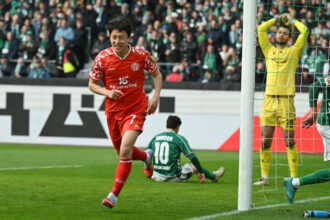
Mainz, in stark contrast, remained ice-cold when their next opportunity arrived. In the second half, as Bremen committed more men forward, Mainz expertly exploited the transition. A quick turnover released Ludovic Ajorque, who held the ball up brilliantly before sliding a perfect pass into the path of the onrushing Lee Jae-sung. The South Korean international made no mistake, slotting home calmly to double the lead and effectively seal the three points. It was a goal born of patience, structure, and lethal counter-attacking efficiency.
Analysis & The Relegation Race Ramifications
This result sends seismic waves through the bottom half of the Bundesliga table. For Mainz, the victory is more than just three points; it’s a massive psychological boost and a validation of their pragmatic approach under Bo Henriksen.
- Defensive Solidity: Mainz registered their first clean sheet in nine matches, a foundation they can build upon.
- Momentum Shift: Moving out of 16th place breaks a cycle of despair and injects belief into the squad.
- Clinical Edge: They scored from two of their three shots on target, a conversion rate that wins tight games.
For Werder Bremen, the concerns are mounting. This defeat extends their winless run and highlights a recurring theme of their season:
- Possession without Punch: Controlling 65% of the ball but managing only a few genuine chances is a worrying pattern.
- Concentration Lapses: The opening goal, sparked by a moment of environmental distraction, is symptomatic of a side lacking the razor-sharp focus required at this level.
- Home Form: Dropping points at the Weserstadion in these six-pointers could prove fatal in the final reckoning.
Expert Prediction: The Bundesliga relegation battle is now a four-team dogfight between Mainz, Union Berlin, Köln, and Bochum. Mainz’s schedule remains brutal, but this win provides a critical buffer and a blueprint: organized defense and capitalizing on minimal chances. Bremen, with a slightly kinder run-in, must urgently rediscover a cutting edge. Their survival may hinge on learning the very lesson Mainz taught them today: in this league, it’s not how much you play, it’s how you play the decisive moments.
Conclusion: A Tale of Two Mentalities
Ultimately, Mainz’s 2-0 triumph at the Weserstadion was a masterclass in survival football. They entered a hostile environment, absorbed pressure, and struck with precision when their opponent’s guard was down—first by a pigeon, later by the demands of chasing the game. Werder Bremen, for all their aesthetic possession, were punished for a lack of ruthlessness at both ends of the pitch. As the season hurtles toward a dramatic conclusion, this match may be remembered as the day Mainz rediscovered their grit and Bremen lost their way. In the frantic scramble for safety, the team that seizes the moment—no matter how bizarre its origin—holds its fate in its own hands.
Source: Based on news from Yahoo Sports.