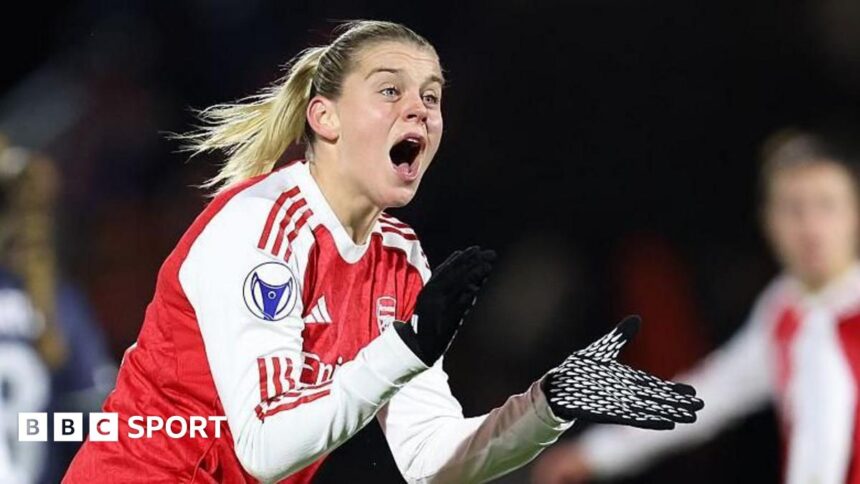
The Russo Riddle: Unlocking the Best Position for Arsenal and England’s Star Forward
The question has followed Alessia Russo from Manchester United to Arsenal and onto the international stage with England: where does she truly belong? Is she the focal point, the ruthless number nine, or is her game better suited to a more creative, withdrawn role? The player herself offers a diplomatic, team-first answer, but for managers and fans alike, solving the Russo riddle is key to unlocking her world-class potential. By examining her tactical evolution, physical attributes, and most impactful performances, we can chart the course for where Arsenal’s #23 is most devastatingly effective.
- More Than a Soundbite: Decoding “Wherever the Team Needs Me”
- The Case for the Classic Number Nine: A Focal Point Forged in Europe
- The Argument for the Creative Catalyst: Playing “In the Hole”
- The Arsenal Conundrum: Balancing Act Under Eidevall
- Verdict and Future Forecast: The Evolution of a Modern Forward
More Than a Soundbite: Decoding “Wherever the Team Needs Me”
When asked about her preferred position, Russo’s trademark response—“Wherever the team needs me”—is the epitome of professionalism. However, this isn’t merely a cliché. It reveals a fundamental truth about her skillset: remarkable tactical flexibility. Unlike strikers molded for a single role, Russo possesses a hybrid blend of talents that can service multiple functions within a forward line.
This adaptability is a manager’s dream but also sparks debate. Deploying her in one position inevitably means sacrificing some strengths to highlight others. Her willingness to adapt speaks to a high footballing IQ and a selfless attitude, but it also places the onus on coaches like Jonas Eidevall and Sarina Wiegman to find the system that maximizes her unique offering. It’s a luxury problem, but a problem nonetheless.
The Case for the Classic Number Nine: A Focal Point Forged in Europe
The most compelling evidence for Russo as a central striker comes from the pinnacle of club football. Her UEFA Women’s Champions League triumph with VfL Wolfsburg in the 2022-23 season was achieved playing as the lone striker in Renee Slegers’ disciplined 4-2-3-1. In this role, she was the undisputed tip of the spear.
Her attributes for this position are clear:
- Elite Hold-Up Play: Russo’s strength and low center of gravity allow her to shield the ball from defenders, bringing midfield runners into play.
- Aerial Dominance: She is a formidable threat in the air, capable of winning long balls and scoring powerful headers.
- Clinical Finishing in the Box: Her goal against Aston Villa this season—a first-time, outside-of-the-boot finish—showcased the instinctive technique of a born goalscorer.
As a traditional nine, her job is to occupy center-backs, finish chances, and provide a physical reference point. The Champions League medal proves she can excel at the very highest level in this capacity.
The Argument for the Creative Catalyst: Playing “In the Hole”
Yet, to view Russo solely as a target woman is to overlook a significant dimension of her game. Watch her for England, particularly during the Euro 2022 victory, and you often saw a different profile. Deployed sometimes behind or alongside Ellen White, and now with Arsenal at times alongside Stina Blackstenius, Russo thrives when given freedom to drop deep and link play.
In a withdrawn or second-striker role, her other qualities come to the fore:
- Vision and Link-Up: She can receive the ball between the lines, turn, and slide in penetrating passes for wingers making diagonal runs.
- Driving Runs from Deep: Starting from a deeper position allows her to run at defenders with momentum, combining her power with surprising technical grace.
- Creating Space for Others: By pulling center-backs out of position, she creates room for inverted wingers like Beth Mead or Lauren James to exploit.
This role leverages her creativity and work-rate, making her less of a fixed point and more of a dynamic, unpredictable force. It arguably makes her more involved in general play and harder for static defenders to mark.
The Arsenal Conundrum: Balancing Act Under Eidevall
At Arsenal, Jonas Eidevall faces this tactical dilemma weekly. The signing of Russo was a statement, but integrating her into a fluid attacking unit has required experimentation. Has she been signed as the long-term successor to Vivianne Miedema, a pure nine, or as a different kind of weapon altogether?
Eidevall has used her in both roles, often within the same match. This season, we’ve seen a promising partnership with Stina Blackstenius evolve, with the two interchanging positions fluidly. This dual-striker system mitigates the “either/or” debate, allowing Russo to be both a finisher and a creator. However, it requires a specific midfield balance behind them and can be vulnerable in transition.
The key for Arsenal is providing Russo with consistent service. Isolated as a lone striker without adequate support, her effectiveness dwindles. But when connected with Arsenal’s creative hub—the likes of Kim Little, Frida Maanum, and Katie McCabe—she becomes the multifaceted engine of their attack.
Verdict and Future Forecast: The Evolution of a Modern Forward
So, what is Alessia Russo’s best position? The analysis points not to a fixed shirt number, but to a context-dependent role defined by the players around her and the tactical battle at hand.
Against a low-block defense that packs the box, her aerial prowess and poacher’s instinct are vital; she is best as the central #9. In open, transitional games or against a high line, her ability to run channels, drop deep, and play-make makes her devastating from a slightly deeper starting position.
The future of elite football, especially in the women’s game, is moving towards these versatile, multi-functional forwards. Russo is at the forefront of this trend. The prediction here is not that she will settle into one role, but that her game will continue to synthesize these aspects. Her “best position” may ultimately be defined as a “Complete Modern Forward”—a player with the physicality to lead the line and the technical intelligence to orchestrate from just behind it.
For England and Arsenal, the solution isn’t to pigeonhole her, but to build systems that allow her fluidity. The answer to the Russo riddle, therefore, lies in movement. Fix her to one spot, and you only get part of the picture. Set her free to roam across the frontline, and you unleash the full, formidable force of a player who isn’t just filling a position—she’s redefining it.
Source: Based on news from BBC Sport.